
If you pay a U.S. person or business for services and expect to report that payment to the IRS, they generally need to complete Form W-9, and you need to request it. That covers most independent contractors, freelancers, single-member LLCs, and many corporations you hire. Collect the form at onboarding, before the first payment goes out, because waiting until tax season creates gaps that can trigger backup withholding on future payments.
TL;DR:
- Requesting a W-9 upfront during onboarding prevents tax reporting gaps and backup withholding on future payments for most small business vendors.
- Form W-9 certifies that the payee's name and TIN are correct and U.S. tax compliant, which is crucial for accurate IRS reporting and avoiding penalties.
- Single-member LLC owners should provide their personal name and SSN or EIN on the W-9, not the LLC's name or number, to prevent IRS notices.
- Even exempt payees like corporations should sign a W-9 to document U.S. status and protect against future backup withholding or 1099 misclassification.
- Storing W-9s securely, validating TINs before year-end, and updating forms with entity changes help reduce IRS penalties and facilitate smooth year-end reporting.
Table of Contents
- Who Needs a W-9 and Why the Form Exists
- Who Needs to Complete a W-9: Clear Categories
- When to Ask for a W-9 (Timing and Reporting Thresholds)
- How to Fill Out a W-9 Correctly: Name and TIN Rules
- Backup Withholding and Penalties: What Happens Without a W-9
- What to Do if a Vendor Refuses or Can't Provide a W-9
- Best Practices for Collecting and Storing W-9s
- How W-9s Connect to Year-End 1099 Reporting
- Why Getting This Right Matters More Than Most Owners Realize
- Let Mygappro Handle Your W-9 and 1099 Compliance
- Sources
- FAQ
Who Needs a W-9 and Why the Form Exists
Form W-9 exists for one purpose: it lets a business collect a payee's correct legal name and taxpayer identification number so it can report payments to the IRS accurately. The IRS instructions for requesters make this clear. If you're required to file an information return, you need the payee's TIN, and the W-9 is the standard vehicle for getting it, along with a signed certification that the number is correct.
You've probably heard "W-9" tossed around as a generic tax form, but it's really a certification document. When someone signs a W-9, they're attesting under penalties of perjury that their name and TIN match what the IRS has on file, that they're not subject to backup withholding, and that they're a U.S. person for tax purposes. That signature matters more than most people realize. It's your legal cover if the IRS later questions why you didn't withhold taxes on a payment.
The information you collect on a W-9 feeds directly into several information returns, not just one:
- 1099-NEC: nonemployee compensation, the most common form small businesses file for contractors
- 1099-MISC: rents, royalties, prizes, and other miscellaneous payments
- 1099-B: proceeds from broker and barter exchange transactions
- 1099-S: proceeds from real estate transactions
Each of these forms requires the payee's name and TIN to match IRS records. Get that mismatched, and you're the one facing penalty notices, not your contractor. That's why getting the W-9 right matters as much as getting it at all.
Here's the part that catches business owners off guard: even payees who end up "exempt" from 1099 reporting, like C-corporations for most service payments, sometimes still need to sign a W-9. A signed form documents their U.S. status and their exempt payee code, which protects you from having to apply presumptive backup withholding if the IRS ever asks why no 1099 was filed for that vendor. Skipping the form because "they're a corporation" is a common shortcut that leaves your paper trail thin.
Who Needs to Complete a W-9: Clear Categories
Not every vendor relationship calls for a W-9, but most of the ones a small business runs into do. Here's how to sort them quickly.
Independent contractors, freelancers, and sole proprietors almost always need to complete one. If you're paying someone $600 or more over the year for services and they're not on your payroll, you should have a W-9 in hand before that first check clears. This is the most common trigger point small businesses run into, and it applies to everyone from your graphic designer to your part-time bookkeeper.
Single-member LLCs trip people up constantly. A single-member LLC is a disregarded entity by default, meaning the IRS treats it as if it doesn't exist separately from its owner. The W-9 should list the owner's name on line 1, not the LLC's name, and the owner's SSN or EIN, not a separate LLC-issued number, unless that LLC has elected corporate tax treatment. Mismatched name-to-TIN combinations tied to LLC filings are one of the most frequent causes of IRS notices, because the business name on line 2 doesn't match what the IRS has on file for the taxpayer behind it.
Partnerships and corporations you hire as vendors generally need a W-9 too, even though certain corporate payments (most services, not all) are exempt from 1099-NEC reporting. Getting the signed form still matters, because it documents exempt payee status and protects you if that vendor relationship changes or expands into taxable territory later.
Trusts and estates that are U.S. persons complete a W-9 the same way an individual would, using the trust's or estate's own TIN. This is different from foreign trusts, foreign individuals, or foreign entities, who must complete a W-8 series form instead (W-8BEN for individuals, W-8BEN-E for entities). A W-9 only applies to U.S. persons; a foreign vendor who mistakenly sends you a W-9 hasn't given you what you need.
Pro Tip: Add "W-9 required before first invoice paid" as a line item in your vendor onboarding checklist. It costs nothing to enforce and it's the single easiest way to avoid chasing signatures in January when you're trying to close out 1099s.
To summarize where a W-9 is expected:
- Independent contractors, freelancers, gig workers, and sole proprietors
- Single-member LLCs (owner's SSN or EIN, not a separate LLC number)
- Partnerships and multi-member LLCs taxed as partnerships
- Corporations (S-corp and C-corp), even where many service payments are exempt from 1099-NEC
- Trusts and estates that qualify as U.S. persons
- Landlords and property managers receiving rent payments you'll report
Foreign contractors and foreign entities are the clear exception. If you're paying someone who lives and works outside the U.S. and has no U.S. tax presence, you need a W-8BEN or W-8BEN-E instead, not a W-9.
When to Ask for a W-9 (Timing and Reporting Thresholds)
Timing is where most compliance headaches start. The rule is simple: request the W-9 at onboarding, before the first payment leaves your account, not after.
- Send the W-9 request the same day you finalize a vendor agreement. Bundle it with your contract, your NDA, or your first invoice template so it's not an afterthought.
- Never rely on the $600 threshold as your cue to ask. The $600 figure is the reporting threshold for 1099-NEC, meaning that's the point where you're legally required to file a 1099 for that payee's total annual payments. But you rarely know in January whether a relationship will cross $600 by December. Asking upfront means you're never scrambling to track someone down after the fact.
- Withhold the check until the form arrives for any new vendor relationship. This sounds heavy handed, but it's standard practice among businesses that have been burned by chasing a W-9 six months after payments started.
- Always request one for rent, legal fees, and recurring vendor payments, regardless of how the relationship started. Landlords and law firms are two categories businesses frequently forget, and both usually require 1099 reporting once payments accumulate. Our guide on 1099 reporting for rent payments covers the specific quirks of landlord reporting.
- Re-request annually if a vendor's business structure changes. A sole proprietor who incorporates mid-year needs a fresh W-9 reflecting the new entity and TIN.
The reason "ask always, not just at $600" matters is that thresholds are calculated per calendar year, per payee, across every payment you make to them. A vendor you pay $150 in January and $500 in October crosses $600 without any single payment looking like a reporting trigger. If you didn't collect a W-9 upfront, you're now contacting them in December asking for tax paperwork right when they're least inclined to respond quickly.
How to Fill Out a W-9 Correctly: Name and TIN Rules
Getting the name and TIN fields right is where most W-9 mistakes happen, and they're avoidable once you know the pattern.
Line 1 vs. the business name line. Line 1 always carries the legal name that matches the TIN being provided, meaning the name on the payee's tax return. For an individual, that's their personal name. For a single-member LLC, it's still the owner's personal name on line 1, with the LLC's name going on line 2 as a "doing business as" reference. For a corporation or partnership, the entity's legal name goes on line 1. Mixing this up, putting a business name where a personal name belongs, is the single most common cause of IRS notices tied to W-9 data.
Which TIN to use depends on the payee type:
- SSN (Social Security Number): individuals, sole proprietors, single-member LLC owners
- EIN (Employer Identification Number): corporations, partnerships, multi-member LLCs, single-member LLCs that elected corporate treatment
- ITIN (Individual Taxpayer Identification Number): individuals who aren't eligible for an SSN but still have U.S. tax filing obligations
- ATIN (Adoption Taxpayer Identification Number): rare, used for pending adoptions, essentially never relevant to vendor payments
If a payee doesn't have a TIN yet, the form allows them to write "Applied For" in the TIN field. This is a temporary bridge, not a permanent solution. Under the 60-day rule tied to backup withholding, a payer generally has 60 days from receiving a properly certified "Applied For" W-9 before backup withholding obligations kick in, giving the payee time to actually get their number issued and update the form.
Pro Tip: If a new vendor writes "Applied For," calendar a 45-day follow-up. Waiting the full 60 days to check in leaves you almost no buffer if their SSN or EIN application is delayed.
Grantor trusts follow a slightly different rule: the grantor's SSN typically goes on the form, not a separate trust EIN, unless the trust has its own reporting requirements under a different structure. This trips up small business owners who lease commercial space from a trust-owned property, since the trust's name shows up on the lease but the TIN belongs to an individual.
Name and TIN mismatches account for a large share of the correction notices the IRS sends to businesses after 1099 season closes. A quick way to sidestep this: cross-check the name on line 1 against the name printed on the payee's most recent tax return or IRS-issued notice, not against their business card or website.
Backup Withholding and Penalties: What Happens Without a W-9
Backup withholding is the IRS's mechanism for making sure tax gets collected even when a payee's paperwork is incomplete or wrong. Once triggered, you're required to withhold a specified portion of the payment and send it to the IRS instead of paying the vendor in full.
According to IRS backup withholding guidance, withholding kicks in when a payee fails to provide a TIN at all, provides a TIN that doesn't match IRS records (a "B-Notice" situation), or has been formally flagged by the IRS as underreporting income in the past.
When a payee's TIN doesn't match IRS records, you'll typically receive what's called a B-Notice. The first B-Notice requires you to send the payee a specific IRS-approved letter and a fresh W-9 within a set window. A second B-Notice within three years generally requires the payee to provide official documentation from the Social Security Administration or IRS confirming their TIN, not just another self-certified W-9.
The practical fallout runs both directions. As the payer, you're on the hook for withholding, remitting, and reporting the withheld amount correctly, and failing to do so exposes you to penalties for underwithholding. As the payee, having 24% of every invoice withheld is a real cash flow hit, even though they can eventually claim the withheld amount as a credit on their own tax return.
Common triggers for backup withholding include:
- No TIN provided at all, even after repeated requests
- A TIN that doesn't match IRS records (name/TIN mismatch)
- A second B-Notice within three years for the same payee
- The IRS directly notifying you that a specific payee requires withholding
None of this is retroactive punishment. It's designed to keep tax collection moving even when paperwork breaks down, but it puts the administrative burden squarely on you as the business making the payment.
What to Do if a Vendor Refuses or Can't Provide a W-9
A vendor refusing to provide a W-9, or stalling indefinitely, isn't rare, but it does need a defined response so you're not caught improvising when 1099 season arrives.
- Re-request in writing, every time. A phone call doesn't create a paper trail. Send a follow-up email or letter that specifically states the W-9 is required for tax reporting purposes, and keep a copy.
- Explain the legal requirement plainly. Some vendors genuinely don't understand why you're asking, especially first-time freelancers. A short note explaining that you're legally required to report payments over the threshold and need their TIN to do so often resolves the hesitation.
- Implement backup withholding if the refusal continues. If a vendor still won't provide a TIN after documented attempts, you're required to begin withholding 24% starting with the next payment, not after the fact.
- If classification is genuinely unclear, consider Form SS-8. Sometimes the real issue isn't the W-9, it's confusion about whether the worker should be a contractor or an employee at all. The IRS guidance on worker classification and Form SS-8 exist specifically to resolve that ambiguity when it's genuinely unclear rather than convenient.
- Document every attempt. Emails, certified letters, portal timestamps, all of it. This documentation is what demonstrates "reasonable cause" if the IRS ever questions why a 1099 wasn't filed or why withholding started late.
Pro Tip: Keep a simple log, even a spreadsheet, tracking the date of every W-9 request per vendor. If an IRS inquiry ever comes, that log is worth more than your memory of "I definitely asked them."
Refusal cases are rare in practice, most vendors want to get paid and understand paperwork comes with that, but the businesses that get burned are almost always the ones with no documented history of trying.
Best Practices for Collecting and Storing W-9s
The businesses that handle W-9 collection well treat it as a system, not a one-off task buried in email threads.
Collect through a secure channel, not open email. Sending a blank W-9 as an email attachment and asking a contractor to fill it out and email it back is how sensitive SSNs end up sitting unencrypted in inboxes for years. A secure client portal or encrypted document request tool closes that gap. The IRS permits substitute W-9 forms submitted electronically as long as the content matches the official form, so there's no compliance reason to stick with paper and email.
Maintain a central repository with version history. If a vendor's business structure changes mid-year, incorporating, changing their EIN, or switching from sole proprietor to LLC, you need the updated form on file, and you need to know which version was active for which payments.
Validate the TIN before year-end, not during it. The IRS offers a TIN Matching program for authorized payers, letting you check a name/TIN combination against IRS records before you file. Commercial TIN-validation services offer similar checks for businesses that don't want to enroll directly. Either option beats discovering a mismatch after your 1099s are already filed.
- Collect W-9s through a secure portal, not unsecured email
- Store all versions in one central, access-controlled repository
- Run TIN matching before filing, not after
- Retain completed W-9s for at least four years after the last payment made under that TIN, matching standard IRS recordkeeping expectations
- Restrict access to W-9 data internally; SSNs and EINs don't need to be visible to your entire team
Pro Tip: If you manage more than a handful of 1099 vendors, TIN matching stops being optional in any practical sense. One mismatched SSN can trigger a B-Notice that eats hours of your December.
Privacy matters here beyond compliance optics. A W-9 contains someone's SSN or EIN, both of which are prime targets for identity theft if stored carelessly. Redacting stored copies where possible, and limiting who inside your business can view raw W-9 data, isn't excessive caution, it's basic risk management for information you're legally required to hold onto.
How W-9s Connect to Year-End 1099 Reporting
Everything you collect throughout the year on W-9s funnels into a single deadline crunch: 1099 filing season. Understanding that connection now saves you from discovering gaps in January.
The name and TIN on file determine which 1099 form applies and how it's populated. A vendor classified as a contractor for services gets a 1099-NEC; a landlord gets a 1099-MISC for rent. Mixing up payee classification, treating a genuine employee as a contractor, or filing the wrong form type because the W-9 data was incomplete, creates rework that costs real time during your busiest filing window.
A clean year-end checklist looks like this:
- Reconcile total payments per vendor against your accounting records before generating any 1099
- Flag any vendor without a W-9 on file well before January, not during it
- Confirm name/TIN combinations against what's stored, not against memory
- File corrections promptly if a 1099 goes out with an error, since correction deadlines are tighter than most business owners expect
- Update your vendor list annually to catch entity changes (sole proprietor to LLC, EIN changes, address updates)
Clean W-9 data doesn't just make filing faster, it directly reduces your exposure to IRS penalty notices for incorrect information returns. The businesses that treat W-9 collection as a rushed, once-a-year scramble are the same ones fielding mismatch notices every spring.
Why Getting This Right Matters More Than Most Owners Realize
Most small business owners treat the W-9 as paperwork friction, a form you chase down because the IRS says so. That framing undersells what's actually at stake. The W-9 is the single point where your entire 1099 compliance chain either holds together or starts leaking.
Here's what the conventional advice tends to miss: the risk isn't really about the $600 threshold or even backup withholding rates. It's about the compounding effect of bad data sitting quietly in your books for months before anyone notices. A mismatched TIN on a vendor you pay monthly doesn't cause a problem in March. It causes a problem in December, when you're trying to close twelve months of payments against a name and number that never matched IRS records in the first place, and now you're issuing corrections during your busiest week of the year.
What actually works isn't more paperwork, it's timing discipline. Businesses that request W-9s before the first payment, not after the relationship has momentum, almost never end up in B-Notice territory. Businesses that wait until a vendor crosses $600 in cumulative payments are the ones scrambling, because by then the working relationship has its own inertia and asking for tax paperwork feels like an awkward afterthought instead of standard onboarding.
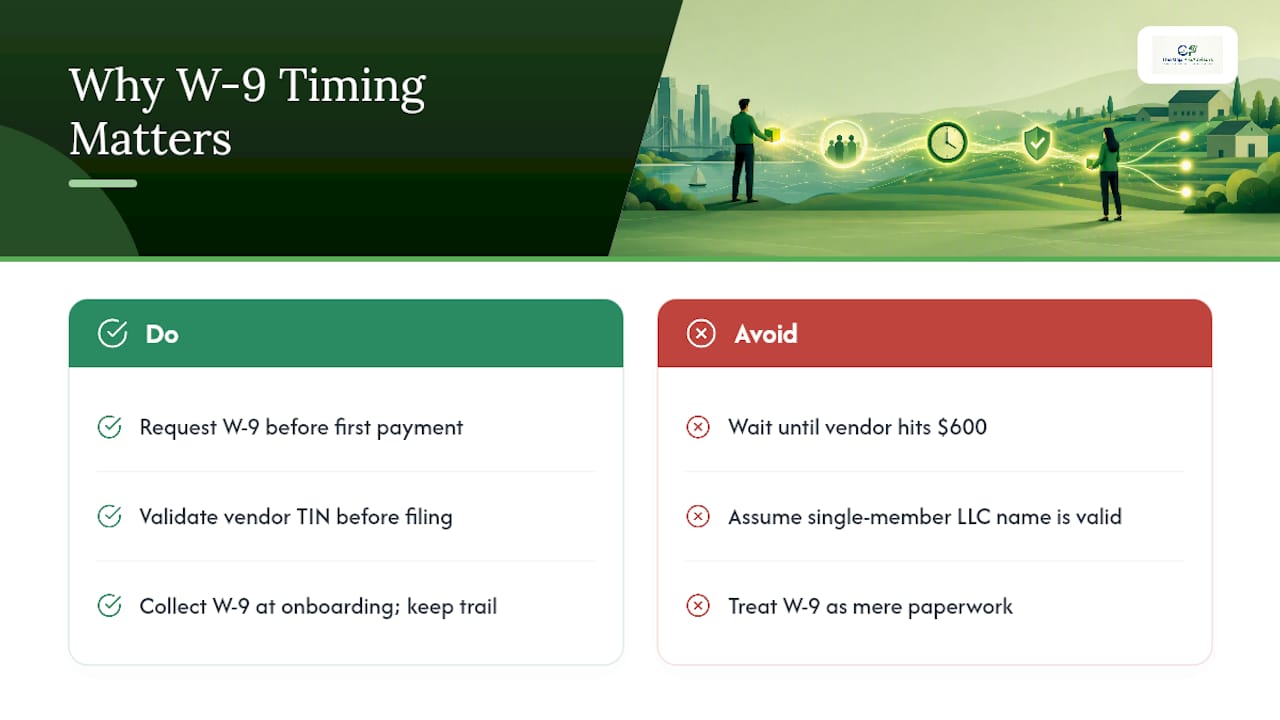
The other underrated piece: single-member LLC confusion causes more IRS notices than outright refusals to provide a W-9. Refusals are rare and fairly easy to handle with documentation. Quiet, well-meaning mistakes, like putting an LLC's name on line 1 instead of the owner's, generate far more of the correction volume we see when reviewing new client books. That's not a compliance failure of intent, it's a form-design gap most business owners never get properly walked through.
This is exactly the kind of detail that Mygappro handles as standard practice for clients: secure W-9 collection at onboarding, TIN validation before filing season, and a documented paper trail if a vendor ever pushes back. Small business owners have told us that fewer things drain a January than discovering a stack of vendor payments with no W-9 behind them.
— Angela
Let Mygappro Handle Your W-9 and 1099 Compliance
Mygappro replaces the spreadsheet-and-email chase most small businesses use for vendor tax paperwork with a secure client portal that collects, stores, and validates W-9s before you ever hit filing season.

Instead of tracking down forms in January, you get contractor compliance built into onboarding: W-9 requests sent automatically, TIN validation before a single 1099 goes out, and a documented history if the IRS ever asks how a payment was classified. This runs alongside online bookkeeping services that keep your books reconciled all year, so year-end reporting is a formality instead of a scramble. Mygappro serves small business owners, entrepreneurs, and HOAs remotely across the U.S., with dedicated support for contractor 1099 filing and the deduction questions that come with it, covered in the 1099 contractor deductions guide.
If you're heading into another tax season with vendor files that don't quite add up, schedule a consultation and let Mygappro clean up the W-9 and 1099 workflow before it becomes a January fire drill.
Sources
Every rule covered above traces back to official IRS guidance, not secondhand interpretation. The Instructions for the Requester of Form W-9 lay out exactly when and how businesses should request the form. The Form W-9 PDF itself contains the name/TIN field rules, exempt payee codes, and the certification language payees sign. For the IRS's take on worker classification questions that sometimes precede a W-9 request, see Independent Contractor or Employee?. The backup withholding page details the 24% rate and B-Notice process. Compliance practices around U.S. person documentation also show up outside tax contexts. Financial services firms rely on similar identity verification standards, as outlined in this compliance playbook for U.S. operators.
This article is general information, not a substitute for advice from a qualified financial advisor. Consult a qualified financial professional about your own circumstances before acting on anything here.
- Instructions for the Requester of Form W-9 | Internal Revenue Service
FAQ
Who Is Required to Have a W-9?
Any U.S. person or entity receiving reportable payments, contractors, freelancers, single-member LLCs, partnerships, and many corporations, generally needs to complete a W-9 when a business requests one for 1099 reporting purposes.
Can I Refuse to Fill Out a W-9?
You can refuse, but the payer is then required to begin backup withholding at 24% on future payments, so refusal usually costs the payee more than simply providing the form.
Why Is Someone Asking Me for a W-9?
A business that pays you $600 or more in a calendar year for services generally must file a 1099, and the W-9 gives them the correct name and TIN needed to do that accurately.
Why Would Someone Need a W-9?
Requesters need a W-9 to satisfy their own IRS filing obligations, since a business that fails to collect accurate payee information risks penalties and may need to apply backup withholding without one.
What's the Difference Between a W-9 and a W-8BEN?
A W-9 applies only to U.S. persons and entities; foreign individuals and foreign entities complete a W-8BEN or W-8BEN-E instead, since the two forms serve different tax residency purposes.