
If your business pays rent to a single landlord during the calendar year exceeding the IRS reporting threshold, you are generally required to file Form 1099-MISC and report that amount in Box 1. That rule applies only to rent paid in the course of your trade or business. Personal rent, such as your home lease, is never reportable.
Here is what you need to do right now:
- Collect a Form W-9 from every landlord before the first payment clears.
- Confirm the payee type. Individuals, partnerships, and most LLCs require a 1099-MISC. Most corporations do not.
- Total year-to-date rent per payee. Once any single payee crosses $600 for the calendar year, the filing obligation is triggered.
- Note the threshold update. For payments made after December 31, 2025 (reported in 2027), a $2,000 Box 1 threshold applies. For payments made in 2025 and reported now, the $600 threshold still governs.
- Schedule your filing. Recipient copies are due January 31; IRS paper copies are due February 28; e-filed returns are due March 31.
Key Takeaways
Filing 1099-MISC for rent requires meeting the IRS annual threshold, confirming payee type, collecting a W-9 before the first payment, and hitting the January 31 recipient deadline.
| Reporting threshold | Any single landlord receiving business rent meeting the IRS reporting threshold requires a Form 1099-MISC. | Threshold update | For payments made after December 31, 2025, the Box 1 reporting threshold is scheduled to update according to IRS guidance. | | W-9 before first payment | Collect the W-9 at vendor setup; it is your defense against backup withholding penalties. | | Rent vs. services split | Rent goes in Box 1 of Form 1099-MISC; service payments go on Form 1099-NEC — never mix them. | | Mygappro 1099 support | Mygappro manages W-9 collection, form preparation, and IRS filing for small businesses nationwide. |
Table of Contents
- When do you need to file a 1099 for rent payments?
- Who receives a 1099-MISC for rent, and who is exempt?
- Which form and box should you use for rent vs. services?
- How do you collect Form W-9 and handle a missing TIN?
- How do you prepare and file Form 1099-MISC for rent?
- What are the penalties for late or incorrect 1099s?
- How do recipients report rental income on their tax returns?
- A prioritized checklist and the most common filing mistakes
- Why standardizing your 1099 process pays off every year
- Mygappro handles your 1099 compliance so you don't have to
- Sources
- FAQ
When do you need to file a 1099 for rent payments?
The filing obligation rests on two conditions: the payment must be made in the course of your trade or business, and it must reach the applicable annual threshold for that payee. IRS instructions are explicit that personal rent payments fall entirely outside this requirement.
What counts as reportable rent:
- Office, warehouse, or retail space leased for business operations
- Equipment or machinery rented for business use (without an operator)
- Pasture or land rented for agricultural business purposes
- Storage units used to hold business inventory
- Facility rentals tied directly to business activity
What does not count:
- Your personal apartment or home lease
- Rent paid through a payment card network, which may instead be reported on Form 1099-K under its own separate rules
- Rent paid to a corporation (with limited exceptions covered below)
Quick scenario examples:
- Office lease at $1,500/month: Clearly reportable. Total annual rent of $18,000 goes in Box 1 of Form 1099-MISC.
- Equipment rental, no operator, $800 for the year: Reportable in Box 1.
- Storage unit for business inventory, $75/month ($900/year): Reportable.
- Sublease pass-through: If you sublease space and pay the original landlord, you are the payer and must file if the threshold is met.
For 2026 payments that you will report in early 2027, industry guidance notes a $2,000 threshold update taking effect after December 31, 2025. Always verify the current threshold in the IRS instructions for the specific tax year you are filing.
Who receives a 1099-MISC for rent, and who is exempt?
Not every landlord gets a 1099-MISC. Knowing who qualifies as a reportable payee saves you from unnecessary filings and, more importantly, from missed ones.
Reportable payees (you must file):
- Individual landlords
- Partnerships and multi-member LLCs taxed as partnerships
- Estates and trusts receiving rent
- Single-member LLCs disregarded for tax purposes (the owner is the payee)
Generally exempt payees (no 1099-MISC required):
- C corporations and S corporations. Rent paid to a corporation is typically exempt from 1099-MISC reporting. Verify the payee's tax classification on their W-9.
- Tax-exempt organizations in most cases
The property manager exception. This one trips up a lot of business owners. When you pay rent to a property management company that acts as an agent for the actual landlord, you generally do not file a 1099-MISC to the underlying owner. The property manager carries the reporting obligation for amounts passed through to the owner. IRS instructions describe this agent-reporting flow directly. That said, if you pay the property manager a management fee separately, that fee for services may require a 1099-NEC if it meets the threshold.
Sublessor responsibilities. If you sublease space from a tenant rather than directly from a building owner, your filing obligation runs to the sublessor, not the building owner. The sublessor is your landlord for reporting purposes.
Which form and box should you use for rent vs. services?
Rent belongs on Form 1099-MISC, Box 1. Services paid to independent contractors belong on Form 1099-NEC. These are two separate forms with separate deadlines, and mixing them is one of the most common triggers for IRS inquiries.
The IRS is clear that nonemployee compensation for services goes on Form 1099-NEC, not 1099-MISC. Reporting a service payment in Box 1 of 1099-MISC, or lumping rent into 1099-NEC, creates a mismatch the IRS matching program will flag.
The mixed-invoice problem. Equipment rented with an operator is the classic example. Say you rent a crane for $3,000 and the operator's labor is $1,500, all on one invoice. You need to split it:
- $3,000 rental portion → Form 1099-MISC, Box 1
- $1,500 operator services → Form 1099-NEC
Keep the allocation workpapers. If the IRS questions the split, you need documentation showing how you arrived at each figure.
A note on 1099-NEC for subcontractors. Questions about whether subcontractors get a 1099 come up often alongside rent questions. The answer is yes, but on the right form. Subcontractor payments for services go on Form 1099-NEC, not 1099-MISC. For a full breakdown of subcontractor 1099 rules and the differences between these two forms, see the 1099-NEC vs 1099-MISC guide.
Pro Tip: Design your lease agreements and vendor invoices to separate base rent, reimbursable expenses, and any service charges on distinct line items. When those categories are clearly labeled from day one, year-end reporting becomes arithmetic rather than guesswork.
How do you collect Form W-9 and handle a missing TIN?
The W-9 is your primary protection against penalties. Collect it before the first payment, not at year-end when landlords are harder to reach and backup withholding obligations may already have kicked in.
- Send the W-9 request before the lease starts or before the first check goes out. Explain that it is a standard IRS requirement for business rent payments.
- Review the W-9 for three things: legal name matching the payee's tax return, Taxpayer Identification Number (TIN), and entity classification (individual, partnership, corporation, LLC).
- Store a dated copy. Keep it in your vendor file with the lease agreement. A digital copy in a secure portal works well.
- If the payee provides an incorrect TIN, the IRS will notify you through a "B" notice. You must then solicit a corrected TIN and, if the problem persists, begin backup withholding.
- If the payee refuses to provide a TIN at all, begin backup withholding immediately and document the refusal in writing. Retaining that communication reduces your penalty exposure if the IRS questions your compliance.
Backup withholding currently applies at a flat rate set by the IRS. The withheld amounts must be remitted to the IRS and reported on Form 945. This is not a situation you want to find yourself in mid-year, which is exactly why the W-9 comes first.
Pro Tip: Add a W-9 collection step to your vendor onboarding checklist and tie it to your accounts payable setup. No W-9 on file, no payment processed. That single internal control prevents the vast majority of backup withholding problems.
How do you prepare and file Form 1099-MISC for rent?
Filing is straightforward when your records are clean. Work through these steps in order:
- Gather all W-9s for landlords you paid during the calendar year. Confirm each payee's name, TIN, and entity type.
- Total reportable rent per payee. Add up every payment made to that landlord during the calendar year. Include any security deposits returned as rent credits if applicable.
- Complete Form 1099-MISC. Enter the total in Box 1. Do not include service charges or reimbursed expenses in Box 1 unless they are genuinely part of the rent obligation.
- Furnish the recipient copy. The landlord must receive their copy by January 31 of the year following payment.
- File with the IRS. Paper filers submit by February 28; e-filers have until March 31. If you are filing 10 or more information returns in total, you are generally required to e-file through the FIRE system or an authorized e-file provider.
- File Form 1096 as a transmittal cover sheet if you are submitting paper returns. E-filers do not use Form 1096.
- Check state requirements. Many states require a separate filing or have their own 1099 reporting rules. Confirm your state's requirements independently.
Key deadlines at a glance:
- January 31: Recipient copy due
- February 28: IRS paper filing due
- March 31: IRS e-file due
If you discover an error after filing, submit a corrected Form 1099-MISC as soon as possible. Check the "CORRECTED" box at the top of the form, enter the correct information, and furnish a corrected copy to the recipient. Do not void and refile unless the original was filed with the wrong payee entirely.
What are the penalties for late or incorrect 1099s?
The IRS penalty structure for information returns scales with how late the correction arrives and whether the failure was intentional. Penalties apply per return, so a business with multiple landlords can accumulate them quickly.
Penalty tiers (per return):
- Filed correctly within 30 days of the due date: lower penalty tier
- Filed correctly more than 30 days late but by August 1: mid-tier penalty
- Filed after August 1 or not filed at all: higher penalty tier
- Intentional disregard: significantly higher penalty with no annual cap
The IRS publishes the current penalty amounts in the instructions for information returns; those figures adjust periodically, so check the current year's instructions for exact dollar amounts rather than relying on figures that may be outdated.
Common errors that trigger penalties:
- Wrong TIN (transposed digits, old EIN, missing number)
- Reporting service payments in Box 1 instead of on Form 1099-NEC
- Missing the recipient furnishing deadline even when the IRS copy is on time
- Failing to file at all because you assumed the landlord was a corporation without verifying on the W-9
How to file a corrected 1099-MISC:
- Obtain a new Form 1099-MISC (do not alter the original).
- Check the "CORRECTED" box at the top.
- Enter the correct payee information and the correct dollar amount.
- Mail or e-file the corrected return to the IRS.
- Send a corrected copy to the recipient promptly.
If you originally filed on paper, submit the correction on paper. If you originally e-filed, submit the correction through the same electronic channel.
How do recipients report rental income on their tax returns?
Understanding how your landlord reports the income you paid helps you anticipate questions and advise payees when appropriate. The 1099-MISC you file does not change the tax treatment; it simply gives the IRS a data point for matching.
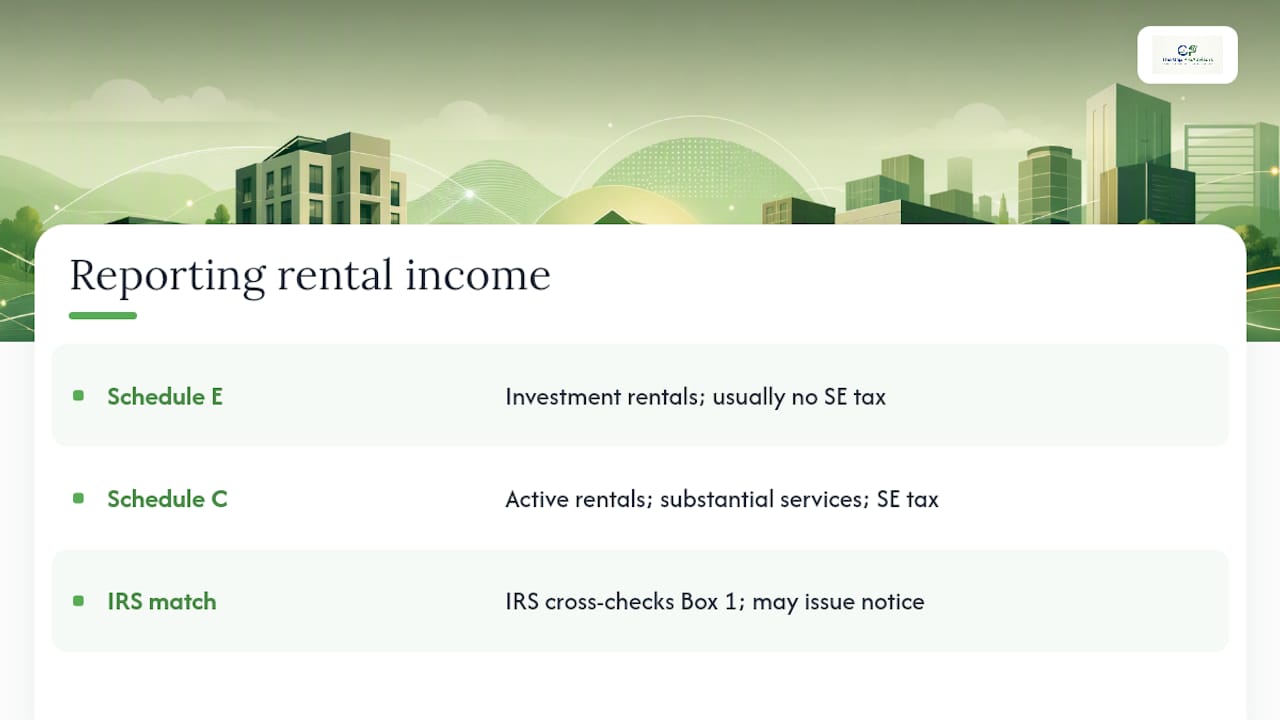
Schedule E (most landlords). Rental income from property held for investment or passive rental activity goes on Schedule E. This is the standard path for a landlord who owns a building, collects rent, and does not provide significant services to tenants. The income is generally not subject to self-employment tax.
Schedule C (active rental businesses). When a landlord provides substantial services beyond basic maintenance, the IRS may treat the activity as a trade or business. Hotels, short-term rentals with daily housekeeping, and similar operations often land on Schedule C. That classification means the income is subject to self-employment tax. For a deeper look at deductions available to 1099 recipients in this situation, the 1099 contractor deductions guide covers the key categories.
The matching function. The IRS cross-references the amount in Box 1 of your 1099-MISC against the landlord's return. If the landlord reports less than what you filed, the IRS may send a notice. That is not your problem to solve, but it reinforces why accuracy in Box 1 matters: an inflated or incorrect figure creates a mismatch that affects your landlord.
A prioritized checklist and the most common filing mistakes
Use this checklist for every landlord you pay during the year:
- Obtain a signed W-9 before the first payment.
- Verify the payee's entity type on the W-9 (individual, partnership, LLC, or corporation).
- Track payments in your bookkeeping software throughout the year, not just in December.
- At year-end, total payments per payee and confirm which ones meet the threshold.
- Select the correct form: Box 1 of Form 1099-MISC for rent, Form 1099-NEC for services.
- Furnish recipient copies by January 31.
- File with the IRS by February 28 (paper) or March 31 (e-file).
- Retain copies of all 1099s, W-9s, and transmittal records for at least four years.
Common mistakes that cause IRS inquiries:
- Lumping rent and service charges on a single 1099-MISC Box 1 entry without splitting the invoice
- Paying through a property manager and filing a 1099-MISC to the underlying owner anyway (double-reporting)
- Skipping backup withholding when a landlord never returned the W-9
- Assuming an LLC is a corporation without checking the W-9 classification box
- Missing the January 31 recipient deadline while hitting the IRS deadline, which still triggers a penalty
Pro Tip: Run a vendor report in your accounting software each November. Flag every vendor coded as "rent" with no W-9 on file and resolve it before December 31. Chasing a landlord for a W-9 in January, when you are already past the first payment, is far more stressful than a November email.
Why standardizing your 1099 process pays off every year
The businesses that dread 1099 season are almost always the ones that treat it as a once-a-year scramble. The ones that handle it calmly built a simple process at the start of the year and let it run.
W-9 collection is the hinge point. Every other step, from form selection to backup withholding to accurate Box 1 entries, depends on having clean payee data before money changes hands. When that data is missing, you are not just facing a compliance gap; you are facing a deadline with no good options.
The split between rent and services is the second place where process discipline pays off. Invoices that clearly separate base rent from operator labor or maintenance services make year-end reporting a ten-minute exercise. Invoices that bundle everything together create an allocation problem that requires documentation, judgment, and sometimes a conversation with a tax advisor.
One internal control worth adding today: require a W-9 as a condition of vendor setup in your accounts payable system. No W-9, no vendor record, no payment. That single gate catches the problem at the right moment, before the first check goes out, rather than in January when the damage is already done.
Mygappro handles your 1099 compliance so you don't have to
Filing 1099s for rent payments correctly means tracking payees all year, collecting W-9s before payments go out, splitting rent from services on mixed invoices, and hitting three separate deadlines in January, February, and March. For a small business owner already managing operations, that is a meaningful compliance burden.

Mygappro's 1099 and contractor filing services handle every step: W-9 collection and storage, year-end payment totals, form preparation, recipient copy delivery, and IRS filing through a secure online portal. You get accurate filings without the year-end scramble, and your tax documents are handled with the same care as your full bookkeeping. If you also need help with broader tax preparation, the tax preparation services page covers what Mygappro offers for small businesses nationwide. Schedule a free consultation at Mygappro and get your 1099 process set up right before the next payment goes out.
Sources
These IRS pages and official resources form the basis of the guidance in this article. Bookmark them for the tax year you are currently filing.
- About Form 1099-MISC, Miscellaneous Information
- Form 1099-MISC (PDF)
- What Types of Rent Belong in 1099-MISC Box 1? | Tax1099 Blog
- Filing Information Returns Electronically (FIRE)
This article is general information, not a substitute for advice from a qualified financial advisor. Consult a qualified financial professional about your own circumstances before acting on anything here.
FAQ
Do I issue a 1099 for rent payments to my landlord?
Yes, if your business pays a landlord $600 or more in rent during the calendar year and the landlord is not a corporation, you must file Form 1099-MISC with the amount in Box 1. The obligation applies only to rent paid in the course of your trade or business, not personal rent.
Do you have to report rent payments to the IRS?
Business rent payments meeting the annual threshold must be reported to the IRS on Form 1099-MISC. Payments made through a property manager shift the reporting obligation to the manager, and payments processed through card networks may fall under Form 1099-K rules instead.
What type of 1099 do you get for rent?
Landlords receiving reportable rent from a business payer receive Form 1099-MISC, with the rent amount shown in Box 1. Service payments, by contrast, appear on Form 1099-NEC, which is a separate form with its own filing deadlines.
How does a landlord report income shown on a 1099-MISC?
Most landlords report rental income on Schedule E of their personal or business return. If the rental activity involves substantial services to tenants, the IRS may treat it as a trade or business, in which case Schedule C applies and the income becomes subject to self-employment tax.
What happens if you miss the 1099-MISC filing deadline?
The IRS assesses per-return penalties that increase the longer the filing is overdue, with the highest tier applying to returns filed after August 1 or not filed at all. Filing a corrected or late return as soon as you discover the error reduces the penalty exposure compared to waiting.