
The most critical 1099 deadlines 2026 filers need to know are listed here, up front. Because January 31, 2026 falls on a Saturday, the standard January 31 due date shifts to Monday, February 2, 2026 under the IRS next-business-day rule documented in Publication 1099. That single calendar fact affects more filings than most small business owners realize.
Here are the key observed 2026 dates at a glance:
- February 2, 2026 — Furnish Form 1099-NEC to recipients AND file with the IRS (paper or e-file). No extension available.
- February 2, 2026 — Furnish most other 1099 forms to recipients (1099-MISC, 1099-INT, 1099-DIV, 1099-R, 1099-G).
- February 16, 2026 — Furnish recipient copies of Forms 1099-B, 1099-S, and 1099-MISC (boxes 8 or 10 only). February 15 falls on a Sunday in 2026, so the observed date moves to Monday, February 16.
- February 28, 2026 — Paper-file most 1099 forms (except 1099-NEC) with the IRS, along with Form 1096.
- March 31, 2026 — E-file most 1099 forms (except 1099-NEC) with the IRS via IRIS or approved software.
One rule that never bends: Section 6071(c) requires Form 1099-NEC to be filed by January 31 every year, paper or electronic. In 2026, that observed date is February 2. No extension is available for 1099-NEC.
Key Takeaways
The single most important fact for 2026: January 31 falls on a Saturday, so the 1099-NEC furnishing and filing deadline moves to February 2, 2026, with no extension available under any circumstances.
| Point | Details |
|---|---|
| 1099-NEC observed deadline | February 2, 2026 for both recipient furnishing and IRS filing; no extension exists for this form. |
| 1099-B, 1099-S recipient copies | Due February 16, 2026 (February 15 falls on a Sunday; next business day applies). |
| Paper vs. e-file for 1099-MISC | Paper IRS filing due February 28; e-file via IRIS due March 31, 2026. |
| E-file threshold | TD 9972 set the mandatory e-file threshold at 10 aggregated information returns; most small businesses now must use IRIS. |
| Mygappro 1099 services | Mygappro manages W-9 collection, TIN verification, IRIS filing, and corrections for small businesses nationwide. |
Table of Contents
- 2026 1099 filing deadlines broken down by form
- How to file in 2026: paper, e-file, IRIS, and timely-mailing rules
- Extensions, corrections, and what to do when something goes wrong
- Penalties for late or incorrect 1099s in 2026
- Your 8-step compliance checklist for 1099 filings in 2026
- Why getting 1099 timing right matters more than most businesses expect
- How Mygappro handles 1099 compliance for small businesses
- Sources
- FAQ
2026 1099 filing deadlines broken down by form
Every 1099 form carries two separate obligations: furnishing a copy to the recipient and filing with the IRS. Those dates are not always the same, and the format you choose (paper vs. e-file) can change your IRS filing deadline by a full month.
The table below shows the observed 2026 dates for the most commonly used forms. "Recipient copy" means the date you must deliver the statement to the payee. "IRS paper" and "IRS e-file" are the dates your filing must reach the IRS.
A few points worth noting:
- The February 16 recipient deadline applies specifically to Forms 1099-B, 1099-S, and 1099-MISC when amounts appear in boxes 8 or 10. Publication 1099 sets this as a February 15 rule; because February 15, 2026 is a Sunday, the observed date moves to February 16.
- Form 1099-NEC is the outlier. Its furnishing and IRS filing deadlines are identical, and both fall on the same observed date: February 2, 2026. Paper and e-file filers face the same deadline.
- The paper vs. e-file gap for 1099-MISC is significant. Paper filers must file by February 28; e-filers get until March 31. That extra month can matter for businesses still gathering data in late February.
- If you file Form 1096 as a paper transmittal, it follows the same February 28 deadline as the paper returns it accompanies.
Pro Tip: Bookmark the IRS Tax Calendar and check it before filing. The IRS occasionally announces last-minute date adjustments, and the calendar reflects the current observed dates for your jurisdiction.
For a deeper comparison of when to use each form, the 1099-NEC vs. 1099-MISC guide covers the classification rules that determine which form you actually need.
How to file in 2026: paper, e-file, IRIS, and timely-mailing rules
Who must e-file in 2026?
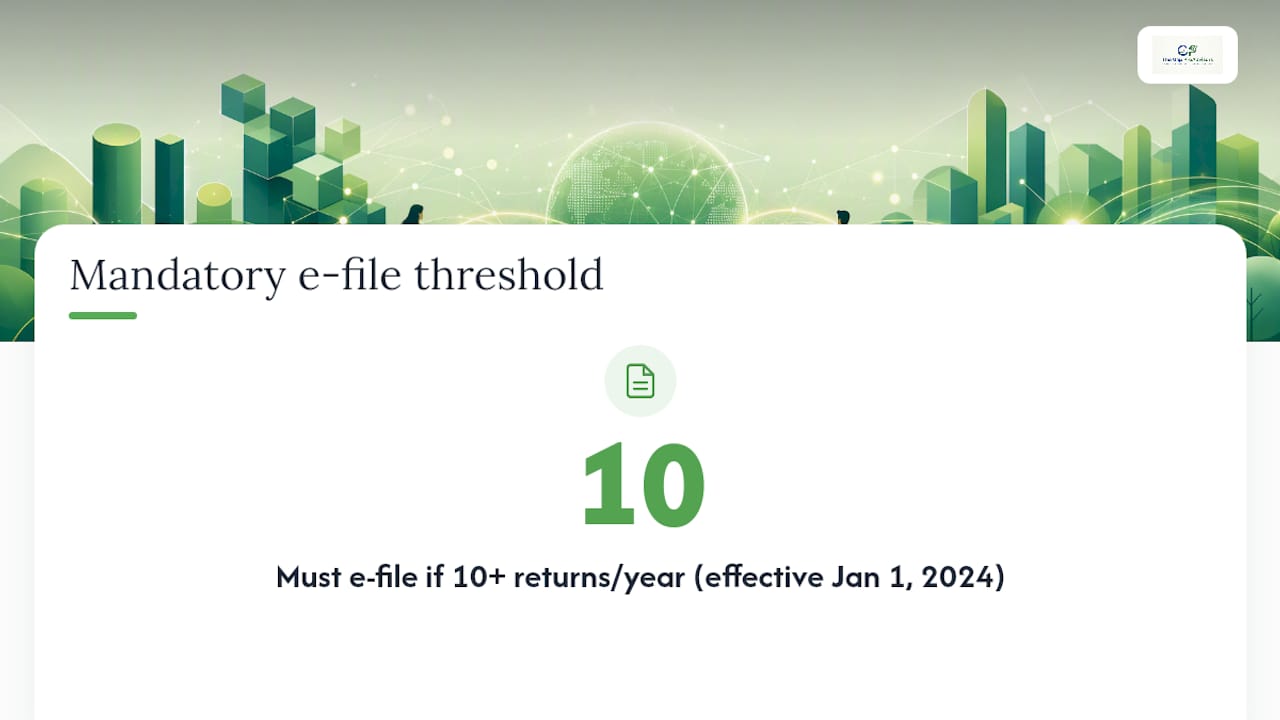
The answer changed significantly starting with returns filed on or after January 1, 2024. Treasury Decision TD 9972 lowered the mandatory e-file threshold to 10 aggregated information returns per year, as documented in Publication 1099. That count is aggregate across all information return types, not per form. A business filing six 1099-NECs and five 1099-MISCs has already crossed the threshold. Many small businesses that previously mailed paper returns now must e-file.
Filing through IRIS
The IRS built IRIS (Information Returns Intake System) as its dedicated portal for e-filing information returns. It handles most 1099 forms and is free to use. Before you submit, review IRS Publications 5717 and 5718 for the technical specifications. If you plan to use the Application-to-Application (A2A) workflow, budget time for vendor onboarding and software testing well before the observed deadline. Missing a technical setup step the week before February 2 is a preventable problem.
The IRS no longer prints carbonless multi-part 1099 forms. You must use online fillable forms or commercially printed forms that meet IRS specifications. IRIS and approved third-party software are the practical path for most filers.
Timely-mailing rules for paper filers
Paper filers meet the timely-filing requirement when returns are properly addressed and either postmarked by the due date or sent via an IRS-designated private delivery service (PDS) with written proof of the send date, per IRS general instructions. Two details matter here:
- PDS items cannot be delivered to a P.O. Box. Use the IRS-provided street address list for PDS shipments.
- A USPS postmark is sufficient proof for standard mail, but keep your receipt.
For e-filers, the timely-filing timestamp is 11:59 p.m. local server time on the applicable due date. Submit before that cutoff, and you are on time. Submit one minute after, and you are late.
Checklist: paper vs. e-file decision
- File count: If you are filing 10 or more information returns in aggregate, e-file is required.
- Software readiness: Confirm your payroll or tax software exports to IRIS-compatible formats before January.
- PDS proof: If you paper-file, use a designated PDS and keep the tracking receipt.
- IRIS setup: Register for IRIS early. First-time users sometimes encounter identity-verification delays.
- Deadline alignment: E-filers for most forms (not 1099-NEC) gain until March 31. Paper filers must be done by February 28.
Pro Tip: Plan your e-file submission at least two business days before the observed deadline. That buffer covers unexpected IRIS outages or last-minute data corrections without putting you at risk.
Extensions, corrections, and what to do when something goes wrong
Requesting a filing extension with Form 8809
Form 8809 gives you an automatic 30-day extension to file most information returns with the IRS. You must submit it by the original due date, not after. In limited hardship circumstances, an additional 30-day extension may be available, but that second extension is not automatic and requires a written explanation.
You can file Form 8809 electronically through IRIS or submit it on paper. Either way, the deadline to request the extension is the same as the original filing deadline for the form you need more time to file.
One firm limit: Forms W-2 and 1099-NEC have no automatic extension. Filing Form 8809 for a 1099-NEC does not buy you extra time. Missing the February 2, 2026 deadline for 1099-NEC means you are late, period.
Form 8809 covers only your IRS filing deadline. It does not extend the deadline to furnish recipient statements. If you need more time to deliver statements to payees, a separate written request to the IRS is required, and approval is not guaranteed.
How to correct a filed return
Mistakes happen. A wrong TIN, a transposed dollar amount, or a missing payee name all require a corrected return. The correction process follows these steps:
- Identify the error type. Wrong dollar amount, wrong payee name/TIN, and wrong form type each follow slightly different correction procedures.
- Prepare a corrected 1099. Check the "CORRECTED" box at the top of the form. Do not void the original unless the IRS instructs otherwise.
- Furnish a corrected statement to the recipient. The payee needs the corrected copy just as they needed the original.
- File the corrected return with the IRS. If your original return was required to be e-filed, the corrected return must also be e-filed. Submitting a paper correction when e-filing was required can itself trigger a penalty unless a hardship waiver is approved.
- Document the correction. Keep a record of what was wrong, when you corrected it, and how the corrected return was filed.
Because the IRS treats corrected returns the same as originals for e-file threshold purposes, the administrative cost of errors is real. Accurate payee records and TIN matching before you file are the most reliable way to avoid correction cycles entirely. For guidance on managing contractor records and W-9 collection, a structured process before year-end pays off.
Penalties for late or incorrect 1099s in 2026
How the IRS calculates penalties
Late filing and late furnishing carry per-form penalties that increase the longer you wait. The IRS structures penalties in tiers based on how quickly you correct the problem:
- Filed within 30 days of the due date: Lower per-form penalty tier.
- Filed after 30 days but by August 1: Mid-range per-form penalty tier.
- Filed after August 1 or not at all: Highest per-form penalty tier.
The same tiered structure applies to late recipient furnishing. Penalties for intentional disregard are higher still and have no cap per form. For the current penalty amounts, check IRS Publication 1099, which documents the penalty schedule alongside the filing rules.
To see how quickly penalties add up: a small business that files 15 Forms 1099-NEC two months late faces a per-form penalty for each of those 15 returns. Multiply that by 15, and the total penalty for a modest contractor roster can exceed what it would have cost to hire a professional to file correctly the first time.
Backup withholding triggers
When a payee's TIN is missing, incorrect, or the payee has failed to certify their TIN on a W-9, the IRS can require you to withhold a flat percentage of payments as backup withholding. The IRS TIN Matching program lets you verify TINs before filing, which is the most direct way to avoid this situation. A mismatch discovered after filing means a corrected return and potential backup withholding liability.
Common mistakes and how to avoid them
- Missing W-9s: Collect a completed W-9 before the first payment, not in January. Chasing contractors for TINs at year-end is a known compliance risk.
- Misclassifying workers: Paying someone as a contractor when they meet employee criteria creates both payroll tax exposure and incorrect 1099 filings. Review contractor classification rules before year-end.
- Failing to e-file when required: With the threshold now at 10 aggregated returns, many businesses that mailed paper returns in prior years must now use IRIS. Filing on paper when e-filing is required triggers a separate penalty.
- Wrong form selection: Nonemployee compensation goes on 1099-NEC, not 1099-MISC. Using the wrong form is a correctable error, but it costs time and creates a correction cycle.
Pro Tip: Run TIN matching through the IRS e-Services portal in November or December. Catching mismatches before you file is far less costly than correcting returns after the fact.
Your 8-step compliance checklist for 1099 filings in 2026
Small businesses that stay ahead of 1099 deadlines treat compliance as a process, not a January scramble. Work through these steps now.
- Collect W-9s from every contractor before payment. A W-9 captures the TIN, legal name, and entity type you need to file accurately. No W-9, no payment, is the cleanest policy.
- Verify TINs using IRS TIN Matching. Submit payee TINs through the IRS e-Services TIN Matching program. Mismatches caught now cost nothing. Mismatches caught after filing cost penalty dollars.
- Categorize all payments by type. Separate nonemployee compensation (1099-NEC) from rent, royalties, and other miscellaneous payments (1099-MISC). Confirm which payments meet the $600 reporting threshold.
- Decide: paper or e-file. If you are filing 10 or more information returns in aggregate, e-filing is required. If you are below that threshold, weigh the March 31 e-file deadline against the February 28 paper deadline.
- Prepare recipient statements early. Draft 1099s in December so recipients get their copies well before the February 2, 2026 observed deadline. Early delivery reduces recipient complaints and correction requests.
- File with the IRS by the observed deadline. February 2 for 1099-NEC (all filers). February 28 for paper 1099-MISC and other forms. March 31 for e-filed 1099-MISC and other forms via IRIS.
- Correct errors promptly. If a recipient reports a discrepancy, file a corrected return as soon as possible. Earlier corrections fall in lower penalty tiers.
- Retain documentation for at least four years. Keep copies of all filed returns, W-9s, TIN matching results, and proof of mailing or e-file confirmation. The IRS can request records well after the filing year.
You can find additional year-round tax compliance resources to pair with this checklist, including guides on small business tax preparation and planning. Businesses operating in California should also note that state filing obligations may intersect with federal information reporting requirements, as covered in this California annual filing guide.
Why getting 1099 timing right matters more than most businesses expect
The conventional wisdom is that 1099 compliance is a January task. File by the 31st, move on. That framing causes most of the problems I see small business owners run into.
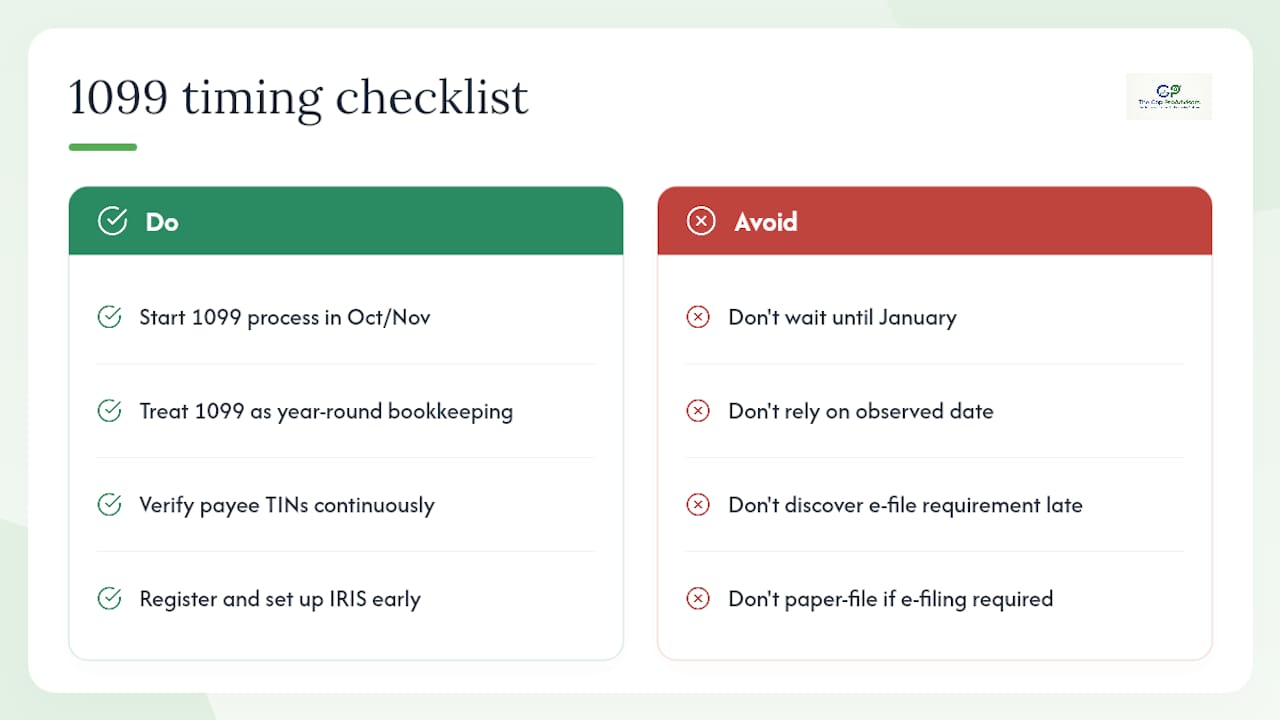
The real risk is not the deadline itself. It is the cascade that follows a missed one. A late 1099-NEC triggers a per-form penalty with no extension available. A wrong TIN triggers backup withholding liability. A paper filing when e-filing was required adds another penalty layer. Each of these is avoidable, but only if the process starts in October or November, not January.
The 2026 calendar shift, where January 31 moves to February 2, is a small grace period that can feel like breathing room. Treat it as a buffer for review, not extra time to start. Businesses that use the observed date as their target, rather than building in a submission window before it, are the ones that end up filing corrected returns in March.
The e-file threshold change from TD 9972 is the other underappreciated shift. Many small businesses that have always mailed paper returns now must use IRIS. That is not a minor procedural change. IRIS requires registration, technical setup, and familiarity with the submission workflow. A business discovering this requirement in late January is already behind.
At Mygappro, the approach is to treat 1099 compliance as part of year-round bookkeeping, not a standalone January task. When payee records are clean, TINs are verified, and payment categories are tracked throughout the year, the filing itself takes hours, not days.
How Mygappro handles 1099 compliance for small businesses
Accurate 1099 filing is one of the most time-sensitive compliance tasks a small business faces each year, and the 2026 calendar shifts make it even more precise. Mygappro's tax preparation services are built specifically for small business owners who want this handled correctly without spending their own time on IRS portals and penalty lookups.

Here is what Mygappro manages for 1099 compliance:
- Collecting and organizing W-9s from your contractors throughout the year
- Verifying TINs before filing to prevent backup withholding issues
- Preparing and filing 1099-NEC, 1099-MISC, and other required forms through IRIS
- Furnishing recipient copies on time with documentation
- Filing corrected returns when errors surface
- Maintaining records for IRS audit readiness
Pricing depends on volume and complexity. Mygappro works with businesses across the U.S. through a secure online portal, so geography is not a barrier. To get a clear picture of what your 1099 filing package would include, schedule a compliance review with The Gap ProAdvisors. No guesswork on scope, no surprise fees at year-end.
Sources
These are the primary IRS publications and portals for 2026 1099 compliance. Open them before you file.
- Publication 1099 (2026), General Instructions for Certain Information Returns | Internal Revenue Service
This article is general information, not a substitute for advice from a qualified financial advisor. Consult a qualified financial professional about your own circumstances before acting on anything here.
FAQ
When are 1099s due in 2026?
Most recipient copies are due February 2, 2026 (the observed date for January 31, which falls on a Saturday). Forms 1099-B, 1099-S, and 1099-MISC boxes 8 or 10 have a recipient deadline of February 16, 2026. IRS filing deadlines are February 2 for 1099-NEC, February 28 for paper 1099-MISC and most other forms, and March 31 for e-filed versions.
What is the 1099 cutoff for 2026?
The $600 payment threshold still applies for most 1099 forms, including 1099-NEC for nonemployee compensation. Payments at or above $600 to a single contractor or vendor during the calendar year generally require a 1099.
Can you extend the 1099-NEC deadline?
No. Form 1099-NEC has no automatic extension. Filing Form 8809 does not apply to 1099-NEC or Forms W-2. The February 2, 2026 observed deadline is firm for both furnishing and IRS filing.
How late can a 1099 be issued?
The IRS applies tiered penalties based on how late the filing is. Returns filed within 30 days of the due date carry a lower per-form penalty. Returns filed after 30 days but by August 1 carry a mid-range penalty. Returns filed after August 1 or not at all carry the highest per-form penalty, with no cap for intentional disregard.
What happens if you miss the January 31 deadline for 1099s?
In 2026, the observed deadline is February 2, not January 31. Missing it means per-form late-filing penalties begin accruing immediately. For 1099-NEC, there is no extension to reduce that exposure. Filing as quickly as possible after the deadline keeps you in the lower penalty tier, so speed matters once a deadline has passed.