
Choose Mercury if you run a VC-backed startup, hold significant working capital, or need deep integrations with Stripe, QuickBooks, or Xero. Choose Relay if you practice Profit First, manage cash across multiple buckets, or want automatic allocation rules baked into your banking layer. Relay positions itself for multi-account cash management; Mercury targets venture-backed startups and treasury needs.
-
Mercury's strongest differentiators: native integrations with Stripe, QuickBooks, and Xero; a Treasury product that earns yield on idle cash; free domestic and international USD wires on the free plan; and developer API access.
-
Relay's strongest differentiators: up to 20 real checking sub-accounts (each with its own routing number) on the free tier; percentage-based automatic allocation rules; and free bookkeeper access.
-
The hybrid pattern: many founders run both — Mercury as the primary account for receipts and integrations, Relay as the allocation layer for tax reserves and owner pay. That setup captures the best of both without meaningful extra cost.
Key Takeaways
Mercury wins on integrations, free wires, and FDIC sweep coverage up to $5M; Relay wins on true sub-account separation, automatic allocation, and free bookkeeper access, and running both platforms together captures the strengths of each.
| Point | Details |
|---|---|
| Match platform to revenue model | Mercury fits startups and ecommerce; Relay fits Profit First and multi-bucket operators. |
| FDIC coverage differs | Mercury covers up to $5M via sweep; Relay covers up to $3M through its program. |
| Wire cost matters | Mercury includes free wires on its free plan; Relay requires a paid Grow plan for outgoing wires. |
| Hybrid setup works well | Route receipts to Mercury for integrations; transfer to Relay for tax and owner pay buckets. |
| Mercury devices need special disposal | Mercury-containing components require certified hazardous waste handling under EPA rules. |
Table of Contents
- How does Mercury work as a business banking platform?
- How does Relay work as a business banking platform?
- Mercury vs Relay: a side-by-side comparison
- Which platform should you choose for your business?
- U.S. regulatory and deposit safety considerations
- What are the best alternatives if neither platform fits?
- How mercury switches and mercury-wetted contacts work
- How do electromechanical, reed, and solid-state relays work?
- What are the key performance trade-offs between mercury and relay types?
- Pros and cons of mercury contacts vs relay types
- U.S. safety and environmental rules for mercury-containing devices
- What replaces mercury switches in modern designs?
- The setup I'd recommend for most small-business clients
- Useful sources and further reading
- FAQ
How does Mercury work as a business banking platform?
Mercury operates as a fintech that delivers banking services through partner banks and a sweep network, and the company has been pursuing a national bank charter. For most small businesses, that distinction is invisibly day-to-day. What you actually feel is the product layer: tight integrations, a clean dashboard, and a Treasury product that puts idle cash to work.
Mercury's core value proposition: integrations with Stripe, QuickBooks, and Xero sit natively inside the account, so your payment data, invoices, and reconciliation flow without manual exports. The Treasury sweep product earns yield on balances you are not actively spending, which matters when you are sitting on a post-raise balance or a large operating reserve.
| Feature | Mercury (free plan) |
|---|---|
| Integrations | Stripe, QuickBooks, Xero, API access |
| Wires | Free domestic + international USD |
| FDIC coverage | Up to $5M via sweep network |
| Sub-accounts | Virtual vaults (shared routing number) |
| Yield on cash | Mercury Treasury sweep product |
| Best for | Startups, ecommerce founders, engineering teams |
Mercury's API access is a genuine differentiator for engineering teams that want to automate payouts, build internal dashboards, or trigger bank actions from their own software. If your team has a developer, Mercury's infrastructure is built for that.
How does Relay work as a business banking platform?
Relay partners with program banks to offer what most fintechs only simulate: true separate checking accounts, each carrying its own routing and account number. That distinction matters for Profit First practitioners and anyone who needs hard separation between operating cash, tax reserves, and owner distributions.
Core Relay features:
- Up to 20 checking accounts on the free tier, each with a distinct routing number and assignable debit cards
- Percentage-based automatic transfers that move money between accounts on a schedule you set
- Free bookkeeper access on the basic plan, so your accountant can view and reconcile without a paid seat
- Multiple physical and virtual cards per sub-account
Who benefits most from Relay:
- Profit First practitioners who need bank-level envelope budgeting, not just spreadsheet categories
- Solopreneurs and consultants with irregular income who want automatic tax set-asides
- Agency owners managing retainer income, payroll funding, and owner pay as separate pools
- Operators whose bookkeeper needs direct read access without sharing login credentials
Relay's paid Grow plan unlocks outgoing wires, which is a real cost consideration if you send wires frequently.
Mercury vs Relay: a side-by-side comparison
Mercury and Relay serve different operator profiles: Mercury for tech-forward businesses that need integrations and treasury; Relay for businesses that need strict cash separation and automatic allocation.
| Dimension | Mercury | Relay |
|---|---|---|
| How it works | Fintech + partner banks + sweep network | Fintech + program banks, true sub-accounts |
| Best for | Startups, ecommerce, engineering teams | Profit First, solopreneurs, agencies |
| FDIC coverage | Up to $5M via sweep | Up to $3M via program |
| Sub-accounts | Virtual vaults (shared routing) | Up to 20 real accounts (separate routing) |
| Outgoing wires | Free on free plan | Requires paid Grow plan |
| Integrations | Stripe, QuickBooks, Xero, API | Limited native integrations |
| Bookkeeper access | Available | Free on basic plan |
| Yield on cash | Mercury Treasury sweep | Not a core feature |

Mercury wins on integrations, wire cost, and yield. Relay wins on account separation, automatic allocation, and bookkeeper access. For most small businesses under $1M in annual revenue, neither FDIC ceiling is a practical constraint. Above that threshold, Mercury's $5M sweep coverage gives more headroom.
Which platform should you choose for your business?
The right choice maps to your revenue model and spending structure. Here is how common operator profiles break down:
- VC-backed startup with a large post-raise balance: Mercury. The Treasury sweep earns yield on idle capital, and the Stripe integration keeps your payment data clean from day one.
- Ecommerce founder running Stripe payouts: Mercury. Native Stripe integration and free wires make reconciliation straightforward.
- Freelancer or consultant using Profit First: Relay. Set up accounts for operating expenses, taxes, owner pay, and profit, then automate the percentage splits.
- Agency sending frequent domestic wires: Mercury, unless you are already on Relay's Grow plan.
- Non-resident LLC owner routing Stripe payouts: Mercury is generally more accessible for international founders, though both platforms have KYC requirements.
Decision checklist:
- Do you need automatic allocation between named cash buckets? Relay.
- Do you need Stripe, QuickBooks, or Xero to sync natively? Mercury.
- Do you send outgoing wires regularly without paying per-wire fees? Mercury.
- Does your bookkeeper need to direct account access at no extra cost? Relay.
- Do you hold more than $3M in deposits? Mercury's sweep coverage gives more protection.
Pro Tip: Open both accounts — they are both free at the base tier. Route all receipts and integrations to Mercury, then set up a weekly automatic transfer to Relay for your tax reserve and owner pay buckets. Your bookkeeper can reconcile both through small business accounting services without manual exports.
U.S. regulatory and deposit safety considerations
Both Mercury and Relay are fintechs, not chartered banks, so your deposits sit at their partner banks and are FDIC-insured through those relationships. Mercury advertises FDIC coverage via its sweep network up to several million dollars; Relay advertises coverage through its program. For the vast majority of small businesses, both ceilings are well above any realistic operating balance.
Partner bank history is worth knowing. Mercury's partner Choice Financial has had a federal consent order, and Relay's partner Thread Bank faced an FDIC enforcement action in 2024. Both platforms continue operating, and deposits remain FDIC-insured through their programs. These events do not mean your money is at risk, but they are a reason to stay informed and avoid concentrating your entire operating cash in a single fintech.
Practical risk controls:
- Keep no more than your working capital needs in any single fintech account
- Run the hybrid pattern (Mercury + Relay) as a natural diversification strategy
- Reconcile both accounts monthly — accurate bookkeeping catches discrepancies before they become problems
- Know your KYC documentation in advance; account freezes during verification are the most common disruption for small businesses
What are the best alternatives if neither platform fits?
If Mercury and Relay both miss your priorities, a few alternatives are worth considering:
- Multiple traditional accounts: some operators simply open two or three accounts at separate FDIC-insured banks and manage allocation manually or through cash flow software
The hybrid pattern (Mercury plus Relay) remains the most practical answer for most small businesses that want both integration depth and strict cash separation without paying for either.
How mercury switches and mercury-wetted contacts work
A mercury switch contains a small sealed glass or metal tube with a bead of liquid mercury inside. When the device tilts or a magnetic field is applied, the mercury flows to bridge two electrical contacts, completing the circuit. Mercury-wetted reed relays use a similar principle: a reed switch is coated with mercury so the contacts close with a liquid metal film rather than solid metal-to-metal contact. That film eliminates contact bounce almost entirely and produces a very low, stable contact resistance.
Common types include tilt switches (used in older thermostats and appliances), mercury-wetted reed relays (used in test equipment and telecommunications), and mercury displacement relays (used in high-current industrial applications). The liquid metal self-heals minor surface oxidation, which is why mercury contacts historically outlasted dry contacts in low-current signal switching.
How do electromechanical, reed, and solid-state relays work?
An electromechanical relay (EMR) uses an electromagnetic coil to pull a mechanical armature, physically moving contacts from open to closed. The moving parts make EMRs audible and relatively slow, but they handle high currents and provide complete galvanic isolation between the control circuit and the load circuit.
Reed relays replace the armature with two thin ferromagnetic reeds sealed in a glass envelope. A coil around the envelope magnetizes the reeds, pulling them together. Reed relays switch faster than EMRs, handle lower currents, and fit into compact packages. Solid-state relays (SSRs) eliminate moving parts entirely, using semiconductor switching (typically a TRIAC or SCR for AC, or a MOSFET for DC) triggered by an optocoupler. SSRs switch in microseconds, produce no contact wear, and generate no electromagnetic interference from mechanical bounce.
What are the key performance trade-offs between mercury and relay types?
Switching speed separates the technologies clearly. SSRs switch in microseconds. Reed relays close in roughly 0.5–2 milliseconds. Electromechanical relays typically take 5–15 milliseconds. Mercury-wetted contacts fall between reed and EMR speeds, but their defining advantage is near-zero contact bounce, which matters in pulse-counting and low-level signal circuits where a single false trigger corrupts data.
Contact wear is where mercury contacts historically excelled. Dry contacts erode with each arc, limiting EMR lifetime to roughly 100,000–1,000,000 operations under load. Mercury-wetted contacts can reach tens of millions of operations in low-current applications because the liquid surface replenishes itself. SSRs have no contact wear at all but generate heat under load and can fail short-circuit rather than open-circuit, which is a different failure mode to plan for.
Current and voltage ratings also differ. EMRs handle the widest range, from milliamps to hundreds of amps. SSRs handle moderate currents well but struggle with very high inrush. Mercury relays are typically rated for low-to-moderate currents in signal and instrumentation applications.
Pros and cons of mercury contacts vs relay types
Mercury contacts:
- Pros: near-zero bounce, stable low contact resistance, long life in signal switching, self-healing surface
- Cons: toxic material requiring special handling, banned or restricted in many new designs, temperature-sensitive (mercury freezes at approximately -38°F), limited current ratings, no longer manufactured for most applications
Electromechanical relays:
- Pros: high current and voltage handling, complete isolation, low cost, wide availability, fail-open behavior
- Cons: mechanical wear, contact bounce (typically 1–10 milliseconds), audible operation, electromagnetic interference from coil switching, slower response
Solid-state relays:
- Pros: silent, fast, no wear, no EMI from contacts, compact
- Cons: leakage current when "off," heat generation under load, fail-short risk, higher cost per unit, sensitive to voltage spikes
Reed relays sit between these extremes: faster and smaller than EMRs, with lower leakage than SSRs, but limited to lower current ratings.
U.S. safety and environmental rules for mercury-containing devices
The EPA regulates mercury under the Toxic Substances Control Act and the Clean Air Act, and OSHA sets permissible exposure limits for mercury vapor in workplaces. For electronics, the practical impact is straightforward: mercury-containing components cannot go in regular trash. They require disposal through certified hazardous waste handlers or manufacturer take-back programs.
The Mercury-Containing and Rechargeable Battery Management Act and state-level regulations (California's Proposition 65 is the most stringent) restrict or require labeling for mercury in consumer products. Many states ban mercury switches in new vehicles and appliances outright. For new designs, specifying a mercury-wetted relay today will likely trigger a compliance review and, in most cases, a redesign requirement. The RoHS directive (relevant for products sold in the EU) bans mercury in most electrical equipment, and many U.S. manufacturers apply RoHS standards globally to simplify supply chains.
If you are working with legacy equipment that contains mercury switches, treat any broken component as a spill requiring EPA-compliant cleanup procedures, not a standard electronics repair.
What replaces mercury switches in modern designs?
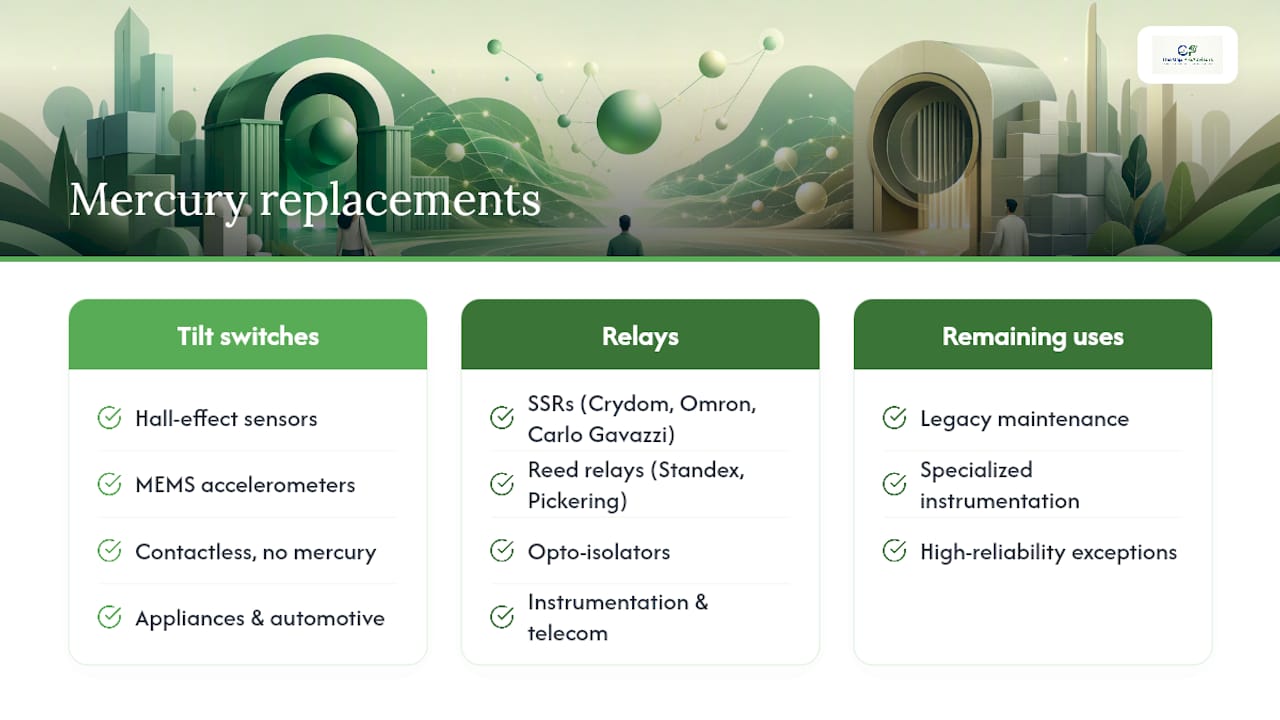
Hall-effect sensors detect magnetic field changes with no moving parts and no hazardous materials, making them the standard replacement for mercury tilt switches in appliances and automotive applications. MEMS accelerometers (found in every smartphone) provide tilt and orientation data digitally, with resolution and reliability that mercury tilt switches cannot approach.
For relay functions, SSRs from manufacturers such as Crydom, Omron, and Carlo Gavazzi cover the vast majority of applications where mercury-wetted contacts were once specified. Reed relays from Standex-Meder and Pickering Interfaces serve instrumentation and telecom switching where low bounce and compact size matter. Opto-isolators handle signal isolation in low-current logic circuits without any mechanical element.
The transition away from mercury in electronics is largely complete for new designs. The remaining use cases are legacy maintenance, specialized instrumentation, and a small number of high-reliability applications where no solid-state equivalent has yet matched the mercury contact's specific combination of bounce suppression and contact resistance stability.
This article covers general information about banking platforms and electronic components. Confirm current regulatory requirements, FDIC coverage terms, and product specifications directly with the relevant institutions and manufacturers before making decisions.
The setup I'd recommend for most small-business clients
Most small-business owners do not need to choose between Mercury and Relay. They need both, set up correctly.
My default recommendation: open Mercury first and connect it to Stripe, QuickBooks, or Xero on day one. That integration alone saves hours of monthly reconciliation. Then open Relay and configure three accounts: operating expenses, tax reserve, and owner pay. Set a weekly automatic transfer from Mercury to Relay at whatever percentages your accountant recommends, whether that is the Profit First ratios or something custom to your margin structure.
What people underestimate is the bookkeeping overhead of running two platforms. You need clean naming conventions, a reconciliation routine, and ideally a bookkeeper who can access both accounts without sharing your login. Relay's free bookkeeper access solves the second problem. A remote bookkeeping service solves the first.
The caution I give every client: do not open multiple accounts and then ignore them. A Relay account with stale allocations and an unreconciled Mercury feed is worse than one clean account. The architecture only works if someone is watching the numbers monthly. If payroll is flowing through one of these accounts, that reconciliation becomes non-negotiable, not optional.
Useful sources and further reading
| Source | What it covers |
|---|---|
| Relay vs Mercury (2026) — Relay Blog | Platform positioning, FDIC coverage details, and Relay's own comparison |
| Mercury vs Relay — SoloFinanceStack | Solo-operator focus, wire policy, integration depth, and regulatory partner notes |
| Mercury vs Relay — Ecommerce Paradise | Ecommerce and DTC operator profiles, revenue-model framing |
| Relay vs Mercury for Delaware LLC — DelawareLLC.com | Sub-account architecture, routing number details, hybrid setup guidance |
For help wiring your bank account structure into clean bookkeeping and tax preparation workflows, Mygappro works with small businesses across the U.S. remotely.
FAQ
Is Mercury or Relay better for a startup?
Mercury is the stronger fit for startups. Its Treasury sweep product earns yield on large post-raise balances, and native Stripe, QuickBooks, and Xero integrations keep financial data clean from day one.
Can you use Mercury and Relay at the same time?
Yes, and many operators do. Route receipts and integrations to Mercury, then transfer a set percentage weekly to Relay for tax reserves and owner pay buckets.
Does Mercury or Relay offer more FDIC coverage?
Mercury advertises up to $5M in FDIC coverage via its sweep network; Relay advertises up to $3M through its program bank arrangement.
Are mercury switches still legal in the U.S.?
Mercury switches in new consumer products and vehicles are banned or restricted in many states, and the EPA requires certified hazardous waste disposal for mercury-containing components. New designs should use Hall-effect sensors or solid-state relays instead.
What is the main difference between a mercury relay and a solid-state relay?
A mercury relay uses liquid metal to bridge contacts with near-zero bounce; a solid-state relay uses semiconductor switching with no moving parts, faster response, and no hazardous materials, making it the standard choice for new designs.