
TL;DR:
- Ramp is better suited for U.S. small businesses using QuickBooks or Xero due to its bi-directional sync and lower eligibility requirements. Brex may be preferable for internationally active or venture-backed teams, but its post-acquisition uncertainties and forward-only sync pose challenges for bookkeeping accuracy. Engaging a bookkeeping partner like Mygappro can streamline migration, cleanup, and ongoing reconciliation regardless of the platform chosen.
For most U.S.-based small businesses focused on bookkeeping and financial close efficiency, Ramp is the stronger choice. SelectHub's analyst comparison places both platforms at comparable overall scores but specifically recommends Ramp for SMB automation and QuickBooks/Xero users. Brex remains a legitimate option for internationally active or NetSuite-heavy teams, but Capital One's $5.15 billion acquisition of Brex in April 2026 introduces real uncertainty around pricing, underwriting, and product velocity that small businesses should weigh carefully.
Best-for quick guide:
- Choose Ramp if you run QuickBooks Online or Xero, want automated GL coding and receipt matching, and need a platform that qualifies without venture funding.
- Choose Brex if your team has significant international spend, uses NetSuite, or already qualifies under Brex's funding/cash-balance thresholds and values tiered rewards.
- Call a bookkeeping partner like Mygappro when you need help aligning your chart of accounts, cleaning up QuickBooks before migration, or managing the ongoing reconciliation after go-live.
Table of Contents
- How do Ramp and Brex compare for bookkeeping teams?
- What does pricing actually cost a small business?
- How do the accounting integrations actually work day-to-day?
- Which platform saves the most bookkeeping time?
- Do rewards and cash management actually matter for small businesses?
- What security and compliance signals should you verify?
- How do credit limits and eligibility work?
- What API and developer tools do Ramp and Brex offer?
- How much can you customize controls and policies?
- Mygappro helps you get either platform running cleanly
- Key Takeaways
- FAQ
How do Ramp and Brex compare for bookkeeping teams?
| Dimension | Ramp | Brex |
|---|---|---|
| Best for | U.S. SMBs, QuickBooks/Xero users, cost-conscious teams | Venture-backed, internationally active, NetSuite users |
| Pricing & fees | Free core plan; paid tiers per user; no annual card fee | No annual card fee; software priced per seat |
| QuickBooks/Xero sync | Bi-directional, near-real-time | Forward-only; edits in accounting software may not sync back |
| NetSuite integration | Available | Deep native sync |
| Expense automation | AI GL coding, receipt matching, duplicate-subscription detection | Receipt capture, auto-categorization, mobile-first UX |
| Rewards & rebates | Up to 1.5% flat cashback | Category multipliers (up to 7x on select categories) |
| Cash management | Business accounts, bill pay, AP automation | Banking, treasury sweep, bill pay (ACH, check, wire) |
| Limits & eligibility | ~$25K cash balance threshold; EIN required; no personal guarantee | $50K+ cash balance or VC funding; EIN required; no personal guarantee |
| Security & compliance | SOC 2 certified | SOC 2 certified |
| Support & onboarding | In-app chat, email, dedicated reps at higher tiers | In-app chat, email; post-acquisition roadmap uncertain |

For bookkeeping teams, the single deciding factor is integration fidelity. Ramp's bi-directional QuickBooks/Xero sync means edits flow both ways, which cuts reconciliation exceptions at month-end. Brex's forward-only sync can leave your accounting software as the source of truth in one direction only, creating manual cleanup when transactions are edited or recoded.
Sync direction glossary:
- Bi-directional sync: changes made in either the spend platform or the accounting software update both systems.
- Forward-only sync: transactions push from the card platform into the accounting software, but edits made in QuickBooks or Xero do not automatically update the card platform record.
What does pricing actually cost a small business?
Ramp's core plan is free for the card and basic expense management. Paid tiers add features like advanced controls and dedicated support, priced per user per month. Brex charges no annual card fee but prices its software platform per seat as well.
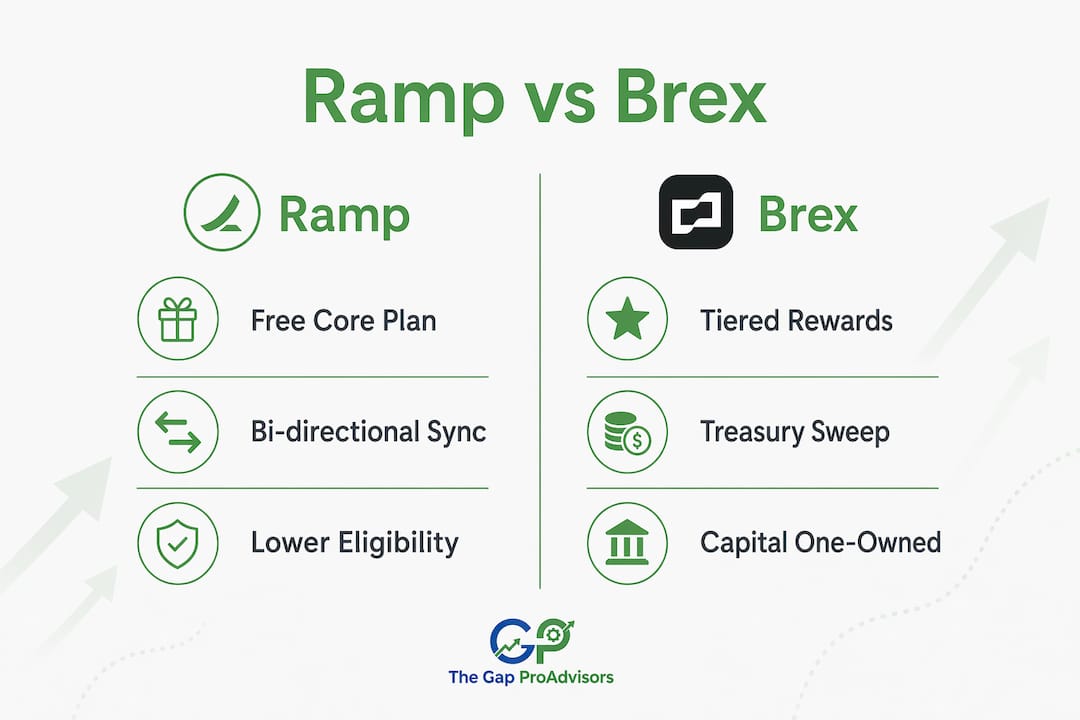
Eligibility is where the two platforms diverge most sharply for small businesses. Ramp generally requires a moderate cash balance in a business bank account, while Brex traditionally requires a higher cash balance or evidence of venture or angel funding. Both platforms require an EIN and a registered business entity. Sole proprietors are generally excluded from both, and underwriting is based on business cash balance and revenue rather than the owner's personal credit.
Hidden costs worth budgeting:
- Foreign transaction fees (Brex charges none; confirm Ramp's current policy for your use case)
- Bill-pay fees for ACH or check disbursements
- Card issuance fees for physical cards at scale
- Setup or onboarding fees if you engage a bookkeeping partner for migration
Pro Tip: Before signing with either platform, ask sales directly: "What is your per-user price at our current headcount, and is that rate locked for 12 months?" Post-acquisition, Brex's pricing structure may shift as Capital One integrates the platform, so get any commitment in writing.
How do the accounting integrations actually work day-to-day?
The integration difference between Ramp and Brex is the most consequential factor for anyone running a monthly close. Ramp offers real-time bi-directional sync with QuickBooks Online, meaning a recode in QuickBooks flows back to Ramp. Brex's sync is near-real-time but forward-only, and edits made in your accounting software for older transactions may not sync back.
Integration behaviors to validate in a trial:
- Push a live transaction through and confirm it appears in QuickBooks within your expected latency window.
- Edit the GL code on a synced transaction in QuickBooks and check whether Ramp or Brex reflects that change.
- Import a set of historical transactions and verify timestamps match the original transaction date, not the import date.
- Attempt a closed-period edit and document whether the platform blocks it or allows an override.
- Attach a receipt in the platform and confirm the attachment appears on the corresponding QuickBooks transaction.
| Platform | Sync direction | Typical latency | Known limitation |
|---|---|---|---|
| Ramp | Bi-directional | Near-real-time | Occasional delay on high-volume days |
| Brex | Forward-only | Near-real-time | Edits in accounting software may not sync back for older transactions |
Run a 14–30 day parallel close: push two weeks of live transactions through the new platform, log reconciliation time, and count exceptions. Compare that baseline to your current process before committing.
Pro Tip: Ask your sales rep to grant bookkeeper-level access during the trial. Many integration friction points only surface when someone other than the admin is doing the daily coding and reconciliation work.
Which platform saves the most bookkeeping time?
Ramp's automation is built around reducing the close cycle: AI-powered GL coding, memo generation, receipt matching, and duplicate-subscription detection. Brex matches on receipt capture and auto-categorization with a polished mobile-first interface, but its automation is less focused on cost-savings intelligence.
Ramp automation highlights:
- AI GL coding with memo generation reduces manual entry per transaction
- Duplicate-subscription detection flags recurring charges that inflate spend
- Potential savings of up to 5% through vendor insights and automated negotiation prompts
- Pre-transaction card controls block out-of-policy spend before it posts
Brex automation highlights:
- Receipt capture with auto-categorization and a clean mobile UX
- Approval workflows configurable by department or spend category
- Post-transaction alerting for out-of-policy charges
The most time-consuming bookkeeping step is not data entry — it is chasing cardholders for receipts and correcting miscoded transactions at month-end. A platform that captures receipts at the point of purchase and auto-codes to the right GL account removes both problems before they reach the bookkeeper's desk.
Pro Tip: Set card-level merchant category controls on Ramp to block categories your team never uses (e.g., entertainment for a fully remote team). Fewer out-of-policy transactions means fewer month-end corrections, not just fewer policy violations.
Do rewards and cash management actually matter for small businesses?
For most small businesses, the honest answer is: rewards matter less than you think, and cash management matters more. Ramp offers flat cashback with rates that vary by customer, which is predictable and easy to reconcile. Brex's category multipliers can be significantly higher on select categories like rideshare, but those rewards are points-based, not cash, and their value depends on how you redeem them.
- Ramp: flat cashback up to 1.5% posts as a credit, simple to record in QuickBooks as a contra-expense.
- Brex: points multipliers reward concentrated spend; splitting spend across cards reduces effective rewards and adds reconciliation complexity.
On cash management, Brex offers a treasury sweep that moves idle balances into yield-bearing accounts, plus bill pay over ACH, check, and wire. Ramp provides business accounts and bill pay with AP automation. Both handle the core payment rails a small business needs.
Pro Tip: If your monthly card spend is under $20,000, the difference between 1.5% flat cashback and a tiered points program is unlikely to exceed a few hundred dollars annually. Prioritize the platform with the cleaner accounting sync over the one with the higher headline reward rate.
What security and compliance signals should you verify?
Both Ramp and Brex hold SOC 2 certifications, which is the baseline your bookkeeper or CPA will ask about. Before signing, request written confirmation of:
- SOC 2 Type II report (not just Type I)
- Encryption at rest and in transit
- Data residency (U.S.-based servers for most small businesses)
- Audit log access for your bookkeeper or accountant
On underwriting and limits, Ramp's cash-balance threshold is lower, making it more accessible for early-stage businesses. Brex's higher threshold and post-acquisition underwriting shift may mean more conservative credit limits as Capital One integrates its risk framework. Acquisitions typically slow product velocity and tighten underwriting in the 12–24 months after closing.
Questions to ask Brex sales specifically:
- What pricing and feature commitments can you put in writing for the next 12 months?
- Has the underwriting model changed since the Capital One acquisition closed?
- Who is my escalation contact if my account manager changes during integration?
Your bookkeeping provider will also need: your EIN, entity formation documents, proof of business bank balance, and a current chart of accounts before onboarding either platform.
How do credit limits and eligibility work?
Ramp sets credit limits based on business cash balance and revenue, with a general starting threshold around $25,000 in business bank deposits. Limits scale as your balance and revenue grow, with no personal guarantee required. Brex requires at least $50,000 in a business bank account for companies without venture or angel funding, and historically offers 10–20x higher limits than traditional corporate cards by underwriting against the business rather than the founder's personal credit.
Neither platform serves sole proprietors. Both require a registered entity (LLC, corporation, or equivalent) and an EIN. If your business is pre-revenue or very early-stage, Ramp's lower cash threshold makes it the more accessible starting point.
What API and developer tools do Ramp and Brex offer?
Both platforms publish REST APIs that let developers pull transaction data, push GL codes, and trigger approval workflows programmatically. Ramp's API is well-documented and commonly used by bookkeeping firms to automate transaction exports into QuickBooks or custom reporting tools. Brex also offers a developer API with webhook support for real-time event notifications, which is useful for teams building custom approval or alerting logic.
For a small business without an in-house developer, the API is less relevant day-to-day. Where it matters is when your bookkeeping partner wants to automate a nightly sync or build a custom reconciliation report. Confirm with your bookkeeper which platform's API their workflow already supports before choosing.
How much can you customize controls and policies?
Ramp lets you set card-level controls by merchant category, vendor, and spend amount, and configure multi-step approval workflows by department or employee. Policy rules can block transactions before they post, which is the more bookkeeper-friendly model. Brex offers similar configurability with department-level budgets, approval chains, and category restrictions, with a reputation for a cleaner setup UI.
The practical difference: Ramp's pre-transaction blocking reduces out-of-policy spend before it reaches the ledger. Brex's post-transaction alerting catches violations after the fact, which means more corrections at month-end. For a small business running a tight close cycle, pre-transaction controls save real time.
Mygappro helps you get either platform running cleanly
Choosing the right platform is only half the work. Getting your chart of accounts aligned, your QuickBooks history cleaned up, and your receipt ingestion configured correctly is where most small businesses lose time after go-live.
Mygappro's small business accounting services cover exactly that: QuickBooks cleanup and chart-of-accounts alignment before you migrate, receipt ingestion setup, ongoing monthly reconciliation, and bookkeeper training on whichever platform you choose. If your QuickBooks file has months of uncategorized transactions or mismatched accounts, a QuickBooks cleanup before you connect Ramp or Brex prevents those errors from compounding in your new system. Mygappro also handles payroll, tax preparation, and 1099 compliance, so your entire financial close runs through one trusted partner. Schedule a free QuickBooks health check at mygappro.com/qbo-health-check to see exactly where your books stand before you commit to either platform.
Key Takeaways
For most U.S. small businesses, Ramp's bi-directional QuickBooks sync and lower eligibility threshold make it the more practical bookkeeping choice in 2026.
| Point | Details |
|---|---|
| Ramp wins for SMB bookkeeping | Bi-directional QuickBooks/Xero sync and AI GL coding reduce month-end reconciliation time. |
| Brex suits funded or global teams | NetSuite depth and tiered rewards favor venture-backed or internationally active companies. |
| Capital One acquisition risk | Brex's April 2026 acquisition may slow product velocity and tighten underwriting for 12–24 months. |
| Eligibility thresholds differ | Ramp requires ~$25K in business deposits; Brex requires $50K+ or VC funding; sole proprietors are excluded from both. |
| Mygappro accelerates go-live | QuickBooks cleanup, chart-of-accounts alignment, and ongoing reconciliation support reduce post-migration surprises. |
FAQ
Which is better for QuickBooks users, Ramp or Brex?
Ramp is the stronger fit for QuickBooks Online users because it offers bi-directional, near-real-time sync, while Brex's sync is forward-only and edits made in QuickBooks may not update Brex records for older transactions.
Does Brex's Capital One acquisition affect small businesses?
Yes. Acquisitions typically bring more conservative underwriting and slower feature rollouts in the 12–24 months after closing, so small businesses evaluating Brex should request written pricing and roadmap commitments before signing.
Can a sole proprietor qualify for Ramp or Brex?
Neither platform generally accepts sole proprietors. Both require a registered business entity such as an LLC or corporation, an EIN, and a minimum business bank balance.
How do Ramp's rewards compare to Brex's?
Ramp offers flat cashback up to 1.5%, which is simple to reconcile. Brex uses category point multipliers that can reach 7x on select spend but require concentrated spending in specific categories to maximize value.
When should a small business use a bookkeeping partner instead of self-managing?
If your QuickBooks file needs cleanup before migration, or if you lack time to manage monthly reconciliation after go-live, a remote bookkeeping service like Mygappro handles chart-of-accounts alignment, ongoing reconciliation, and compliance so you can focus on running your business.