
TL;DR:
- TaxJar is ideal for small ecommerce sellers seeking quick, affordable US sales tax management. Avalara suits larger, complex operations with extensive B2B and exemption certificate needs. If exceeding basic requirements, a managed service like Mygappro can provide compliance and audit support.
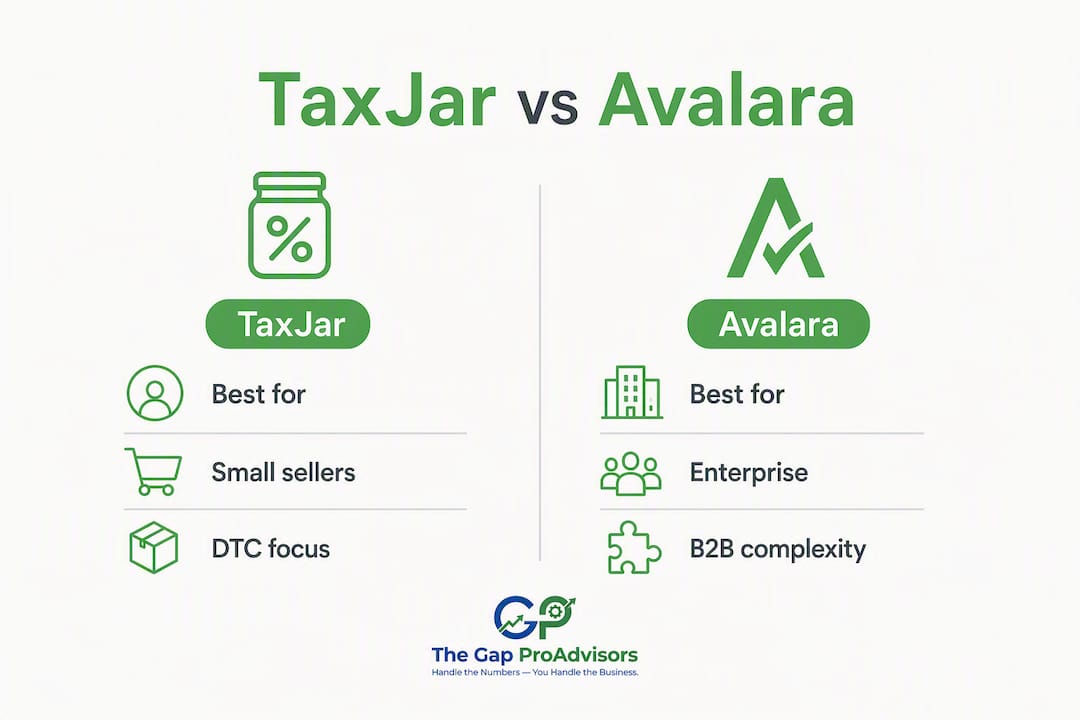
For most small U.S. ecommerce sellers, TaxJar is the smarter starting point. It's faster to set up, more affordable, and built for the Shopify-and-marketplaces world most DTC sellers live in. Avalara earns its place when your business carries meaningful B2B/wholesale revenue, operates across 20+ nexus states, or needs audit-grade reporting ahead of a raise or sale. The deciding factors aren't transaction volume alone — they're your tech stack, your exemption-certificate load, and how much compliance risk you can afford to carry yourself.
Quick scenario picks:
- Shopify or Amazon seller with moderate revenue: TaxJar with AutoFile. Typical annual costs are roughly $1,000–$5,000/year for sellers in the $2M–$5M revenue band.
- Growing brand with B2B wholesale and resale certificates: Avalara with CertCapture. When managing large numbers of active certificates, a managed repository becomes necessary to reduce audit risk.
- High-growth firm preparing for PE diligence or a sale: Avalara. Audit-grade reporting and certificate management reduce diligence friction and potential escrow holdbacks.
- Prefer a hands-off solution entirely: Mygappro's remote bookkeeping and tax services handle sales-tax workflows without requiring you to configure or maintain software yourself.
Most U.S. states enforce economic nexus thresholds based on sales or transaction volume, with some states setting higher thresholds. Knowing where you stand against those thresholds is the first step before choosing any platform.
Table of Contents
- How does TaxJar vs Avalara actually compare?
- How accurate are TaxJar and Avalara at calculating tax rates?
- How each platform handles compliance changes and legislative updates
- What real users say about each platform
- Which platform scales better as your business grows?
- How each platform protects your data
- When a managed service makes more sense than software
- Key Takeaways
- FAQ
How does TaxJar vs Avalara actually compare?
| TaxJar | TaxJar AutoFile | Avalara | Avalara CertCapture | |
|---|---|---|---|---|
| Best for | DTC/marketplace sellers under ~$5M | Sellers wanting automated state filings | B2B, multi-state, ERP-connected, exit-ready | Firms with 30+ exempt customers |
| Pricing model | — | $50–55/filing (add-on, per state) | Custom quote; usage-based annual tiers | Bundled with Avalara enterprise plans |
| Feature scope | Calculation, nexus tracking, reporting | Automated return filing in covered states | Calculation, returns, nexus, exemptions, VAT/GST | Certificate collection, storage, expiration tracking |
| Exemption certificates | Flag exempt customers; no full repository | N/A | Full CertCapture system | Centralized repository with audit trails |
| Audit-grade reporting | Standard | Standard | Deep, diligence-ready | Certificate audit trail |
| International VAT/GST | Limited (U.S./Canada primary) | U.S. only | Broad (U.S., Canada, Europe, and beyond) | N/A |
| Integrations | Shopify, Amazon, Stripe, QuickBooks | Tied to TaxJar platform | NetSuite, SAP, Acumatica, Shopify, and more | Avalara ecosystem |
| Setup timeline | Days to weeks (self-serve) | Immediate with TaxJar | Weeks to months; often needs integrator | Configured with Avalara implementation |
| Support | Online; phone on Professional plan | Via TaxJar | Custom; offshore support reported | Via Avalara account team |

Pricing reality: For small businesses under $5M, enterprise platforms can cost 5x–10x more than lighter tools, with much of that spend going to features that never get used. Avalara's modular structure (AvaTax, Returns, CertCapture) means costs compound quickly, and setup often requires a paid integrator.
Exemption certificates: TaxJar lets you flag exempt customers but doesn't manage certificate collection or expiration tracking. Avalara CertCapture handles the full lifecycle: collecting, storing, and tracking certificates with expiration alerts and a full audit trail. If you sell wholesale and your certificate backlog is growing, CertCapture isn't optional.
International support: Avalara covers VAT/GST across multiple countries including the U.S., Canada, and Europe. TaxJar's AutoFile is U.S.-only; international filings fall to you.
ERP-connected businesses running NetSuite, SAP, or Acumatica need GL-level connectors for accurate tax posting. Shopify and Stripe connectors aren't a substitute where wholesale and B2B matter.
Pro Tip: Don't let enterprise features tempt you if your stack is Shopify plus two marketplaces. The tech-stack complexity and nexus footprint are the real selection drivers — not the feature list on a vendor's homepage.
How accurate are TaxJar and Avalara at calculating tax rates?
Both platforms update tax rates continuously, but they approach accuracy differently. TaxJar pulls rate data at the transaction level and applies it against your nexus profile, which works well for standard product categories sold through integrated channels. Its economic nexus dashboard is useful but, as some users note, doesn't account for every nuance that affects threshold calculations.
Avalara's AvaTax engine is built for complex, multi-jurisdiction environments where product taxability rules vary by state, county, and even city. It handles product-level tax codes, exemption logic, and jurisdiction-specific rules at a depth TaxJar doesn't match. For a seller with a single product category on Shopify, that depth is overkill. For a distributor selling across 30 states with mixed taxable and exempt SKUs, it's the difference between accurate filings and audit exposure.
How each platform handles compliance changes and legislative updates
Tax law changes constantly. After South Dakota v. Wayfair (2018) established economic nexus, states moved quickly to set their own thresholds and rules. Both platforms push rate and rule updates automatically, so you're not manually tracking every state legislature.
TaxJar updates its rate tables and nexus thresholds on a rolling basis. Since Stripe acquired TaxJar in 2021, some users have reported slower product development and outsourced support, which raises questions about how quickly edge-case rule changes get addressed. Avalara, as a larger compliance operation, maintains a dedicated tax research team that monitors legislative changes across all U.S. states and international jurisdictions. That team depth matters when a state changes its product taxability rules mid-year or introduces a new exemption category.
Neither platform, however, replaces year-round tax planning. Software automates calculation and filing but carries no legal liability and offers no strategic guidance on entity structure, exit planning, or back-tax exposure.
What real users say about each platform
TaxJar users consistently praise its ease of setup and clean integrations with Shopify and Amazon. The self-serve model works well for sellers who want to connect, configure, and move on. The friction shows up in support: since the Stripe acquisition, customers report outsourced offshore support, slower response times, and AutoFile fees that nearly doubled in early 2026, rising from $30–35 to $50–55 per filing.
Avalara users in B2B and wholesale environments value CertCapture and the depth of its reporting. The common complaint is cost unpredictability: modular pricing means the bill grows as you add products, and implementation projects regularly run longer and cost more than initial estimates. For mid-market ecommerce sellers without complex needs, Avalara is widely described as overbuilt and expensive.
Which platform scales better as your business grows?
TaxJar fits cleanly from startup through roughly $5M in revenue for DTC and marketplace sellers. Past that point, or when B2B wholesale becomes a meaningful revenue line, its limitations in certificate management and ERP integration start to create real compliance gaps.
Avalara is built to scale with companies across multiple entities, international markets, and complex product catalogs, supporting growth over several revenue milestones. It's the platform of choice for companies that expect PE diligence within 12–18 months, because audit-grade reporting and a clean certificate repository directly reduce diligence friction. Industry analysts recommend choosing based on your current nexus footprint and tech stack, not your aspirational size.
How each platform protects your data
Both TaxJar and Avalara operate as cloud-based SaaS platforms and maintain standard enterprise security practices. Avalara publishes SOC 2 compliance documentation and maintains security certifications appropriate for enterprise customers handling sensitive financial data across multiple jurisdictions. TaxJar, operating within Stripe's infrastructure since the 2021 acquisition, benefits from Stripe's security posture, which includes SOC 2 Type II certification and PCI DSS compliance for payment-adjacent data. For most small businesses, either platform's security posture is sufficient. If your business is subject to specific regulatory requirements (healthcare, financial services), verify each vendor's current certifications directly before committing.
When a managed service makes more sense than software
Software handles calculation and filing. It doesn't handle the judgment calls: whether a product is taxable in a given state, how to clean up a certificate backlog from three years of unmanaged exemptions, or what your back-tax exposure looks like before a sale.

Mygappro's remote bookkeeping and tax services are built for small business owners who want accurate, compliant financials without configuring and maintaining software themselves. If you're switching platforms, cleaning up prior-year books, or facing audit exposure, a managed service removes the risk of getting the setup wrong. Before a consult, pull together your sales by channel, your current state registrations, any exemption certificates on file, and your most recent returns. Mygappro's tax preparation services are a practical starting point if you have back-tax exposure or need a clean set of books before migrating to any new platform. Schedule a free consultation at mygappro.com/services.
This article is general information, not professional tax or legal advice. Confirm your specific compliance obligations with a qualified tax professional or your state's revenue authority.
Key Takeaways
TaxJar is the right starting point for most small ecommerce sellers; Avalara earns its cost only when B2B complexity, heavy certificate volume, or exit-readiness requirements make enterprise-grade compliance necessary.
| Point | Details |
|---|---|
| TaxJar fits most small sellers | Typical all-in cost of $1,000–$5,000/year suits DTC sellers under ~$5M on Shopify or marketplaces. |
| Avalara for complex compliance | Best when you have 20+ nexus states, meaningful B2B wholesale, or PE diligence expected within 12–18 months. |
| CertCapture is a real differentiator | Past ~30–40 active resale certificates, a managed repository like CertCapture becomes necessary to avoid audit risk. |
| Enterprise cost can be excessive | For small businesses, enterprise platforms can cost 5x–10x more than lighter tools, with much of that spend unused. |
| Mygappro as managed alternative | Mygappro's remote bookkeeping and tax services handle sales-tax workflows without requiring you to configure software yourself. |
FAQ
Which is better for a small Shopify seller: TaxJar or Avalara?
TaxJar is the better fit. Its plug-and-play Shopify integration, self-serve setup, and AutoFile service cover the needs of most DTC sellers at a fraction of Avalara's cost.
When should I switch from TaxJar to Avalara?
Consider switching when your B2B/wholesale revenue grows, you cross into 20+ nexus states, or you need audit-grade reporting and full exemption-certificate management ahead of a raise or sale.
Does TaxJar AutoFile cover all states?
TaxJar AutoFile covers a range of U.S. states on standard filing schedules, but it is not available in every state and does not support international filings.
What is Avalara CertCapture and do I need it?
CertCapture is Avalara's exemption-certificate management system. If you have more than 30–40 active resale or exemption certificates with expiration dates, it becomes functionally necessary to avoid audit exposure.
Can software replace a tax professional?
No. Sales tax software automates calculation and filing but carries no legal liability and provides no strategic planning. A qualified tax professional or managed service like Mygappro handles the judgment calls software cannot.