
Most U.S. small businesses pay a typical monthly fee for full-service payroll covering a small team of employees, according to 2026 pricing data. That cost estimate assumes a base fee plus a per-employee charge and includes tax filings and direct deposit. Smaller teams or fewer add-ons generally cost less, but multi-state payroll, benefits administration, or more frequent pay runs increase the bill.
The one-line verdict: if you have fewer than 10 employees and a single-state operation, a DIY payroll platform is often the most affordable path. Once you cross 15 or more employees, or operate in multiple states, a full-service payroll provider or a firm like The Gap ProAdvisors typically saves more in compliance risk and staff time than it costs.
The three levers that move your bill the most:
- Base fee: the flat monthly charge every vendor applies, typically $20–$200+
- Per-employee fee (PEPM): charged per active employee per month, typically $2–$20
- Payroll frequency: weekly runs cost more than biweekly or monthly runs with many vendors
Table of Contents
- How do payroll vendors charge you?
- What does a typical monthly payroll bill actually look like?
- What drives your payroll costs up or down?
- How to estimate your payroll bill before you call a vendor
- How to choose a payroll provider without getting burned
- What are your alternatives to a full-service payroll provider?
- What The Gap ProAdvisors sees with real U.S. small-business clients
- Key Takeaways
- The real cost of getting payroll wrong
- Mygappro handles payroll so you can focus on your business
- Useful sources for further research
- FAQ
How do payroll vendors charge you?
The most common pricing structure is a monthly base fee plus a PEPM charge. You pay the base whether you run payroll once or ten times, and the PEPM scales with your headcount. Beyond that core model, vendors use a few other structures worth knowing before you compare quotes.
| Pricing model | How it works | Best for |
|---|---|---|
| Base + PEPM | Fixed monthly fee plus a per-employee charge | Most small businesses with steady headcount |
| Per-payroll-run | Charged each time you run payroll, no base fee | Very small teams with infrequent pay runs |
| Flat monthly fee | One fixed price regardless of employee count | Businesses with predictable, stable headcount |
| Percentage of payroll | A percentage of total gross wages processed | PEO or co-employment arrangements |
The base + PEPM model is the most transparent and the easiest to budget. Per-run pricing sounds cheap until you run biweekly payroll for 20 employees and realize you're paying twice a month for every person. Flat-fee plans are rare outside of very small-team tiers. Percentage-of-payroll pricing shows up most often in Professional Employer Organization (PEO) arrangements, where the vendor co-employs your staff and bundles HR, benefits, and workers' comp into one fee.
Common add-ons that raise your bill:
- Multi-state payroll processing ($8–$12+ per additional state per month)
- Year-end W-2 and 1099 printing and mailing
- Same-day or next-day direct deposit (often an upgrade fee)
- Benefits administration and open enrollment support
- Time tracking and scheduling integrations
- Off-cycle or bonus payroll runs
- New-hire reporting and onboarding tools
Add-ons can push your per-employee cost up by $1–$10 PEPM beyond the base plan, so always ask for a sample invoice before signing.
Pro Tip: Ask every vendor to define "active employee" in their contract. Some providers charge PEPM for terminated employees who still appear in the system during the final pay period. That one definition can quietly inflate your bill by 5–10% in months with turnover.
What does a typical monthly payroll bill actually look like?
The table below uses a standard $50–$60 base fee plus $5–$10 PEPM assumption, consistent with published 2026 benchmarks. Add-ons are listed separately so you can see exactly where costs grow.
| Business size | Base fee | PEPM ($7.50 avg) | Basic add-ons | Estimated monthly total |
|---|---|---|---|---|
| Small (25 employees) | $55 | $187 | $30–$60 (tax filing) | $175–$300 |
| Medium (around 100 employees) | $55–$60 | $750–$900 | $60–$150 (multi-state, benefits) | $550–$1,100 |
| Large (around 500 employees) | $60+ | $2,500–$3,000+ | $500+ (full service) | $2,500–$3,000+ |
The formula is straightforward:
Monthly cost = base fee + (PEPM × number of employees) + add-on fees
For a 25-employee business on biweekly payroll with basic tax filing included: $55 + ($7.50 × 25) + $50 = $292.50 per month.
Two factors shift these numbers significantly. First, payroll frequency: a vendor charging per run will bill you 26 times a year for biweekly payroll versus 12 for monthly, which can double the run-based portion of your cost. Second, your employee mix matters. Contractors paid via 1099 often carry separate per-contractor fees, and some vendors charge differently for hourly versus salaried workers.
What drives your payroll costs up or down?
Understanding the levers gives you real negotiating power with vendors. Here are the primary cost drivers for U.S. small businesses:
- Number of employees: every additional active employee adds a PEPM charge directly to your bill
- Payroll frequency: weekly payroll costs more than biweekly, which costs more than monthly, especially with per-run pricing
- Multi-state payroll: each additional state typically adds $8–$12 or more per month in processing and compliance fees
- Contractor vs. employee mix: 1099 contractor payments often carry separate per-contractor fees
- Benefits administration: adding health insurance, 401(k), or FSA management through your payroll vendor adds meaningful PEPM charges
- Pay methods: paper checks cost more than direct deposit; same-day ACH is usually an upgrade
- Tax services: automated federal and state tax payment and filing is often included in full-service plans but is an add-on on entry-level tiers
- Support level: phone and dedicated account manager support costs more than chat-only or self-serve
Red flags that signal hidden fees:
- Per-pay-run charges with no monthly cap
- Per-state fees buried in the contract's fine print
- Setup or onboarding fees not disclosed on the pricing page
- Charges for off-cycle runs (bonus payroll, termination checks)
- Year-end W-2 fees listed separately from the annual plan price
Pro Tip: Request a sample invoice that matches your exact payroll frequency and state mix before you commit. Pricing pages often show the base plan only. A real invoice from a vendor reveals every line item, including the ones that don't appear in the marketing materials, as Forbes Advisor notes.
How to estimate your payroll bill before you call a vendor
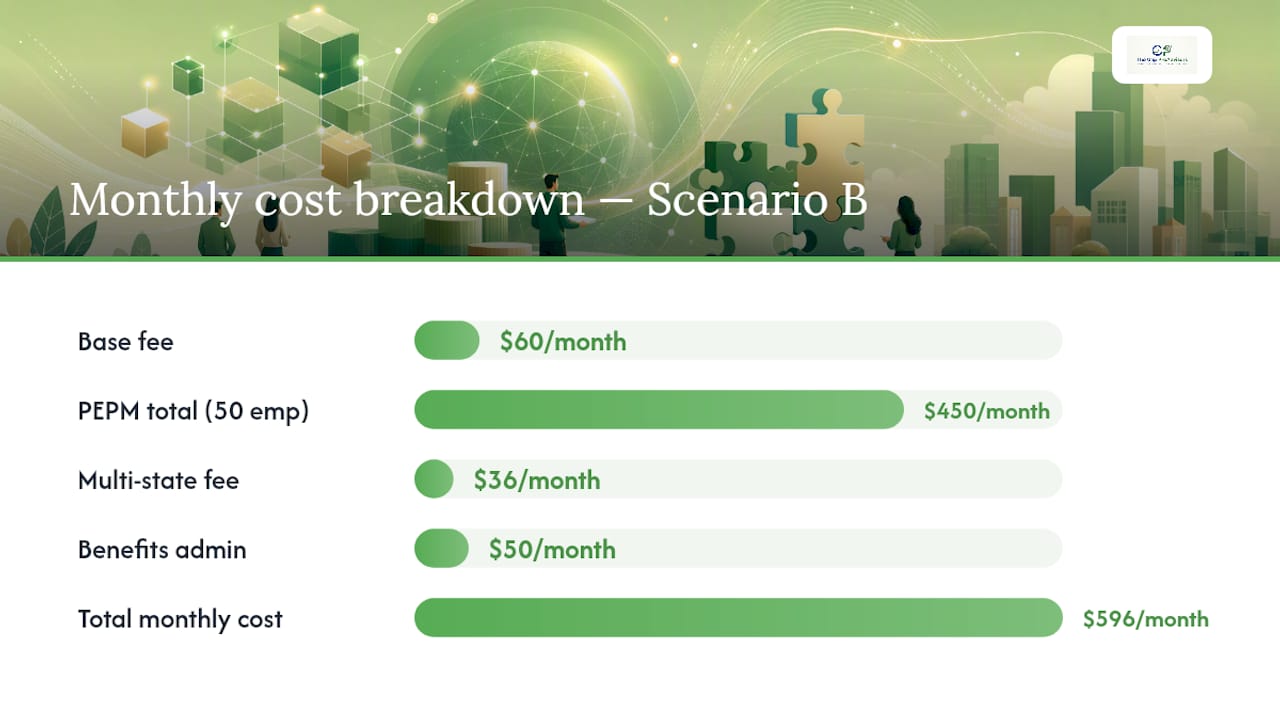
Use this formula and the steps below to build a reliable budget number before you talk to any provider.
Formula: Monthly cost = base fee + (PEPM × employees) + add-on fees
- Count your active employees by pay type (salaried, hourly, part-time, contractors).
- Identify your payroll frequency (weekly, biweekly, semimonthly, or monthly).
- List every state where you have employees on payroll.
- Note required services: tax filing, direct deposit, W-2/1099 preparation, benefits admin, time tracking.
- Plug into the formula using a conservative PEPM of $8–$10 and a base fee of $50–$60 for a full-service plan.
- Add a 15–20% buffer for add-ons you may not have identified yet.
Scenario A — 10 employees, monthly payroll, single state, basic plan: $50 base + ($8 × 10) + $20 tax filing = $150/month
Scenario B — 50 employees, weekly payroll, three states, full-service plan: $60 base + ($9 × 50) + $36 multi-state + $50 benefits admin = $596/month
Before requesting quotes, gather this checklist of inputs:
- Total employee count and breakdown by type
- States where employees work or live
- Payroll frequency preference
- Whether you need benefits administration or time tracking
- Preferred direct deposit timing (standard vs. same-day)
- Your accounting software (QuickBooks, Xero, etc.) for integration compatibility
Annual billing is worth asking about. Some vendors offer up to roughly 20% savings for annual prepayment, though that reduces your flexibility to switch providers mid-year.
How to choose a payroll provider without getting burned
Pricing transparency is the single most predictive indicator of a good vendor relationship. Some vendors publish clear starter pricing while enterprise vendors require a sales call for any quote, which slows your comparison and often signals that pricing is negotiable but opaque. Prioritize vendors who show base + PEPM rates publicly.
Vendor selection checklist:
- Does the vendor publish base fee and PEPM pricing on their website?
- Is federal and state tax payment and filing included, or is it an add-on?
- Does the plan support all states where your employees work?
- Are contractor (1099) payments included or separately priced?
- What are the onboarding and setup fees, and are they one-time or recurring?
- Does the platform integrate directly with your accounting software?
- What support channels are available (phone, chat, dedicated rep) and during what hours?
- How are off-cycle payroll runs priced?
- Are year-end W-2 and 1099 forms included in the annual fee?
- What is the contract length and cancellation policy?
Questions that reveal the most about cost and risk:
- "How do you define an active employee for billing purposes?"
- "What happens to my bill if I add a new state mid-year?"
- "Can you send me a sample invoice for my exact employee count and pay frequency?"
Walk away or renegotiate if a vendor charges per-state fees without a cap, bills inactive employees, or cannot give you a written quote within 48 hours. For deeper comparisons of specific platforms, the payroll provider comparison guides at Mygappro's blog break down feature and pricing differences across popular options.
Pro Tip: When evaluating vendor security and integration infrastructure, the same due-diligence questions you'd ask an IT provider for your small business apply here: ask about data encryption, uptime SLAs, and what happens to your payroll data if you cancel.
What are your alternatives to a full-service payroll provider?
You have four realistic options, each with a different cost profile and risk level.
- DIY payroll software: entry-level platforms can run under $50 per month for very small teams. You handle setup, compliance monitoring, and tax filings yourself or with minimal automation. Best for early-stage businesses with fewer than 10 employees, a single state, and an owner willing to spend time on compliance.
- Bookkeeper handling payroll: bookkeepers typically bill $40–$100 per hour for payroll work. For a small team with simple payroll, this can be cost-effective if the bookkeeper already manages your books. The risk is that bookkeepers vary widely in payroll compliance expertise.
- CPA for payroll processing: accountants bill $150–$400 per hour, and using a CPA for day-to-day payroll processing is rarely cost-effective. CPAs add the most value in tax planning, complex filings, and audit situations. Reserve your CPA for those tasks and use dedicated payroll software or a service for routine processing.
- Full outsourcing or PEO: a Professional Employer Organization co-employs your staff and bundles payroll, HR, benefits, and compliance into one fee, often priced as a percentage of gross payroll. This is the most expensive option per dollar but can be cost-justified for businesses in highly regulated industries, those with multi-state complexity, or those growing rapidly.
Which profile fits which option:
- Fewer than 10 employees, single state, simple pay: DIY software or a bookkeeper who already knows your books
- 15–75 employees, steady growth, multi-state emerging: a full-service payroll provider or a firm like The Gap ProAdvisors
- Complex tax situations, audit risk, or strategic planning needs: pair a payroll service with a CPA for tax work only
- Rapid growth, multi-state, regulated industry: PEO or co-employment arrangement
What The Gap ProAdvisors sees with real U.S. small-business clients
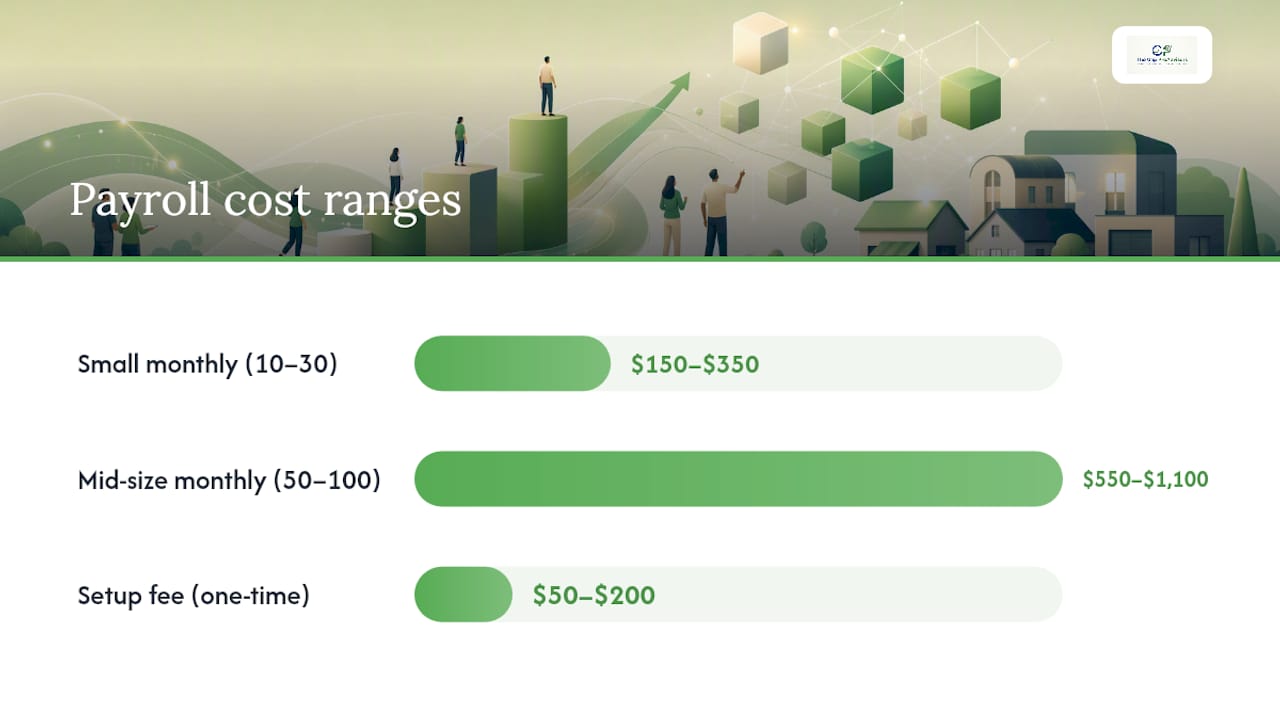
The ranges Mygappro works with across its client base align closely with the benchmarks above. Small businesses with 10–30 employees typically land in the $150–$350 per month range for full-service payroll, depending on pay frequency and state count. Mid-size clients with 50–100 employees generally see monthly totals between $550 and $1,100 once multi-state fees and benefits administration are factored in.
What those numbers include in practice:
- Federal and state payroll tax calculation, payment, and filing
- Direct deposit processing for all employees
- Year-end W-2 and 1099 preparation
- QuickBooks Online integration to reduce reconciliation time
- New-hire reporting and compliance monitoring
Onboarding typically takes one to three weeks from the initial consultation to the first live payroll run. That timeline covers gathering employee data, setting up tax accounts, configuring direct deposit, and running a parallel test payroll. One-time setup fees, when charged, generally fall in the $50–$200 range depending on complexity and the number of employees being migrated.
The biggest ongoing cost most business owners underestimate is not the PEPM fee. It's the staff hours spent fixing mismatches between payroll records and the general ledger. Tight integration between your payroll platform and your accounting software, whether that's QuickBooks Online or another system, cuts that reconciliation time significantly and reduces the accounting fees you'd otherwise pay to clean up errors. Mygappro's remote bookkeeping services are built around exactly that kind of integrated workflow.
Pro Tip: Build two budget scenarios before your first vendor call: one based on your current headcount and pay frequency, and one that assumes 30–50% growth. That second scenario reveals whether a flat-rate plan becomes cheaper than PEPM pricing as you scale, and it prevents a mid-year pricing surprise when you hire.
Key Takeaways
Most U.S. small businesses pay a typical monthly fee for full-service payroll over a small team, and the biggest cost drivers are employee count, payroll frequency, and multi-state complexity.
| Point | Details |
|---|---|
| Typical cost range | Expect $175–$300/month for 25 employees, $550–$1,100/month for 100 employees, and $2,500–$3,000+/month for 500 employees, using a $50–$60 base plus $5–$10 PEPM. |
| Add-ons raise bills fast | Multi-state fees, benefits admin, and same-day deposits can add $1–$10 PEPM beyond the base plan. |
| Use the formula | Monthly cost = base fee + (PEPM × employees) + add-ons; build two scenarios before calling vendors. |
| Prioritize transparency | Choose vendors who publish base + PEPM pricing publicly; opaque pricing usually means hidden fees. |
| Mygappro's approach | The Gap ProAdvisors offers remote full-service payroll with QuickBooks integration, covering all 50 states with no surprise fees. |
The real cost of getting payroll wrong
Most small business owners I talk with focus almost entirely on the monthly invoice when evaluating payroll providers. That's understandable. But the invoice is rarely where the real financial exposure lives.
The actual cost of a payroll mistake is the IRS penalty for a late tax deposit, the staff hours spent correcting a misclassified contractor, or the accounting fees to untangle six months of payroll entries that never synced correctly with your books. Those costs don't show up on the vendor's pricing page.
What I've seen work consistently for small businesses is treating payroll as a compliance function first and a cost center second. That shift in framing changes which questions you ask vendors, which features you prioritize, and how you evaluate the true value of a service. A provider that charges $50 more per month but files your taxes accurately and integrates cleanly with QuickBooks is almost always the better financial decision than the cheapest option that leaves reconciliation to you.
The businesses that budget payroll well are the ones that gather their inputs first (employee count, states, pay frequency, benefits needs) and then compare vendors on a like-for-like basis. The ones that struggle are the ones who pick the lowest base fee and discover the add-ons later.
Mygappro handles payroll so you can focus on your business
Running payroll accurately across multiple states, keeping up with IRS deposit schedules, and making sure your books match your payroll records every month is a real operational load. Mygappro's small business payroll services are built to carry that load for you, remotely, across all 50 states, with no long-term contracts and no surprise fees buried in the fine print.
The Gap ProAdvisors handles federal and state tax filing, direct deposit, W-2 and 1099 preparation, and QuickBooks Online integration as part of its standard payroll service. Onboarding runs one to three weeks. You bring your employee list, your current payroll records, and your state tax account details, and the team handles the rest. Whether you're in San Angelo, TX or anywhere else in the country, the process is the same: accurate, compliant, and connected to your books from day one.
Schedule a free consultation at mygappro.com to get a quote based on your exact employee count, pay frequency, and state mix.
Useful sources for further research
These references were used to build the cost ranges and benchmarks in this guide. Each one is worth bookmarking if you're actively comparing vendors.
- Payroll Services Cost: Guide for Small Businesses in 2026
- How Much Do Payroll Services Cost? (2026)
- How much do payroll services cost? - Forbes Advisor
- How much payroll services cost - Business.com
- ADP vs. QuickBooks Workforce
Use these as starting points, not final answers. Vendor pricing changes frequently. Always ask for a written quote that matches your specific payroll setup before committing to any plan.
FAQ
What is the average monthly cost of payroll services?
Most U.S. small businesses pay $175–$300 per month for full-service payroll covering around 25 employees, based on a $50–$60 base fee plus $5–$10 per employee per month. Costs rise with employee count, payroll frequency, and multi-state complexity.
How much does it cost to outsource payroll for a small business?
Outsourcing payroll typically runs about $150 to several hundred dollars per month for businesses with 10–100 employees, depending on the services included. Full-service plans covering tax filing, direct deposit, and year-end forms cost more than basic processing-only plans.
How much do payroll services charge per employee?
Per-employee fees typically range from $2–$20 per employee per month, with most full-service providers landing in the $5–$10 range. Add-ons like benefits administration or multi-state support can push that figure higher.
Is it cheaper to use payroll software or hire someone to do payroll?
DIY payroll software is usually the lowest-cost option for very small, single-state businesses, often under $100 per month. Hiring a bookkeeper ($40–$100/hour) or a CPA ($150–$400/hour) for routine payroll processing costs more but reduces your compliance risk. A dedicated payroll service like Mygappro sits between those extremes, offering professional accuracy without CPA-level hourly rates.
What questions should I ask a payroll provider before signing up?
Ask how they define an "active employee" for billing, whether tax filing is included or an add-on, what per-state fees apply, and whether off-cycle runs carry extra charges. Request a sample invoice that matches your exact payroll frequency and employee count before you commit.