
Every startup founder should separate business and personal finances on day one, move off spreadsheets into dedicated accounting software, build a Chart of Accounts sized to your stage, and run a simple weekly and monthly review cadence. Get those four right and you'll know your cash runway, stay audit ready, and avoid the scramble that catches most founders off guard before their first fundraise.
TL;DR:
- Building a scalable Chart of Accounts with around 20 to 50 accounts tailored to your funding stage prevents costly restructures during investor due diligence.
- Automated bank feeds and expense capture tools should be set up early, but complex integrations and multi-entity systems are unnecessary until transaction volume or investor demands increase.
- Monthly reconciliation and regular review of cash runway, burn rate, and key operational metrics are essential to avoid surprises before fundraising or tax season.
- Outsourcing bookkeeping becomes necessary when processing more than 75 transactions monthly, when payroll is active, or when preparing financials for a funding round.
- Maintaining clean, reconciled books with proper expense categorization and timely tax filings reduces penalties and streamlines compliance process.
Table of Contents
- What Bookkeeping for Startups Actually Covers
- Build a Chart of Accounts That Scales With You
- Practical Bookkeeping Cadence: What to Check and When
- In-House vs. Outsourced Bookkeeping: When to Make the Call
- Tools and Automation: What to Set Up Now vs. Later
- A Bookkeeper's View: Where Founders Actually Slip
- Legal and Tax Filing Deadlines Every Startup Should Track
- Basic Internal Controls to Prevent Fraud in Startup Bookkeeping
- An Editorial Take: Why Fundraising Readiness Should Drive Your Bookkeeping Priorities
- How The Gap ProAdvisors Can Help You Get This Right
- Sources
- FAQ
What Bookkeeping for Startups Actually Covers
Bookkeeping and accounting get lumped together constantly, but they aren't the same job. Bookkeeping is the daily and weekly recordkeeping: categorizing transactions, reconciling bank accounts, tracking payroll entries, and keeping your ledger current. Accounting sits a level higher. It's the analysis, tax strategy, and financial statement interpretation that turns your ledger into decisions.
Startups that treat these as one blurry task usually end up with neither done well. The bookkeeper who touches your books every week catches the coding errors and mismatched deposits before they snowball. The accountant who reviews your books quarterly (or your tax preparer once a year) can't fix six months of miscategorized expenses in an afternoon.
Here's what solid bookkeeping for startups actually delivers:
- A clean, reconciled general ledger with every transaction matched to a bank or credit card record
- Categorized expenses that map cleanly to your Chart of Accounts, not a junk drawer "miscellaneous" bucket
- Payroll records that separate wages, taxes, and contractor payments
- Monthly financial statements: profit and loss, balance sheet, and cash flow
One decision shapes almost everything downstream: cash versus accrual accounting. Cash accounting records revenue and expenses when money actually moves, which is simple and fine for a very early, low-transaction startup. Accrual accounting records revenue when it's earned and expenses when they're incurred, regardless of when cash changes hands. Once you have subscription revenue, deferred contracts, or you're raising outside capital, accrual is the standard investors and auditors expect. Startup bookkeeping best practices consistently point to accrual as the method that survives due diligence.
Entity structure (LLC, S corp, C corp) also affects how your books get set up, but that decision deserves its own conversation with a tax professional rather than a DIY guess. Get it wrong and you'll be restructuring your Chart of Accounts later, which is exactly the rebuild this article is meant to help you avoid.
Build a Chart of Accounts That Scales With You
Your Chart of Accounts, often shortened to CoA, is the master list of every category your money moves through: each bank account, expense type, revenue stream, and liability gets its own line. Skip building one properly and you'll be rebuilding your entire ledger structure the week an investor asks for a clean P&L.

Account count should track your company's stage, not your ambitions. A Chart of Accounts template designed for startups recommends roughly 20 to 30 accounts at pre-seed, 30 to 50 at seed, and 50 to 100 or more once you're past Series A and running multiple departments or product lines. Most pre-seed and seed founders do fine with a modest number of accounts total. More than that too early just adds categorization decisions nobody has time for.
A workable numbering convention keeps the structure predictable as you add accounts:
- 1000s: Assets (checking, savings, accounts receivable, prepaid expenses)
- 2000s: Liabilities (accounts payable, payroll liabilities, deferred revenue)
- 3000s: Equity (owner contributions, retained earnings)
- 4000s: Revenue (subscription revenue, service revenue, product sales)
- 5000s: Cost of goods sold (hosting and infrastructure, payment processing fees, contractor delivery costs)
- 6000s and up: Operating expenses (salaries, marketing, software subscriptions, professional fees)
If your business runs on recurring revenue, don't skip the SaaS-specific line items. A proper SaaS Chart of Accounts separates subscription revenue from deferred revenue and isolates hosting and infrastructure costs as COGS rather than burying them in general operating expenses. Miss that distinction and your gross margin calculation will be wrong, sometimes wildly so, which matters enormously the moment an investor starts modeling your unit economics.
Pro Tip: Before adding a new account, ask whether a tag or class could do the job instead. Templates built for growing companies favor tags or classes over new accounts for tracking dimensions like product line, department, or marketing campaign. It keeps your CoA lean while still giving you the granular reporting view you need.
Add accounts only when a genuinely new transaction type shows up, not because it feels more organized to split things further. A bloated CoA is almost as painful as no CoA at all. It just takes longer to notice.
Practical Bookkeeping Cadence: What to Check and When
Books don't stay accurate on their own. They need a rhythm, and the rhythm should be light enough that you (or whoever owns this task) can actually stick to it.
- Daily or as transactions happen. Capture receipts the moment you spend, whether that's a photo in your accounting app or a forwarded email receipt. Glance at your cash balance. Flag anything unusual, like a duplicate charge or an unrecognized vendor, before it gets buried under a week of other activity.
- Weekly. Review your bank feed and match transactions to your ledger. Resolve duplicates and miscategorized items while the context is still fresh in your memory. Waiting a month means you're reconstructing what a $340 charge from three weeks ago actually was.
- Monthly close. Reconcile every bank and credit card account against your ledger. Record payroll liabilities and confirm they match what you actually remitted. Adjust deferred revenue if you're on accrual accounting and have subscription contracts spanning multiple months. Then pull your three core reports: profit and loss, balance sheet, and cash flow statement, and actually read them.
That monthly review should answer three questions every founder needs answered, according to startup bookkeeping guidance: what's your cash runway, what's your net burn rate, and how is the one operational metric tied directly to your business model trending (monthly recurring revenue for SaaS, gross merchandise volume for marketplaces, active users for a freemium product). Founders who try to track every metric end up tracking none of them well. These three keep you honest without drowning you in dashboards.
In-House vs. Outsourced Bookkeeping: When to Make the Call
There's no universal right answer here. The right model depends on your transaction volume, whether you've started running payroll, and how close you are to a fundraise.
DIY bookkeeping (you, doing it yourself, in your accounting software) works fine when transaction volume is low and your finances are simple. It costs you time instead of money, and time is the scarcer resource for most early founders. An in-house hire gives you dedicated attention and someone who knows your business intimately, but it's the most expensive option relative to hours actually worked, and finding someone qualified who wants a part-time bookkeeping role at an early-stage startup isn't easy. Outsourced bookkeeping sits in between: professional expertise, lower cost than a full-time hire, and built-in scalability as your volume grows; explore pricing and packages available to find the right fit for your startup.
A few signals tell you it's time to stop doing this yourself:
- You're processing more than roughly 50 to 75 transactions a month and spending hours reconciling them
- You've started running payroll, which brings its own compliance obligations once you hire employees
- You're preparing for a fundraise and need investor-ready financials on short notice
- Your revenue model has gotten more complex (subscriptions, multiple product lines, deferred revenue)
Pro Tip: When evaluating an outsourced bookkeeping provider, ask three direct questions: How often will my books be updated and reconciled? What reports do I receive, and on what schedule? Can I see my data in real time, or only when you send a report? A provider worth hiring should give you clean, direct answers to all three without hedging.
Tools and Automation: What to Set Up Now vs. Later
Spreadsheets feel free, but they cost you accuracy the moment your transaction volume grows past a trickle. Moving to dedicated accounting software with connected bank feeds is the single highest-leverage move most early founders can make, because it automates the transaction capture that eats hours every week.
Start automating in this order:
- Receipt capture through your accounting app's mobile scanning feature
- Recurring invoices for repeat customers or subscription billers
- Bank feed reconciliation rules that auto-categorize predictable, repeat transactions
- Payroll automation once you're running regular pay cycles
Hold off on multi-entity consolidation, complex system integrations, or custom API connections until your volume or your investors actually demand it. Automating expense capture and reconciliation early cuts errors and saves hours, but added complexity before you need it just creates more surface area for something to break. Whatever you automate, keep human eyes on your monthly reconciliation and retain admin access to your own financial data. Automation should remove drudgery, not your visibility into your own numbers.
A Bookkeeper's View: Where Founders Actually Slip
We see the same pattern across new clients: months of commingled personal and business expenses, a CoA with fifteen "miscellaneous" entries, and payroll recorded as a plain expense instead of properly split between wages and liabilities. Cleaning that up has recovered real deductions clients didn't know they'd missed and cut hours off their monthly close.

Two fixes come up constantly: open a dedicated business bank account before your first transaction, and reconcile monthly, not quarterly. If your books need a real reset, our cleanup and catch-up service exists for exactly that situation.
Legal and Tax Filing Deadlines Every Startup Should Track
Bookkeeping and tax deadlines are deeply connected. Your books are what make those deadlines survivable instead of a fire drill. If your startup pays estimated taxes, the IRS requires quarterly payments using Form 1040-ES for pass-through entities, generally due in mid-April, mid-June, mid-September, and mid-January of the following year. Missing a quarter means penalties, and penalties compound if your books weren't tracking taxable income accurately in the first place.
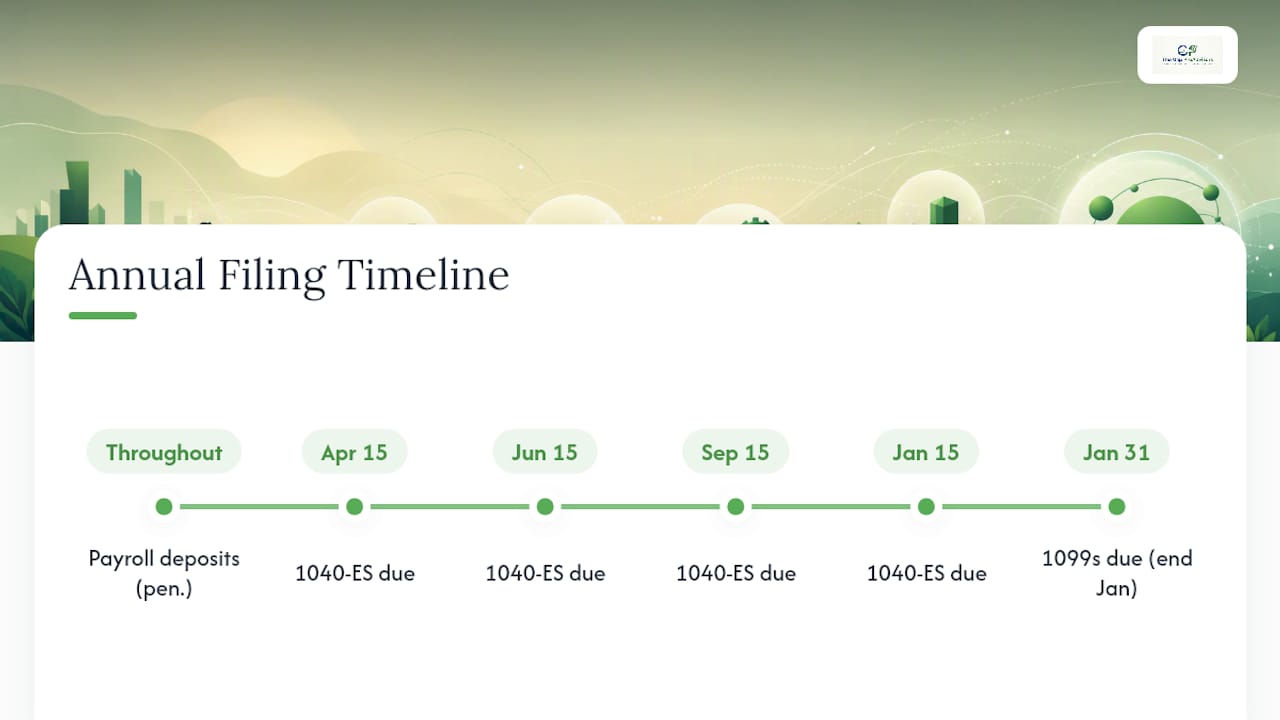
If you've paid any contractor $600 or more in a calendar year, you're on the hook for issuing a 1099 by the end of January. That deadline is unforgiving because contractors need their copy to file their own returns, and the IRS expects your copy filed on the same timeline. Clean bookkeeping throughout the year means this is a five-minute export, not a scramble through twelve months of invoices trying to remember who you paid what.
Payroll tax deposits run on their own schedule too, either monthly or semiweekly depending on your deposit liability size, and missing those triggers automatic penalties regardless of intent.
None of these deadlines are optional, and none of them are forgiving of "we'll catch up later" bookkeeping. The founders who handle tax season calmly are the ones whose books were accurate every month leading up to it, not the ones who reconstruct a year of transactions in March. Building that habit now, even informally, is worth more than any software feature you'll buy.
Basic Internal Controls to Prevent Fraud in Startup Bookkeeping
Startups feel too small and too scrappy for fraud to be a real risk. That assumption is exactly what makes early-stage companies vulnerable. Small teams mean fewer checks, and fewer checks mean a single person often controls both the money and the record of the money.
A few controls cost you almost nothing to implement and close most of the obvious gaps:
- Separate duties where you can. The person who approves an expense shouldn't be the same person who reconciles the account it came from, even if that means a cofounder does a quick second look.
- Require two approvals above a set dollar threshold. Even a simple rule like "anything over $500 needs a second signature" stops most casual misuse before it starts.
- Reconcile bank accounts monthly, without exception. Fraud and simple errors both hide in accounts that don't get reconciled regularly.
- Limit who has banking and payroll system access. Not every team member needs the ability to move money, even if they need visibility into the numbers.
- Review the vendor list periodically. A fake vendor added to divert payments is one of the oldest tricks in the book, and it only works when nobody's watching the list.
None of this requires an internal audit team. It requires a handful of habits built into your monthly close, treated as seriously as reconciling the bank feed itself.
An Editorial Take: Why Fundraising Readiness Should Drive Your Bookkeeping Priorities
Most bookkeeping advice treats every task as equally urgent. It isn't. If you're planning to raise capital in the next 12 to 18 months, your Chart of Accounts and monthly reconciliation deserve attention months before your pitch deck does, because investor diligence moves fast and messy books slow it to a crawl or kill the deal outright.
The conventional advice to "just use software and you're fine" undersells how much the setup matters. Software doesn't fix a CoA with fifteen miscellaneous accounts or a founder who's been paying business expenses from a personal card since incorporation. The tool only works as well as the structure underneath it.
Prioritize in this order: separate your accounts first, build a right-sized CoA second, then establish your monthly cadence. Everything else, including which software or which automation rule you set up first, matters far less than getting those three foundations right early.
— Angela
How The Gap ProAdvisors Can Help You Get This Right
Mygappro is the practical alternative to hiring a full-time bookkeeper before your transaction volume justifies one. Our remote bookkeeping model gives you reconciled books, categorized expenses, and monthly reports without the overhead of an in-house salary, and every client works through a secure online portal instead of chasing down a spreadsheet by email.

We handle the situations founders dread most: months of commingled books that need a proper cleanup and catch-up, ongoing remote bookkeeping with flat-rate pricing, payroll processing once you've hired your first employee, and tax preparation timed to your actual filing deadlines rather than a last-minute scramble. If your business is approaching the triggers covered earlier, growing transaction volume, your first payroll run, or a fundraise on the horizon, that's the signal it's time to talk to us.
Visit our small business bookkeeping services page to see exactly what's included, or schedule a free consultation and we'll walk through your books together before you commit to anything.
Sources
A few resources are worth bookmarking alongside this guide. Mercury's Chart of Accounts template gives you a starting structure sized to your funding stage. The SBA's guide to hiring employees covers payroll obligations before your first hire. The IRS Form 1040-ES page explains estimated tax payment mechanics directly from the source. For a broader records checklist, our small business tax checklist walks through what to organize before filing season.
- Chart of Accounts for Startups: A Simple Template | Mercury
- SaaS Chart of Accounts: Complete Template & Setup Guide (2026)
- Bookkeeping for Startups: 9 Best Practices, According to Experts - NerdWallet
FAQ
What Is the Difference Between Bookkeeping and Accounting?
Bookkeeping is the daily and weekly recordkeeping of transactions, reconciliations, and categorized expenses. Accounting is the higher-level analysis, tax strategy, and financial statement interpretation built on top of that data.
How Many Accounts Should a Startup's Chart of Accounts Have?
Pre-seed startups typically need 20 to 30 accounts, seed-stage companies around 30 to 50, and Series A and later companies often need 50 to 100 or more as departments and revenue streams multiply.
Should Startups Use Cash or Accrual Accounting?
Very early, low-transaction startups can use cash accounting for simplicity, but companies with subscription revenue, deferred contracts, or an upcoming fundraise should switch to accrual, since it's the standard investors and auditors expect.
When Should a Startup Hire a Bookkeeper or Outsource the Work?
Consider hiring or outsourcing once you're processing more than roughly 50 to 75 transactions a month, you've started running payroll, or you're preparing financials for a fundraise. Mygappro's remote bookkeeping services are built for founders hitting exactly that point.
What Financial Reports Should Founders Review Every Month?
Founders should review the profit and loss statement, balance sheet, and cash flow statement monthly, and track three key numbers: cash runway, net burn rate, and one operational KPI tied to their business model.
What Tax Deadlines Matter Most for Startup Bookkeeping?
Startups paying estimated taxes generally owe quarterly payments via Form 1040-ES, and any contractor paid $600 or more in a year requires a 1099 filed by the end of January.