
Your S corp reasonable salary is the market-rate wage you would pay an outside hire to perform the same services you provide to your business — and the IRS requires you to pay it, report it as wages, and document how you arrived at the number before you take a single dollar in distributions.
Here are the three things to do right now:
- Pick a defensible method. Choose the market approach (BLS/OES comparables), the cost/many-hats build-up (break your duties into roles and weight each by hours), or the income/independent-investor test. Ideally, run two and find the overlap.
- Pull BLS/OES data today. Go to the Bureau of Labor Statistics Occupational Employment and Wage Statistics database, search your occupation code, and download the median and 75th-percentile wage for your metro area. Save the printout with the URL and date.
- Run a roles-and-hours check, then process payroll. Log every duty you perform, estimate weekly hours per duty, map each to a market wage, and calculate an annual figure. Then run actual payroll — a memo without a paycheck does not satisfy the IRS.
Alert: Paying yourself $0 or a token wage while pulling large distributions is the single clearest audit flag the IRS looks for. Whatever number you land on, document your methodology and keep that record with your payroll files.
Key Takeaways
A defensible S corp reasonable salary is a documented, market-rate wage tied to your specific duties and BLS/OES comparables — not a percentage rule — reviewed annually and supported by payroll records, board minutes, and a written compensation memo.
| Point | Details |
|---|---|
| IRS standard | Reasonable compensation equals what a like enterprise would pay for like services under like circumstances. |
| Reclassification risk | Paying $0 or a token salary while taking large distributions is the top audit trigger; back FICA, penalties, and interest follow reclassification. |
| Best calculation method | Run both the market approach (BLS/OES data) and the cost/many-hats build-up; use the overlap as your defensible range. |
| Documentation required | Keep a compensation memo, BLS printouts with date and URL, board minutes, payroll register, W-2s, and Form 941 filings. |
| Mygappro | Mygappro prepares the compensation analysis, manages payroll and deposits, and keeps your documentation audit-ready year-round. |
Table of Contents
- What does the IRS actually mean by 'reasonable compensation' for S corp owners?
- Why getting your S corp salary wrong is an expensive mistake
- The IRS multi-factor test: what examiners actually look at
- How to calculate a defensible S corp salary step by step
- Three worked examples with real math
- The documentation and reporting checklist you need to keep
- What to do if the IRS opens an audit or proposes reclassification
- Why the documented approach beats every shortcut
- Mygappro handles the analysis, payroll, and documentation for you
- Sources
- FAQ
What does the IRS actually mean by 'reasonable compensation' for S corp owners?
The IRS does not define a specific dollar amount. Instead, IRS guidance on S corporation compensation describes the standard as what would "ordinarily be paid for like services by like enterprises under like circumstances." That phrase is the legal anchor for every salary decision you make as an S corp owner.
Who must be paid a salary? The rule covers shareholder-employees, corporate officers who perform services, and any owner who receives or is entitled to payments from the business. Per IRS guidance on S corporation employees and officers, corporate officers who perform services are treated as employees for FICA, FUTA, and withholding purposes — full stop.
The core tax distinction is straightforward. Distributions are not. That gap is exactly why the IRS scrutinizes S corp owner pay: an owner who routes all compensation as distributions avoids payroll taxes entirely, which is the scheme the reasonable-compensation rules exist to prevent.
Why getting your S corp salary wrong is an expensive mistake
The IRS has authority to reclassify distributions as wages when it determines the owner's salary was unreasonably low. When that happens, the consequences stack up fast.
What reclassification actually costs you:
- Back FICA taxes — both the employer share (7.65%) and the employee share (7.65%) on the reclassified amount, plus Medicare on amounts above the Social Security wage base.
- Failure-to-deposit penalties, which can reach 15% of the unpaid tax under IRC §6656.
- Interest on unpaid taxes from the original due date.
- Accuracy-related penalties of 20% under IRC §6662 if the IRS finds the underpayment was due to negligence or disregard of rules.
The audit red flags examiners look for:
- Zero or token salary with large S corp distributions.
- A salary-to-distribution ratio that is dramatically skewed toward distributions.
- Inconsistent or absent payroll records (no Form 941 filings, no W-2 issued to the owner).
- No documentation connecting the owner's duties to a market wage.
- Prior-year returns showing the same pattern repeatedly.
The Watson case is the most-cited example. David Watson, a CPA who owned his practice through an S corp, paid himself a modest salary while taking significantly more in distributions. The Eighth Circuit upheld the IRS reclassification, and Watson owed back payroll taxes plus penalties. The court used market data for CPA compensation in his area to set a reasonable figure — not Watson's preferred number.
The IRS multi-factor test: what examiners actually look at
IRS Fact Sheet FS-2008-25 lays out the multi-factor framework courts and IRS examiners use to evaluate whether an S corp owner's salary is reasonable. No single factor is decisive; examiners weigh all of them together. Here is each factor and the evidence that supports it.
-
Training and experience. Document your credentials, licenses, years in the field, and any specialized expertise. A CPA with 20 years of experience commands a higher market wage than a generalist bookkeeper — your resume and license records make that case.
-
Duties and responsibilities. A detailed job description listing every function you perform (sales, operations, client delivery, HR, finance) is your primary exhibit. Courts give this factor significant weight.
-
Time and effort devoted to the business. Keep a weekly hours log, even a rough one. If you work 50 hours a week across five roles, that log supports a higher salary than a vague claim of "part-time involvement."
-
Dividend history. A long history of paying distributions without corresponding wages is a negative signal. Document that distributions follow, not replace, a market salary.
-
Payments to non-owner employees. If you pay a non-owner employee $80,000 to do a subset of what you do, paying yourself $30,000 is hard to defend. Payroll records for all employees provide context.
-
Timing and manner of bonuses. Year-end bonuses paid only in profitable years can look like disguised distributions. If you pay a bonus, tie it to a compensation agreement adopted at the start of the year.
-
What comparable businesses pay. This is the factor with the most objective support. BLS/OES wage data by occupation and geography, industry salary surveys, and published compensation studies all belong in your file.
-
Compensation agreements. A written compensation agreement or board resolution adopted before the tax year begins is strong contemporaneous evidence. Board minutes documenting the rationale carry real weight in an exam.
-
Use of a formula. If your compensation is set by a documented formula (e.g., a percentage of gross revenue tied to a market benchmark), describe and record that formula. Formulas are credible when they produce market-rate results.
In practice, examiners focus most heavily on duties and responsibilities, market comparables, and time devoted to the business. Build your narrative around those three, then support the remaining factors with whatever records you have.
How to calculate a defensible S corp salary step by step
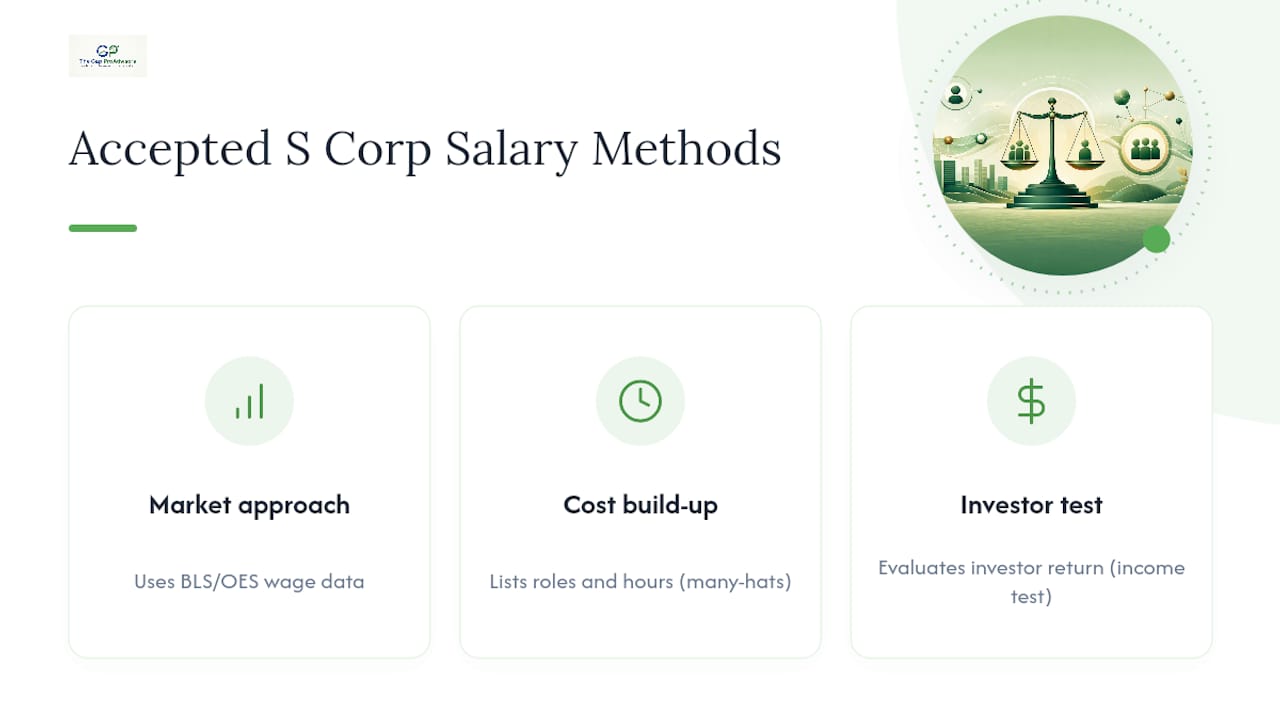
There is no single IRS-prescribed formula, but three methods are widely accepted by practitioners and courts. The strongest approach uses two of them and documents the overlap.
Method 1: The market approach
Pull BLS/OES occupational wage data for your specific occupation code and metropolitan area. Choose the median wage if your experience and business size are typical; use the 75th percentile if you have significant experience, manage a team, or operate in a high-cost market. Apply a local cost-of-labor adjustment if BLS data for your metro differs materially from the national figure.
Method 2: The cost/many-hats build-up
List every distinct role you perform — CEO, sales director, operations manager, bookkeeper, IT support. Estimate the weekly hours you spend in each role. Find the BLS median wage for each role, convert to an hourly rate, and multiply by your annual hours in that role. Sum the results. This method is especially useful for owners who wear many hats in a small business.
Method 3: The income/independent-investor test
Ask: if a passive investor owned this business and hired a professional manager to run it, what return would that investor expect on the equity invested? The salary is what remains after paying the investor a reasonable return.
A simple workflow
- List every duty you perform and estimate weekly hours per duty.
- Map each duty to an OES occupation code.
- Pull median and 75th-percentile wages for your metro area from BLS.
- Select a percentile based on your experience and the business's complexity.
- Apply a local wage adjustment if your metro data differs from the national figure.
- Run the cost build-up as a cross-check.
- Document sources (URL, date, percentile chosen) in a compensation memo.
- Adopt the salary by board resolution or written agreement before the tax year begins.
Pro Tip: Run both the market approach and the cost build-up. If they produce similar figures, you have a defensible range. If they diverge significantly, investigate why — a large gap often signals that one method is missing a major duty or using the wrong occupation code.
Three worked examples with real math
These examples use hypothetical figures to illustrate the methodology. Actual salaries depend on your specific duties, location, and market data.
Example A: Solo consulting shop (cost/many-hats method)
Maria runs a one-person IT consulting S corp. She estimates her weekly hours across three roles:
Maria sets her salary at $93,000. Her S corp nets $180,000 before her salary. After the $93,000 salary (plus roughly $14,200 in employer payroll taxes), she takes $72,800 as a distribution. If the IRS reclassified the entire $72,800 distribution as wages, she would owe an additional $11,150 in FICA taxes plus penalties and interest.

Example B: Professional services owner (market method)
James is a licensed CPA running an accounting S corp in Dallas. BLS data for his metro area shows the 75th-percentile wage for accountants and auditors that fits his experience and management role. He selects that wage level as his salary.
The Social Security wage base for 2026 is $176,100. His total payroll tax cost (employer share) is approximately $8,033. His remaining distributions are not subject to FICA.
Example C: High-profit business (independent-investor test)
Sarah's S corp generates $500,000 in net income before her compensation. BLS data for her role as a marketing director suggests a market salary of $130,000. Under the independent-investor test, she asks: would a passive investor in a business of this size and risk profile accept a return on equity after paying a $130,000 salary? The answer is yes — the remaining $370,000 represents a strong investor return. She sets her salary at $130,000 and documents the investor-return analysis in her compensation memo.
Setting a salary above the wage base increases your marginal payroll-tax cost per dollar of salary, which is a legitimate cash-flow consideration — but it does not change the IRS's reasonable-compensation standard.
The documentation and reporting checklist you need to keep
Good documentation does two things: it supports your salary number if the IRS asks, and it creates the paper trail that can reduce or eliminate penalties even if reclassification occurs. Here is what to maintain.
Documentation file:
- Roles-and-hours log (weekly, updated throughout the year).
- BLS/OES printouts with URL, date accessed, occupation code, and percentile selected.
- Written compensation memo explaining your methodology and the factors you considered.
- Board minutes or shareholder resolution adopting the salary before the tax year begins.
- Copies of any industry salary surveys used.
Payroll records:
- Payroll register showing each pay period, gross wages, withholdings, and net pay.
- Form W-2 issued to yourself at year-end, matching wages reported on Form 1120-S.
- Form 941 (Employer's Quarterly Federal Tax Return) filed each quarter, showing wages paid and taxes deposited.
- Federal tax deposit receipts (EFTPS confirmations) for each deposit period.
- Form 940 (annual FUTA return) if applicable.
Tax return tie-out:
- Form 1120-S reports officer compensation on Line 7; that figure must match the W-2 wages you issued to yourself.
- Schedule K-1 reflects your share of S corp income after the salary deduction.
Practical tip: Process payroll through a dedicated payroll service that generates automatic deposit confirmations and quarterly 941 filings. Ad-hoc transfers from the business account to your personal account look like distributions, not wages, and create exactly the ambiguity an IRS examiner will exploit. Regular, documented payroll runs eliminate that problem. For owners who need help setting up a deposit schedule, payroll resources and guides can provide practical templates.
They are deductible by the shareholder on the individual return as self-employed health insurance, but they must flow through payroll first; for managing employer-paid benefits and compliance, consider using a Palm Beach PEO Broker. Missing this step is a common compliance error.
What to do if the IRS opens an audit or proposes reclassification
An IRS examination of your S corp compensation is manageable when you have contemporaneous documentation. Here is the sequence to follow.
Immediate actions:
- Preserve all payroll records, compensation memos, board minutes, and BLS printouts exactly as they are. Do not alter, backdate, or reconstruct documents.
- Pull your Form 941 filings and EFTPS deposit history to confirm payroll was processed as reported.
- Locate your compensation memo and any board resolutions adopted before the tax year under examination.
How the IRS typically proceeds:
An agent will request payroll records, the corporate return (Form 1120-S), and supporting documentation for officer compensation. If the agent believes the salary is unreasonably low, they will issue a proposed adjustment reclassifying a portion of distributions as wages, along with proposed FICA taxes, failure-to-deposit penalties, and interest. You will receive a notice with a response deadline.

When to bring in a tax professional:
Get an experienced CPA or tax attorney involved immediately if the proposed reclassification exceeds $50,000, if the examination covers multiple years, or if the agent is requesting records beyond the standard payroll file. Multi-year examinations and complex independent-investor analyses are not situations to navigate alone.
Mitigation: Even when reclassification occurs, well-documented contemporaneous analysis can reduce or eliminate accuracy-related penalties. The IRS's reasonable-cause exception under IRC §6664 applies when you can show you made a good-faith effort to determine the correct amount. A compensation memo with BLS sources and a documented methodology is exactly that kind of evidence.
Pro Tip: If you receive an IRS notice proposing wage reclassification, do not respond without reviewing your documentation file first. A clear, organized response package — memo, BLS printouts, payroll register, board minutes — often resolves the issue at the examination level without escalating to appeals.
Why the documented approach beats every shortcut
It is not. The IRS has no prescribed percentage rule, and courts evaluate reasonableness based on duties and market comparables, not ratios. An owner who earns $400,000 and pays herself $60,000 because "60/40 is the rule" is exposed to exactly the same reclassification risk as someone who pays $0.
The same logic applies to the 70/30 rule and any other percentage heuristic you may have read about. These rules circulate because they are simple, not because they are defensible. A practitioner who builds a salary on a percentage without tying it to market data is giving you a number that cannot survive scrutiny.
What actually works is a documented, market-anchored salary reviewed annually. When your duties change — you hire a manager, shift from hands-on delivery to oversight, or add a new service line — your salary should be revisited. When revenue grows materially, the independent-investor test may produce a different result than it did two years ago. An annual review, documented in board minutes, keeps your position current and shows the IRS that your salary is an ongoing, good-faith determination rather than a number set once and forgotten.
For multi-owner S corps, the analysis applies separately to each shareholder-employee based on that person's specific duties, time devoted, and market comparables. Two owners with identical equity stakes but different roles should have different salaries. Paying equal salaries to unequal contributors is a red flag in the other direction — it suggests the salary was set for tax reasons rather than compensation reasons.
Mygappro handles the analysis, payroll, and documentation for you
Setting a defensible S corp salary takes more than a BLS search and a rough calculation. It takes a documented methodology, regular payroll processing, quarterly filings, and an annual review that keeps pace with your business. That is exactly what Mygappro delivers.

The Gap ProAdvisors prepares your compensation memo, pulls BLS/OES comparables for your occupation and metro area, and documents the multi-factor analysis in a format that holds up in an IRS exam. From there, Mygappro manages your payroll processing — deposits, Form 941 filings, W-2s, and the year-end reconciliation that ties your officer compensation to your Form 1120-S. You also get year-round tax planning so your salary, distributions, and overall tax position are reviewed together, not in isolation. If you ever face an IRS notice, Mygappro's team is already familiar with your records and can respond quickly.
Ready to get your salary set correctly and your payroll running on time? Schedule a consultation with The Gap ProAdvisors and get a defensible number backed by real documentation.
Sources
The following primary sources belong in your documentation package and are the references this article draws on for IRS standards, market data, and reporting requirements.
FAQ
How do you determine a reasonable salary for an S corp?
Use BLS/OES wage data for your occupation and metro area as your market benchmark, then cross-check with a cost/many-hats build-up that weights each duty by hours worked. Document both methods in a written compensation memo and adopt the salary by board resolution before the tax year begins.
What is the 70/30 rule for S corps?
The IRS evaluates reasonableness based on duties and market comparables, not ratios, so a percentage split alone will not protect you in an audit.
What is the 2% rule for S corps?
It is a reporting requirement, not a salary-setting formula.
What income level makes an S corp worth it?
The payroll-tax savings from S corp distributions typically outweigh the added compliance costs such as payroll processing, quarterly 941 filings, and a separate corporate return when net self-employment income is at a level where these savings justify the expense, though the exact breakeven depends on your salary level, state taxes, and professional fees. Mygappro can run a side-by-side comparison for your specific situation.
How often should you review your S corp salary?
Review your salary at least once a year, and immediately when your duties change materially, revenue grows significantly, or you hire employees who take over functions you previously performed yourself. Annual board minutes documenting the review are part of a complete contemporaneous record.
This article provides general information about IRS reasonable compensation rules for S corporations and is not a substitute for professional tax or legal advice. Consult a qualified tax professional or the IRS directly to confirm current rules and how they apply to your specific situation.