
How do S corps and C corps actually differ for Florida businesses?
The choice between an S corporation and a C corporation comes down to two things: how you want your profits taxed and who you plan to bring in as owners. Both structures give you limited liability protection under Florida law, but their tax treatment and ownership rules are fundamentally different.
Here is a quick summary of the core distinctions:
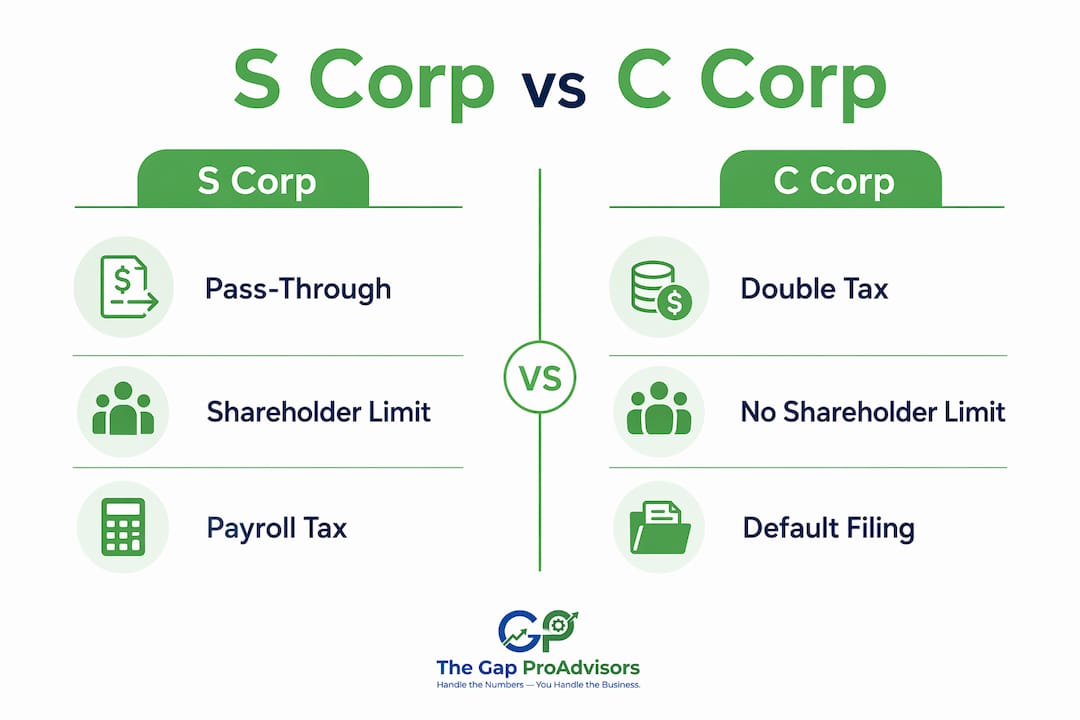
- Taxation: S corps use pass-through taxation, meaning profits flow to owners' personal returns and avoid a second layer of corporate tax. C corps pay tax at the entity level, and shareholders pay again on dividends.
- Florida state tax: Florida's 5.5% corporate income tax applies to C corps at the entity level. S corps generally bypass this tax at the corporate level.
- Shareholders: S corps are capped at 100 shareholders, all of whom must be U.S. citizens or permanent residents. C corps have no such limits.
- Stock classes: S corps may issue only one class of stock. C corps can issue preferred and common stock, which matters for investors.
- Formation: Both require filing Articles of Incorporation with the Florida Department of State. S corp status is a separate IRS tax election, not a different legal entity.
- Liability: Both shield your personal assets from business debts, provided you maintain corporate formalities.
Table of Contents
- How do you form an S corp or C corp in Florida?
- What are the real tax differences between S corps and C corps?
- Does your liability protection change based on which structure you choose?
- How do ownership rules and shareholder restrictions affect your options?
- What are the advantages and disadvantages of each structure?
- How do you decide between an S corp and a C corp in Florida?
- What financial services help Florida S corp and C corp businesses stay compliant?
- Mygappro handles the financial complexity so you can focus on your business
- Key Takeaways
- FAQ
How do you form an S corp or C corp in Florida?
The formation process for both entity types starts at the same place: the Florida Department of State. You file Articles of Incorporation, appoint a registered agent with a Florida address, and pay the required state filing fees. From there, the paths diverge.
A C corp is the default. Once your Articles are accepted, you are automatically taxed under Subchapter C of the Internal Revenue Code. An S corp requires an additional step: filing IRS Form 2553 to elect S corp tax status. That election must be filed by the 15th day of the third month of the tax year you want it to take effect.
| Step | S Corp | C Corp |
|---|---|---|
| File Articles of Incorporation | Required | Required |
| Appoint Florida registered agent | Required | Required |
| File IRS Form 2553 | Required | Not applicable |
| Default tax treatment | Pass-through (Subchapter S) | Corporate tax (Subchapter C) |
| Annual report to Florida DOS | Required | Required |
| Bylaws and initial meeting | Required | Required |
One important clarification: S corp is a tax election, not a separate legal entity. A Florida LLC can also elect S corp tax treatment by filing Form 2553, combining the operational flexibility of an LLC with pass-through tax benefits.
What are the real tax differences between S corps and C corps?
Tax treatment is where the s corp vs c corp comparison gets most consequential for your bottom line.
S corp taxation:
- Profits pass through to owners and are reported on personal returns (Form 1040)
- The corporation files an informational return using Form 1120-S
- No federal corporate income tax at the entity level
- Florida's 5.5% corporate income tax generally does not apply at the entity level
- Owners who work in the business must pay themselves a reasonable salary, which is subject to payroll taxes. Distributions beyond that salary avoid self-employment tax, which is where the real savings come from.
C corp taxation:
- The corporation files Form 1120 and pays federal corporate income tax
- Florida's 5.5% corporate income tax applies at the entity level
- Dividends paid to shareholders are taxed again on personal returns, creating double taxation
- Retained earnings can be reinvested without triggering personal tax, which can be advantageous for growth-focused businesses
The S corp payroll requirement adds compliance costs. Payroll processing, quarterly filings, and Form 1120-S preparation all cost money. These costs can outweigh tax benefits unless net profits are consistently strong.
Pro Tip: Before electing S corp status, run a break-even analysis comparing your estimated payroll tax savings against the added cost of payroll processing and professional tax preparation. Many Florida small business owners find the election pays off clearly once profits are healthy and consistent.

Does your liability protection change based on which structure you choose?
No. Both S corps and C corps provide the same core liability shield under Florida law. As a shareholder, your personal assets are not on the hook for the corporation's debts or legal judgments, as long as you keep the corporate structure intact.
That protection depends entirely on how you operate:
- Maintain separate business bank accounts and never mix personal and business funds
- Hold annual shareholder and director meetings and document the minutes
- Adopt and follow corporate bylaws
- Keep accurate financial records and file required reports with the Florida Department of State
- Ensure the corporation is adequately capitalized
If you skip these steps, a court can "pierce the corporate veil" and hold you personally liable. Florida courts apply this doctrine to both S corps and C corps equally. The corporate formality requirements are not optional, regardless of which tax election you make.
How do ownership rules and shareholder restrictions affect your options?
This is where S corps and C corps diverge most sharply, especially if you plan to raise outside capital.
S corp restrictions under IRS rules:
- Maximum of 100 shareholders
- All shareholders must be U.S. citizens or permanent residents
- No partnerships, corporations, or non-resident aliens as shareholders
- Only one class of stock permitted (voting rights can differ, but economic rights cannot)
- Violating any of these rules can trigger IRS termination of your S corp election
C corp ownership rules:
- No limit on the number of shareholders
- Foreign investors and business entities can hold shares
- Multiple stock classes allowed, including preferred stock with special dividend rights
- Venture capital and institutional investors typically require preferred stock, which only a C corp can offer
For most Florida small businesses with a small, stable ownership group, S corp restrictions are manageable. If you are building toward outside investment or a future sale to institutional buyers, the C corp structure gives you far more flexibility.

What are the advantages and disadvantages of each structure?
S corporation benefits:
- Single layer of taxation keeps more profit in your pocket
- Distributions beyond your salary avoid payroll taxes
- Losses pass through to offset other personal income (subject to IRS limits)
- No Florida corporate income tax at the entity level
S corp drawbacks:
- Ownership restricted to 100 U.S. shareholders
- Cannot issue preferred stock, limiting investor appeal
- Payroll compliance adds administrative cost and complexity
- S corp election can be lost if ownership rules are violated
C corporation advantages:
- No shareholder limits or nationality restrictions
- Multiple stock classes support complex investor arrangements
- Retained earnings can grow inside the corporation without triggering personal tax
- Easier path to venture capital, private equity, or an eventual IPO
C corp disadvantages:
- Double taxation on distributed profits
- Florida's 5.5% corporate income tax reduces net income at the entity level
- Higher compliance costs overall
Neither structure wins outright. The right answer depends on your profit level, ownership plans, and growth timeline.
How do you decide between an S corp and a C corp in Florida?
A few practical questions will point you in the right direction:
- Are you planning to raise venture capital or bring in foreign investors? If yes, a C corp is almost certainly the right structure. Institutional investors expect preferred stock and no shareholder restrictions.
- Do you have 100 or fewer U.S.-based owners and no plans to go public? An S corp is worth evaluating seriously.
- Are your net profits strong and consistent? The payroll compliance costs of an S corp make more sense when profits are healthy enough that the tax savings clearly exceed the added expense.
- Do you want to reinvest profits into the business without triggering personal tax? A C corp lets you retain earnings at the corporate level, which can be useful for capital-intensive growth.
- Are you currently operating as an LLC? You may be able to get the best of both worlds by keeping your LLC structure and electing S corp tax treatment, rather than forming a separate corporation.
Pro Tip: The S corp vs C corp decision is not permanent, but changing course later can be costly and complicated. Get a professional tax analysis before you file anything with the IRS or the Florida Department of State.
For Florida entrepreneurs considering commercial real estate as part of their business plan, the buy vs. lease decision also interacts with your entity structure in ways worth discussing with a financial advisor.
What financial services help Florida S corp and C corp businesses stay compliant?
Running a corporation in Florida means ongoing obligations, not just a one-time filing. The right professional support keeps you compliant and protects your tax position year-round.
Key services that matter for Florida corporations:
- Remote bookkeeping tailored to corporate recordkeeping requirements, keeping your books audit-ready and your financials accurate
- Tax preparation and planning for entity-specific returns, including Form 1120-S for S corps and Form 1120 for C corps, plus Florida corporate tax filings
- Payroll processing with reasonable compensation documentation for S corp owners, a requirement the IRS actively scrutinizes
- QuickBooks Online support to maintain organized, real-time financial records that satisfy corporate formality requirements
- Contractor and 1099 compliance for businesses using independent contractors alongside their corporate structure
Professional advisory support is not just about filing returns. It is about making sure your entity structure continues to serve your tax goals as your business grows.
Mygappro handles the financial complexity so you can focus on your business
Choosing between an S corp and a C corp is only the beginning. Once you have made that decision, the real work is maintaining compliance, managing payroll, and keeping your books in order year after year. That is where many Florida small business owners lose the tax advantages they worked to set up.
Mygappro provides remote bookkeeping, tax preparation, and payroll services built specifically for small business owners navigating exactly this kind of complexity. Whether you are running an S corp that needs accurate payroll and Form 1120-S filing, or a C corp managing Florida's corporate income tax, Mygappro gives you a dedicated team through a secure online portal, without the overhead of a traditional accounting firm. You get accurate books, proactive tax planning, and the confidence that your corporate structure is working the way it should.
Schedule a free consultation at mygappro.com to see how Mygappro can support your Florida corporation from day one.
Key Takeaways
For Florida entrepreneurs, the S corp vs C corp decision turns on tax treatment, ownership structure, and long-term growth plans, with no single right answer for every business.
| Point | Details |
|---|---|
| Tax treatment | S corps use pass-through taxation; C corps face double taxation on distributed profits. |
| Florida corporate tax | Florida's 5.5% corporate income tax applies to C corps but generally not to S corps at the entity level. |
| Ownership limits | S corps are capped at 100 U.S. shareholders and one stock class; C corps have no such restrictions. |
| Compliance requirements | Both entity types must maintain corporate formalities to preserve liability protection under Florida law. |
| Mygappro | Mygappro provides remote bookkeeping, payroll, and tax preparation tailored to Florida S corp and C corp compliance needs. |
FAQ
Is it better to be an S corp or C corp?
It depends on your profit level, ownership plans, and growth goals. S corps work well for small, profitable businesses with U.S.-based owners who want to avoid double taxation, while C corps suit businesses planning to raise outside capital or issue preferred stock.
Can a Florida LLC be an S corp?
Yes. A Florida LLC can elect S corp tax treatment by filing IRS Form 2553, combining LLC management flexibility with pass-through taxation benefits, provided the LLC meets IRS eligibility requirements.
What are common S corp mistakes to avoid?
The most costly mistakes include failing to pay yourself a reasonable salary, violating shareholder eligibility rules (which can terminate your S corp election), and underestimating payroll compliance costs relative to your actual tax savings.
How do I tell if my business is an S corp or C corp?
Check your IRS correspondence. If you filed Form 2553 and received IRS approval, you are an S corp. If you never filed that form, your corporation is taxed as a C corp by default. Your tax return form also confirms it: Form 1120-S means S corp; Form 1120 means C corp.