
Payroll tax penalties are government charges and interest assessed when an employer fails to deposit, report, or pay required employment taxes on time. If you've just received an IRS notice, here's what to do right now: pay whatever amount you can immediately, set up electronic deposits through EFTPS, gather your payroll records, and call the phone number printed on the notice. Two rules drive most of the serious risk: the Failure-to-Deposit (FTD) penalty under IRC 6656, and the Trust Fund Recovery Penalty (TFRP), which can make you personally liable for 100% of unpaid withheld taxes.
Stop escalation fast:
- Pay a partial amount now — even a partial payment halts interest accrual on the paid portion
- Enroll in EFTPS at eftps.gov to make all future deposits electronically
- Pull your payroll journals, bank statements, and payroll service records before contacting the IRS
- Call the IRS number on your notice or reach collections at 1-800-829-4933
- If the amount is large or a TFRP investigation is possible, contact a tax professional before responding
Table of Contents
- What payroll tax penalties can you actually face?
- How are these penalties actually calculated?
- Which taxes, forms, and deposit schedules trigger penalties?
- What happens when payroll taxes go unpaid?
- How to respond when you receive an IRS notice
- How to request penalty abatement or relief
- How to prevent payroll tax penalties going forward
- Why payroll penalties are an existential risk for small businesses
- Key Takeaways
- Payroll compliance deserves your direct attention
- Mygappro keeps your payroll deposits accurate and on time
- Useful sources
- FAQ
What payroll tax penalties can you actually face?
The IRS and state agencies assess several distinct payroll tax penalties, and knowing which one applies to your notice changes how you respond.
Failure-to-Deposit (FTD) penalty is the most common. Under IRC 6656, the rate depends on how many days late your deposit is: 2% for 1–5 days, 5% for 6–15 days, 10% for more than 15 days, and 15% after the IRS issues a specific demand notice. These rates are not cumulative — the highest applicable tier applies based on total days late.
Failure-to-file penalty runs at 5% of unpaid tax per month, capped at 25% of the total unpaid amount. If your return is more than 60 days late, the minimum penalty is the lesser of $485 or 100% of the tax owed.
Failure-to-pay penalty accrues at 0.5% per month on unpaid tax, also capped at 25%. When both failure-to-file and failure-to-pay apply in the same month, the failure-to-file rate drops by 0.5%, so the combined rate is 5% rather than 5.5%.
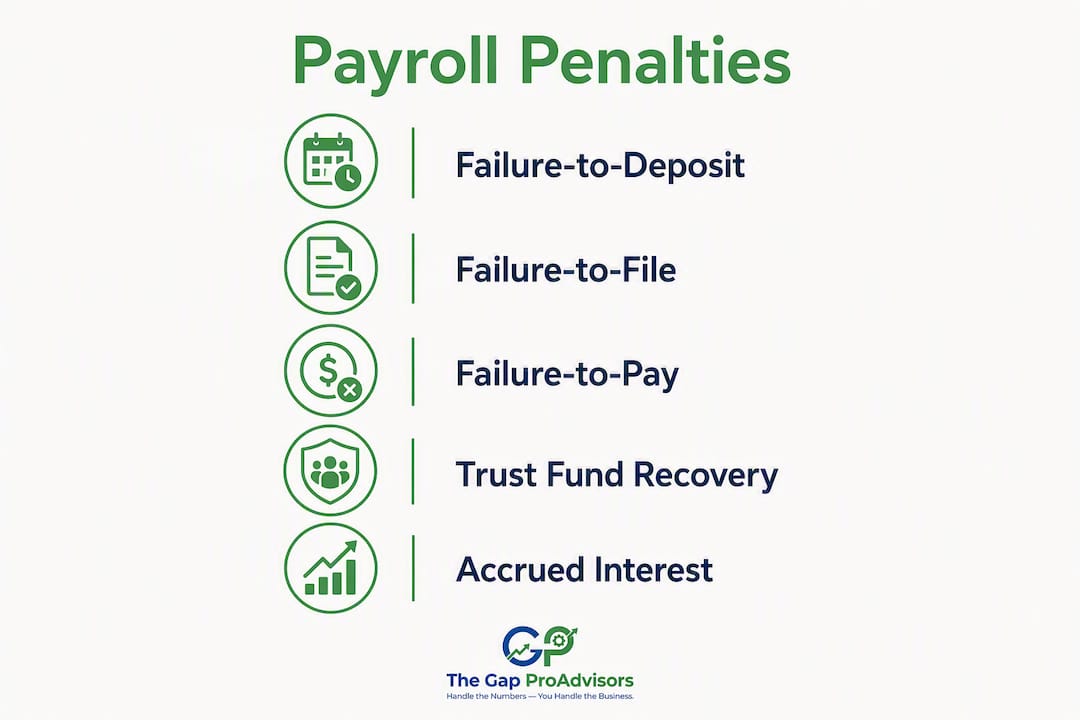
Trust Fund Recovery Penalty (TFRP) is the most dangerous. The IRS can assess 100% of unpaid trust fund taxes against any "responsible person" who willfully fails to collect or remit withheld taxes. This penalty pierces the corporate structure entirely.
Interest accrues on both unpaid taxes and unpaid penalties, compounding daily at the federal short-term rate plus 3%.
State penalties vary widely. Most states assess late-deposit and late-filing penalties in the 1%–15% range, and many also impose separate unemployment insurance (SUI) penalties for late FUTA/state unemployment filings.
How are these penalties actually calculated?
The math is straightforward once you know the rules. The key principle: FTD penalties are not stacked by tier. If your deposit is 18 days late, you owe 10% of the deposit amount — not 2% + 5% + 10%.

FTD penalty rate table
| Days Late | FTD Rate |
|---|---|
| 1–5 days | 2% |
| 6–15 days | 5% |
| 16+ days | 10% |
| After IRS demand notice | 15% |
Worked example A — monthly depositor, 10 days late: A monthly depositor owes a significant amount in federal payroll taxes. The deposit arrives 10 days after the due date. The applicable rate is 5% (6–15 days). The penalty is calculated as the deposit amount multiplied by the rate, plus daily interest until paid.
Worked example B — Form 941 filed 2 months late with unpaid tax: An employer files Form 941 two months late with an unpaid tax amount. Failure-to-file penalty is calculated as 5% per month for each month late, capped as specified. Failure-to-pay penalty accrues at 0.5% per month. Combined penalties apply before interest.
Worked example C — EFT avoidance penalty: A business required to use electronic funds transfer pays by check instead. Under IRM guidance enforced via IRC 6656, the IRS can assess a 10% avoidance penalty on the full deposit amount regardless of whether the payment was otherwise on time. The penalty equals 10% of the deposit amount for using the wrong payment method.
Interest compounds daily on unpaid balances. A $10,000 penalty left unpaid for a full year at the current rate adds hundreds of dollars in interest charges on top of the original penalty.
Which taxes, forms, and deposit schedules trigger penalties?
Not every payroll-related tax follows the same deposit rules, and the schedule assigned to your business determines when deposits are due.
Trust fund taxes (the ones that trigger TFRP risk) include employee federal income tax withholding and the employee share of FICA (Social Security and Medicare). Employer-side taxes — the employer's matching FICA share and FUTA — are also deposited through EFTPS but do not carry TFRP exposure because they are not withheld from employees.
Deposit schedule and form reference
| Tax / Form | Deposit Schedule | Key Due Date |
|---|---|---|
| Form 941 (quarterly payroll) | Monthly or semi-weekly | Monthly: 15th of following month; Semi-weekly: Wed/Fri after payday |
| Form 940 (FUTA annual) | Quarterly if liability exceeds $500 | January 31 annually |
| Form 945 (non-payroll withholding) | Monthly or semi-weekly | Same as 941 schedule |
| State withholding / SUI | Varies by state | Check your state agency |
How the IRS assigns your schedule: Your deposit schedule is based on your total tax liability reported during a lookback period (generally the 12-month period ending June 30 of the prior year). Employers with $50,000 or less in lookback liability are monthly depositors; those above $50,000 are semi-weekly.
The $100,000 one-day rule overrides both schedules: if accumulated liability reaches $100,000 on any day, you must deposit by the next business day regardless of your assigned schedule.
De minimis exception: If your total Form 941 tax liability for a quarter is under $2,500, you may pay with the return instead of making separate deposits. Crossing that threshold and still paying with the return can trigger an FTD penalty.
Pro Tip: Set a recurring calendar reminder two business days before each deposit due date. Missing a deposit by even one day starts the penalty clock — and the IRS does not grant informal grace periods.
What happens when payroll taxes go unpaid?
Unpaid payroll taxes don't sit still. Interest accrues daily, and the IRS moves through a predictable escalation sequence that ends in collection actions most small businesses cannot survive.
- CP501 / CP503 notice — Initial balance-due notice. The IRS states the amount owed and requests payment.
The TFRP is particularly severe because it survives bankruptcy and attaches personally. A business owner who closes the company still owes 100% of the unpaid trust fund taxes from their personal assets.
How to respond when you receive an IRS notice
The first 48–72 hours after discovering a missed deposit or receiving a notice are the most important. Here's the exact sequence to follow:
- Read the notice carefully — Identify the tax period, the form involved, and the specific penalty type. Verify the IRS's math against your own payroll records before assuming the amount is correct.
Pro Tip: Keep a written log of every IRS call: date, time, representative ID, and what was discussed. This contemporaneous record can support a reasonable-cause abatement request later.
How to request penalty abatement or relief
The IRS offers two main paths to reduce or eliminate assessed penalties: First-Time Abatement (FTA) and reasonable-cause relief.
First-Time Abatement (FTA) is the faster option. You qualify if you have no penalties in the three tax years prior to the year being penalized, you've filed all required returns, and you've paid or arranged to pay any tax owed. FTA applies to failure-to-file, failure-to-pay, and failure-to-deposit penalties. You can request it by phone when you call the IRS — no written form required in most cases.
Reasonable-cause relief requires demonstrating that you exercised ordinary business care and prudence but were still unable to comply. Qualifying circumstances include:
- Serious illness or death of the person responsible for payroll
- Natural disaster or fire that destroyed records
- Reliance on erroneous written advice from a tax professional or the IRS itself
- Unavoidable absence of the key person responsible for deposits
How to file a written request:
- Write a clear explanation of the facts and timeline, attaching supporting documents (medical records, disaster declarations, professional correspondence).
- File Form 843 (Claim for Refund and Request for Abatement) if the penalty has already been assessed and paid.
- If relief is denied, you have the right to appeal through the IRS Office of Appeals.
One critical limit: the IRS generally cannot remove interest unless the underlying penalty is also removed. Paying the penalty in full while seeking abatement stops further interest accrual on that amount.
Pro Tip: Attach a timeline showing the exact sequence of events — when the problem started, when you discovered it, and every step you took to fix it. Contemporaneous evidence (emails, bank records, doctor's notes) is far more persuasive than a narrative written months later.
How to prevent payroll tax penalties going forward
Prevention costs far less than remediation. These controls are practical for any small business, regardless of payroll size.
- Classify workers correctly — Misclassifying employees as independent contractors is one of the most common payroll mistakes that triggers back taxes, penalties, and interest. When in doubt, use IRS Form SS-8 to request a determination.
A small business tax checklist that covers both filing and deposit deadlines is one of the simplest tools you can put in place today.
Why payroll penalties are an existential risk for small businesses
Payroll tax penalties and accrued interest can quickly deplete small-business cash reserves, and the compounding effect is faster than most owners expect. A single missed quarterly deposit on a $50,000 payroll tax liability can generate thousands of dollars in penalties within weeks, before a single IRS notice arrives.

The TFRP makes this worse. Because it pierces the corporate structure and attaches to individuals personally, closing the business does not resolve the debt. An owner who paid vendors and suppliers while withholding taxes went unremitted has, in the IRS's view, made a willful choice — and that determination survives bankruptcy.
Expert mitigation checklist:
- Confirm EFTPS enrollment and test a deposit before the first due date
- Set up a separate payroll tax reserve account and fund it on every payday
- Review your deposit schedule classification every July
- Reconcile Form 941 to payroll records before filing each quarter
- Document every payroll approval with a dated signature or digital record
- If you receive any IRS notice, respond within the deadline printed on it — never ignore it
A business owner who caught a missed deposit within five days, paid immediately, and documented the bank error that caused it avoided both the higher FTD tiers and a TFRP investigation. Quick action and a paper trail made the difference between a $300 penalty and a potential six-figure personal liability.
Key Takeaways
Payroll tax penalties compound fast, carry personal liability risk through the TFRP, and are almost always preventable with the right deposit controls and documentation habits.
| Point | Details |
|---|---|
| FTD penalty tiers | Rates run 2%, 5%, 10%, or 15% based on days late — the highest applicable tier applies, not a sum of all tiers. |
| TFRP personal liability | The IRS can assess 100% of unpaid trust fund taxes against responsible persons, piercing the corporate structure. |
| Abatement options | First-Time Abatement (FTA) requires no penalties in the prior three years; reasonable-cause relief requires documented evidence. |
| Prevention priority | A dedicated payroll tax account, automated EFTPS deposits, and quarterly reconciliations eliminate most penalty risk. |
| Mygappro's role | Mygappro handles deposit scheduling, EFTPS setup, Form 941 filing, and notice response so you stay compliant year-round. |
Payroll compliance deserves your direct attention
Most payroll tax problems don't start with negligence. They start with a busy owner who trusted a process that wasn't fully set up, or a payroll provider who didn't communicate a missed deposit until weeks later. By then, the penalty clock has been running.
What I've seen consistently is that the businesses most at risk are the ones growing fastest — more employees, more payroll complexity, and less time to verify that deposits are actually landing on time. The TFRP is not a theoretical risk for a small business. It's a real mechanism the IRS uses regularly, and it follows the owner personally.
Treat payroll compliance the way you treat your most important vendor relationship: verify it, document it, and never assume it's handled. Your cash flow and your personal financial security both depend on it.
Mygappro keeps your payroll deposits accurate and on time
Missed deposits and late filings are the two most common sources of payroll tax fines for small businesses — and both are entirely preventable with the right support in place. Mygappro's remote payroll services cover EFTPS enrollment, deposit scheduling, Form 941 and Form 940 preparation, and quarterly reconciliations, so nothing falls through the cracks between paydays.

When an IRS notice does arrive, Mygappro's team helps you read it correctly, verify the IRS's math, and prepare the documentation needed for abatement requests. Combined with year-round bookkeeping and tax services, you get a complete compliance picture — not just payroll in isolation. New clients can request a payroll penalty-risk review to identify any gaps in their current deposit process before the IRS does.
Schedule a free consultation at mygappro.com to get started.
Useful sources
| Source | What it supports |
|---|---|
| IRS: Failure to Deposit Penalty | FTD tier rates, non-stacking rule, abatement guidance, and payment plan options |
| IRS: Trust Fund Recovery Penalty (TFRP) | TFRP 100% personal liability rule and responsible-person assessment process |
| IRS: Establishing Responsibility and Willfulness (IRM 5.7.3) | How the IRS defines responsible persons and willfulness for TFRP purposes |
| IRS Notice 784 | Who qualifies as a responsible person; willfulness definition including paying vendors before taxes |
| IRS: Penalties overview | Failure-to-file and failure-to-pay rates, interest on penalties, and general penalty framework |
| Tax Notes: IRM 20.1.4 Failure to Deposit | EFT avoidance penalty, de minimis exception, and IRC 6656 deposit enforcement |
| ADP: Payroll tax penalties and how to avoid them | Common penalty triggers, cash-reserve risk, and employer-facing prevention guidance |
| H&R Block: Estimated tax penalty | How late payments trigger penalties even when final tax liability is zeroed out |
| Paylocity: Payroll tax penalties resource | Employer-facing rate summaries and common trigger explanations |
FAQ
What are the penalties for paying payroll taxes late?
The IRS charges a tiered Failure-to-Deposit penalty of 2%, 5%, 10%, or 15% depending on how many days late the deposit is, plus daily interest on the unpaid balance.
What triggers a payroll tax penalty?
Late or missing deposits, filing Form 941 or Form 940 after the due date, paying by check when EFT is required, and misclassifying employees as contractors are the most common triggers.
What happens if my employer doesn't pay payroll taxes?
The IRS can assess the Trust Fund Recovery Penalty against any responsible person — including officers and check-signers — making them personally liable for 100% of the unpaid withheld taxes.
Can payroll tax penalties be removed?
Yes. First-Time Abatement is available if you have a clean penalty history for the prior three years. Reasonable-cause relief is available with documented evidence of circumstances beyond your control, though interest is only removed if the underlying penalty is also removed.
What is the $600 rule in payroll taxes?
The $600 threshold applies to contractor payments: businesses must file a Form 1099-NEC for any unincorporated contractor paid $600 or more in a year. Failing to file triggers separate information-return penalties, not the FTD penalty, but both fall under the broader category of payroll tax compliance issues.