
For 2026 federal tax purposes, most employer-provided on-site meals are now nondeductible, while client meals, business travel meals, and qualifying meeting meals remain subject to the 50% deduction rule under IRC §274. This shift, effective for amounts paid or incurred after December 31, 2025, is the most significant change to the business meals tax deduction in years.
Here is what you should do right now:
- Categorize existing meal expenses by type (client, travel, employee on-site, events) before year-end so nothing gets misclassified.
- Update your expense codes in your bookkeeping system to separate deductible from nondeductible meals.
- Preserve all receipts with business purpose, attendees, and date noted on each one.
- Review payroll implications if your business provides on-site meals, since those meals may now be taxable compensation to employees.
- Consult a tax advisor on any fact-specific situations, especially employer cafeteria or breakroom arrangements.
The controlling statutes are §274 (general meal and entertainment deduction rules), §119 (meals furnished for the convenience of the employer), and the amendments introduced through Section 274(o) as modified by recent legislation.
Key Takeaways
| Point | Details |
|---|---|
| Employer on-site meals are nondeductible | Effective January 1, 2026, cafeteria and convenience meals lose their deduction unless a specific exception applies. |
| Client and travel meals stay at 50% | Business meals with clients, prospects, or during overnight travel remain 50% deductible with proper documentation. |
| Employee events are 100% deductible | Holiday parties and annual picnics open to all employees qualify for a full deduction under §274(e)(4). |
| Documentation is non-negotiable | Every meal deduction requires date, amount, place, business purpose, and attendee names to survive an audit. |
| Mygappro handles the transition | The Gap ProAdvisors offers remote bookkeeping cleanup, expense reclassification, and tax preparation to align your records with the 2026 rules. |
Table of Contents
- What changed with the meals deduction 2026 rules?
- Which meals are deductible in 2026, and at what percentage?
- How do employer-provided meals work under the 2026 rules?
- When does the GSA standard meal allowance simplify your deductions?
- How do you substantiate meal deductions in 2026?
- Where do you report meal deductions on your federal return?
- Scenario walkthroughs: how the 2026 rules play out in real situations
- Your 2026 employer and business owner action checklist
- How Mygappro helps clients stay compliant with the 2026 rules
- How meal deductions interact with travel and transportation expenses
- How the 2026 changes affect fringe benefits and employee reimbursements
- What the 2026 meal deduction rules really mean for your business
- The Gap ProAdvisors: your partner for 2026 meal deduction compliance
- Sources
- FAQ
What changed with the meals deduction 2026 rules?
The 2026 changes did not arrive without warning, but many businesses are still catching up. Under the Tax Cuts and Jobs Act framework and subsequent amendments, Congress set a hard deadline: for amounts paid or incurred after December 31, 2025, the deduction for employer-operated eating facilities and for meals provided to employees for the convenience of the employer is generally disallowed.
TD 9925 and related Treasury rulemaking projects laid the regulatory groundwork for this transition.
A few carve-outs survive. Meals provided on certain vessels, oil platforms, or remote work sites where no other food options are available may still qualify for a deduction. Meals sold to customers at fair market value remain fully deductible as a cost of goods. Restaurants and food-service businesses that sell meals as their primary product are not affected in the same way. Treasury guidance on some edge cases is still pending, so check for updated IRS notices throughout the year.
Which meals are deductible in 2026, and at what percentage?
Jackson Hewitt's 2026 guide confirms that client meals, business travel meals, and many meeting meals remain at 50%, while employer on-site meals are now generally nondeductible.
| Deductibility Category | Typical Examples |
|---|---|
| 50% deductible | Client or prospect meals with documented business purpose; meals during business travel away from home; meals at business meetings with employees or partners; meals at conferences or seminars |
| 100% deductible | Employee recreational events (holiday parties, annual picnics) open to all employees; meals treated as taxable compensation to the employee; meals sold to customers at fair market value |
| 0% / Nondeductible | Employer-operated cafeteria or breakroom meals provided for convenience of the employer; on-site snacks and coffee provided to employees generally; meals with no documented business purpose; lavish or extravagant meals beyond what is ordinary and necessary |
A $400 dinner for two with a client is not automatically disqualified, but you need a clear business purpose and documentation. When a single expense includes both a deductible meal and nondeductible entertainment (a dinner followed by a concert, for example), you must allocate and separately track each component. Baker Tilly's 2026 guidance provides a categorized breakdown of 100% deductible, 50% deductible, and nondeductible scenarios, including industry-specific exceptions worth reviewing.
How do employer-provided meals work under the 2026 rules?
This is where the 2026 changes hit hardest for employers.
Practically, this means:
- On-site breakroom snacks and coffee provided as a general employee perk are now nondeductible.
- Cafeteria meals subsidized by the employer and provided on business premises are generally nondeductible unless a specific exception applies.
- Overtime meals delivered to employees working late, previously a common 50% deduction, are now nondeductible in most cases.
- Qualifying exceptions include meals on certain remote vessels or platforms, meals sold at fair market value, and meals treated as taxable compensation.
The payroll implication is significant. If you previously excluded on-site meals from employee wages under §119, you need to reassess whether those meals now constitute taxable compensation. If they do, the fair market value must be included in the employee's W-2 wages and subjected to withholding. Coordinate with HR to update your meal policy language and with your payroll provider to adjust withholding calculations. IRS Publication 15-B is the primary reference for fringe benefit reporting and withholding when meals shift from excludable to taxable.
Pro Tip: Set up a separate expense code in your bookkeeping system specifically for "employer convenience meals" and flag it as nondeductible. This prevents those costs from accidentally flowing into your deductible meal categories at year-end and saves your CPA hours of cleanup work.
When does the GSA standard meal allowance simplify your deductions?
For business travel, you have two options: track actual meal costs with receipts, or use the GSA standard meal allowance (per diem) as a simplified method. The IRS recognizes per diem as an official alternative to actual-cost substantiation for travel meals.
The GSA per diem rate for your travel destination varies, and your deductible amount is half of that per diem rate. You do not need to save every restaurant receipt when using per diem, but you still need to document the travel dates, destination, and business purpose.
Per diem vs. actual costs: a quick comparison
- Per diem (GSA rate): Fewer receipts, simpler recordkeeping, fixed deduction amount. Best for frequent travelers and sole proprietors who want predictability.
- Actual costs: More documentation required, but potentially higher deduction if your real meal costs exceed the GSA rate for that location. Useful in high-cost cities where per diem rates lag behind actual restaurant prices.
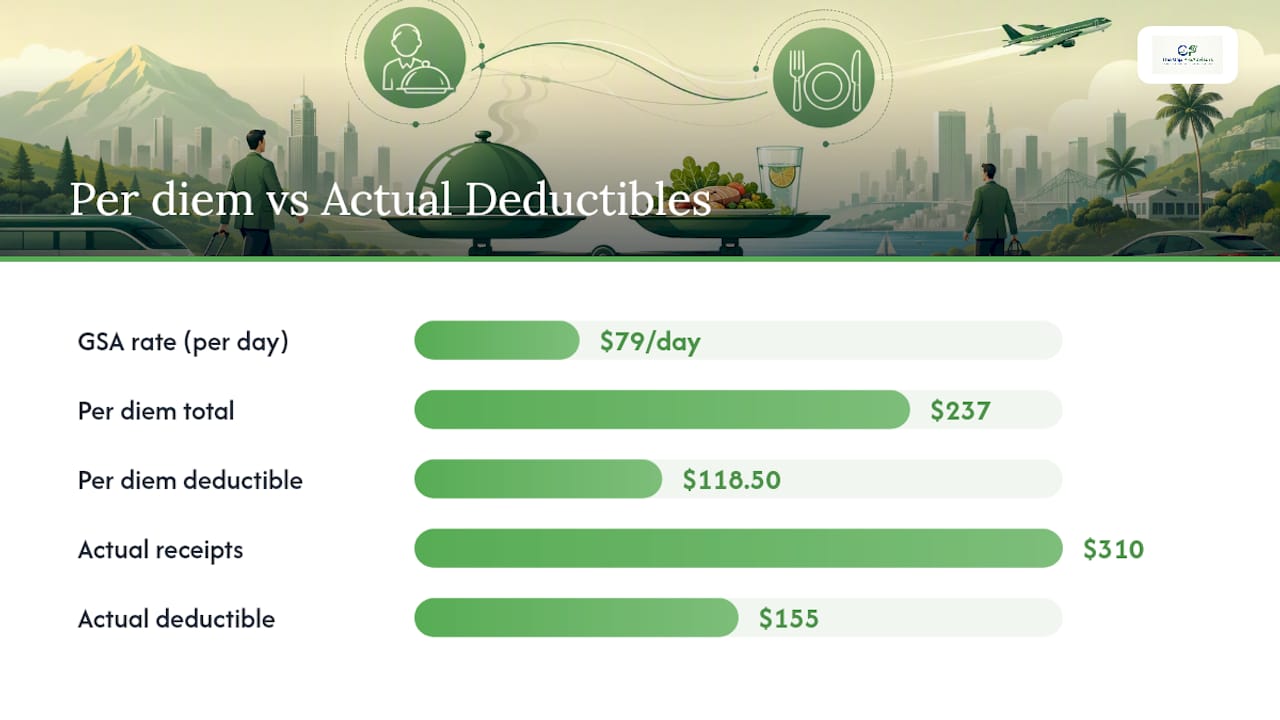
Example calculation: A sole proprietor travels to Chicago for three days. The GSA per diem meal rate for Chicago is $79 per day. Total per diem allowance: $237. If actual receipts totaled $310 for the same trip, the deductible amount would be $155. The actual-cost method wins here, but only if the receipts are properly documented.
How do you substantiate meal deductions in 2026?
Documentation is the difference between a clean deduction and a disallowed one at audit. The IRS requires specific information for every meal expense you claim.
Documentation checklist for every meal expense:
- Date of the meal
- Amount paid, including tips
- Place (name and location of the restaurant or venue)
- Business purpose (what was discussed or decided, not just "business lunch")
- Attendees and their business relationship to you (client, employee, prospect)
- Proof of payment (receipt, credit card statement, or canceled check)
Common audit red flags include meals claimed without attendee names, recurring round-dollar amounts that suggest estimates rather than actual costs, and meals coded as "business" with no documented purpose. Meals over $75 require a receipt; below that threshold the IRS allows a written record, though keeping receipts for everything is the safer practice.
Digitizing receipts at the point of purchase is the most reliable method. Apps that capture an image and attach it directly to a transaction in your bookkeeping system eliminate the "lost receipt" problem entirely. Year-end reconciliation becomes a matter of reviewing coded transactions rather than hunting down paper.

Pro Tip: Use a bookkeeping tool that lets you attach a photo receipt to each transaction and add a memo field for business purpose and attendees. If every meal transaction has a receipt and a note attached before it leaves your expense report, your documentation is audit-ready without any extra work at tax time.
Where do you report meal deductions on your federal return?
The form depends on your business structure. Here is where meal deductions appear on the most common returns:
- Schedule C (sole proprietors and single-member LLCs): Report deductible meals on Line 24b, separate from travel. The 50% limit is applied before you enter the amount.
- Form 1120 (C corporations): Meals appear as an ordinary business deduction on the return; the 50% limit is applied in the books before reporting.
- Form 1065 (partnerships): Deductible meals flow through to partners; the 50% limit applies at the partnership level.
- S corporation returns (Form 1120-S): Same treatment as partnerships; the 50% limit applies before amounts pass through to shareholders.
- Form W-2 (payroll): If employer-provided meals are now taxable to employees, their fair market value must be included in Box 1 wages and Box 12 with the appropriate code. Refer to Publication 15-B for the correct reporting codes.
For employee reimbursements to remain nontaxable, your business must maintain an accountable plan. That means employees must have a business connection for the expense, submit adequate documentation (receipts and business purpose), and return any excess reimbursement within a reasonable time. Reimbursements that do not meet accountable plan requirements are treated as taxable wages.
Scenario walkthroughs: how the 2026 rules play out in real situations
-
Client lunch, billed separately from entertainment. You take a client to lunch to discuss a contract renewal. The bill is $120. Because the meal is separate from any entertainment activity and has a documented business purpose, it qualifies as a 50% deductible business meal. Your deduction: $60. Document the client's name, the business topic discussed, and keep the receipt.
-
Employee on-site lunch provided for convenience. Your company provides lunch daily in the office breakroom as a perk. Before 2026, this was 50% deductible. Starting January 1, 2026, it is nondeductible under the new rules. If you continue providing these meals, you must decide whether to treat their fair market value as taxable compensation on employee W-2s or simply absorb the cost as a nondeductible business expense. Either way, the employer gets no deduction.
-
Travel day meals using per diem vs. actual receipts. An employee travels to Phoenix for two days. The GSA per diem meal rate for Phoenix is $74 per day. Per diem method: $148 total, limited to 50% = $74 deductible. Actual receipts for the trip total $195. Actual method: $195 limited to 50% = $97.50 deductible. The actual-cost method produces a higher deduction, but requires full receipt documentation for each meal.
-
Company holiday party. Your business holds an annual holiday party open to all employees. This qualifies as a 100% deductible employee recreational event under §274(e)(4), provided it is primarily for the benefit of non-highly-compensated employees and is open to all staff. Document the event date, location, total cost, and a list of attendees. The 100% deduction applies to the food and beverage costs; any entertainment portion (a band, for example) is nondeductible.
-
Mixed meal and entertainment expense. A client dinner followed by tickets to a sporting event totals $350: $150 for dinner, $200 for tickets. The dinner is 50% deductible ($75); the tickets are nondeductible under §274. You must separate these on your receipt and in your bookkeeping system. Lumping them together as "client entertainment" loses the meal deduction entirely.
Your 2026 employer and business owner action checklist
Getting aligned with the new rules is a process, not a single task. Here is a prioritized sequence:
-
Immediately: audit your current meal expense categories. Pull your chart of accounts and identify every code that captures meal or food costs. Flag any category that previously captured employer convenience meals or breakroom costs as nondeductible going forward.
-
This week: update your bookkeeping expense codes. Create separate codes for (a) 50% deductible client and travel meals, (b) 100% deductible employee events, and (c) nondeductible employer-provided meals. This separation is the single most important step for clean year-end reporting, as Larson Gross advises.
-
This month: review your employee meal policy. If you provide on-site meals, decide whether to discontinue the benefit, treat it as taxable compensation, or restructure it to qualify for an exception. Update your written policy to reflect the decision.
-
This quarter: coordinate with your payroll provider. If any meals are now taxable to employees, adjust withholding and update your payroll system. Your payroll team needs to know which meals are now includable in W-2 wages before the next payroll run.
-
Before year-end: train staff on documentation requirements. Every employee who submits meal expense reports needs to know the five documentation fields (date, amount, place, purpose, attendees). A one-page reference card distributed now prevents a documentation scramble in January.
Additional policy and planning actions:
- Review your accountable plan language to confirm it still covers the meals you reimburse.
- Ask your CPA to model the tax impact of eliminating vs. continuing employer-provided meals.
- Set a calendar reminder to check for updated IRS or Treasury guidance mid-year, since some edge cases remain under active rulemaking.
How Mygappro helps clients stay compliant with the 2026 rules
The 2026 meal deduction changes create real bookkeeping and payroll work that most small business owners did not budget for. Mygappro's team at The Gap ProAdvisors works with business owners remotely to handle exactly this kind of transition.
A typical engagement for a client navigating the 2026 rules includes:
- Bookkeeping cleanup and reclassification of existing meal expense categories to separate deductible from nondeductible costs.
- Chart of accounts update to create the correct expense codes for client meals, travel meals, employee events, and nondeductible employer-provided meals.
- Payroll coordination to assess whether on-site meals now constitute taxable compensation and adjust W-2 reporting accordingly.
- Tax planning review to model the net impact of the new rules on your effective tax rate and identify any restructuring opportunities.
- Year-round support through a secure online portal so questions get answered before they become filing problems.
Clients who engage Mygappro for year-round tax planning typically catch classification issues months before the return is due, rather than discovering them during tax prep. For businesses that need a full expense history review, the bookkeeping cleanup service is a practical starting point.
How meal deductions interact with travel and transportation expenses
Meals and travel are related but governed by separate rules, and conflating them is a common source of errors. The two categories must be tracked separately in your bookkeeping system.
The "away from home" requirement applies to both. You must be traveling away from your tax home overnight, or for a period long enough to require rest, for travel meals to qualify under §274. A day trip where you return home the same evening does not qualify as business travel for meal deduction purposes, even if you ate lunch with a client during the trip.
Per diem rates from the GSA cover meals and incidental expenses (M&IE) but not lodging or transportation.
How the 2026 changes affect fringe benefits and employee reimbursements
The reclassification of employer-provided meals has a direct ripple effect on fringe benefit planning. Meals that were previously excludable from employee income under §119 (furnished on business premises for the convenience of the employer) may now be taxable fringe benefits if the employer continues providing them.
When a meal crosses from excludable to taxable, two things happen: the employer loses the deduction, and the employee owes income tax on the fair market value. That double impact makes the cost of continuing an on-site meal program significantly higher than it was before 2026. Some employers are responding by converting cafeteria subsidies into taxable meal allowances or stipends, which are deductible as compensation but still taxable to the employee.
Reimbursement plans also need a review. If your accountable plan previously covered on-site meal costs that are now nondeductible, those reimbursements may no longer qualify as nontaxable. An accountable plan only protects reimbursements for expenses that are themselves deductible to the employer. Where the underlying expense is now nondeductible, the reimbursement may need to be run through payroll as taxable wages.
What the 2026 meal deduction rules really mean for your business
But the 2026 changes expose a blind spot that many small business owners carry: the assumption that feeding your employees at the office is a routine, low-risk deduction.
It was never as simple as that. The §119 exclusion was always fact-specific, and the IRS has challenged convenience-of-the-employer claims for decades. What changed in 2026 is that Congress removed the employer's deduction entirely for most on-site meal arrangements, regardless of whether the exclusion still applies to the employee. That asymmetry is genuinely new and genuinely consequential.
The businesses most at risk are not the ones taking clients to lunch. They are the ones running informal breakroom programs, ordering team lunches weekly, or subsidizing a cafeteria without ever formally documenting the arrangement. Those costs were often buried in "office expense" or "meals" with no separate tracking, and they are now nondeductible.
The practical priority is not a comprehensive policy overhaul. It is accurate categorization, starting today. Get the expense codes right, document the business purpose on every meal receipt, and let your tax advisor assess the structural questions. The rules are clear enough to act on now.
The Gap ProAdvisors: your partner for 2026 meal deduction compliance
The 2026 meal deduction rules require real changes to how you track, code, and report food-related expenses. Mygappro's remote bookkeeping and tax services give small business owners a flat-rate, year-round solution that handles exactly this kind of compliance work without the overhead of a traditional firm.
Whether you need a full books cleanup to reclassify past meal expenses, help updating your chart of accounts, or a tax preparation review that applies the 2026 rules correctly to your return, The Gap ProAdvisors works with you through a secure online portal from anywhere in the U.S. Schedule a free consultation to review your meal expense categories and confirm your payroll reporting is aligned with the new rules.
This article is for general informational purposes only and does not constitute individualized tax or legal advice. Consult a qualified CPA or tax advisor for guidance specific to your situation.
Sources
Check these official and professional resources for the most current guidance on 2026 meal deductions. Treasury and IRS rulemaking on some edge cases is still active, so revisit these sources mid-year for any updates.
- Guidance for 2026 deductions on meals, travel and other entertainment expenses | Baker Tilly
- Meals and Entertainment Deduction Guide - Larson Gross
This article is general information, not a substitute for advice from a qualified financial advisor. Consult a qualified financial professional about your own circumstances before acting on anything here.
FAQ
Are meals still tax deductible in 2026?
Yes, but the rules depend on the type of meal.
What is the standard meal allowance for 2026?
The standard meal allowance is the GSA per diem rate for the travel destination, which varies by city.
What meals are 100% deductible under IRS rules?
How does the new nondeductibility rule for employer meals work?
Effective January 1, 2026, employers can no longer deduct the cost of meals furnished to employees for the convenience of the employer or the cost of operating an employer-run eating facility, unless a specific statutory exception applies. Employers who continue these programs should assess whether the meals are now taxable compensation reportable on Form W-2.
How do you claim meal deductions on a federal return?
C corporations report them on Form 1120; partnerships on Form 1065.