
By default, your LLC is a pass-through entity for federal income tax. A single-member LLC is treated as a disregarded entity and reports income on your personal return. A multi-member LLC defaults to partnership status and files Form 1065. You can change either classification by filing Form 8832 with the IRS. Here are the two things to do right now:
- Confirm your EIN and tax classification. If you don't have an Employer Identification Number yet, get one from IRS.gov before anything else. Then confirm whether your LLC is currently treated as a disregarded entity, partnership, or corporation.
- Set up basic bookkeeping and estimated tax payments. Open a dedicated business bank account, track every dollar in and out, and plan to pay quarterly estimated taxes if you expect to owe $1,000 or more.
Your single most important first step: confirm your tax classification and collect your income and expense records before your first filing deadline arrives.
Pro Tip: Don't wait until April to figure out your classification. The IRS has strict timing rules on elections, and missing a window can cost you an entire tax year.
Key Takeaways
The most important thing a new LLC owner can do is confirm their federal tax classification, set up separate bookkeeping, and start making quarterly estimated tax payments before the first deadline passes.
| Point | Details |
|---|---|
| Default classification matters | Single-member LLCs are disregarded entities; multi-member LLCs default to partnership status unless Form 8832 is filed. |
| Forms follow classification | Schedule C for disregarded entities, Form 1065 plus Schedule K-1 for partnerships, Form 1120-S for S-corps. |
| Set aside 25%–30% of net profit | That range covers self-employment tax and federal income tax for most pass-through LLC owners. |
| Quarterly payments are required | If you expect to owe $1,000 or more, pay estimated taxes through EFTPS by each quarterly due date. |
| Mygappro handles the full picture | Bookkeeping, payroll, estimated tax setup, and LLC tax return preparation, all through a secure remote portal. |
Table of Contents
- How LLCs are taxed: the simple breakdown beginners need
- Which federal tax forms your LLC needs and when they're due
- How to choose a federal tax classification for your LLC
- First-year checklist: everything to gather before you file LLC taxes
- How much to set aside: estimating and paying quarterly taxes
- Common deductions and beginner tax-saving tips for LLC owners
- State and local taxes: what to check for your state
- When a tax or bookkeeping service genuinely helps LLC owners
- The beginner mistakes that cost LLC owners the most
- How Mygappro supports LLC owners from day one
- Sources
- FAQ
How LLCs are taxed: the simple breakdown beginners need
The IRS does not have a separate federal tax category called "LLC." Instead, it maps your LLC onto one of four existing tax structures depending on how many members you have and whether you've filed an election.
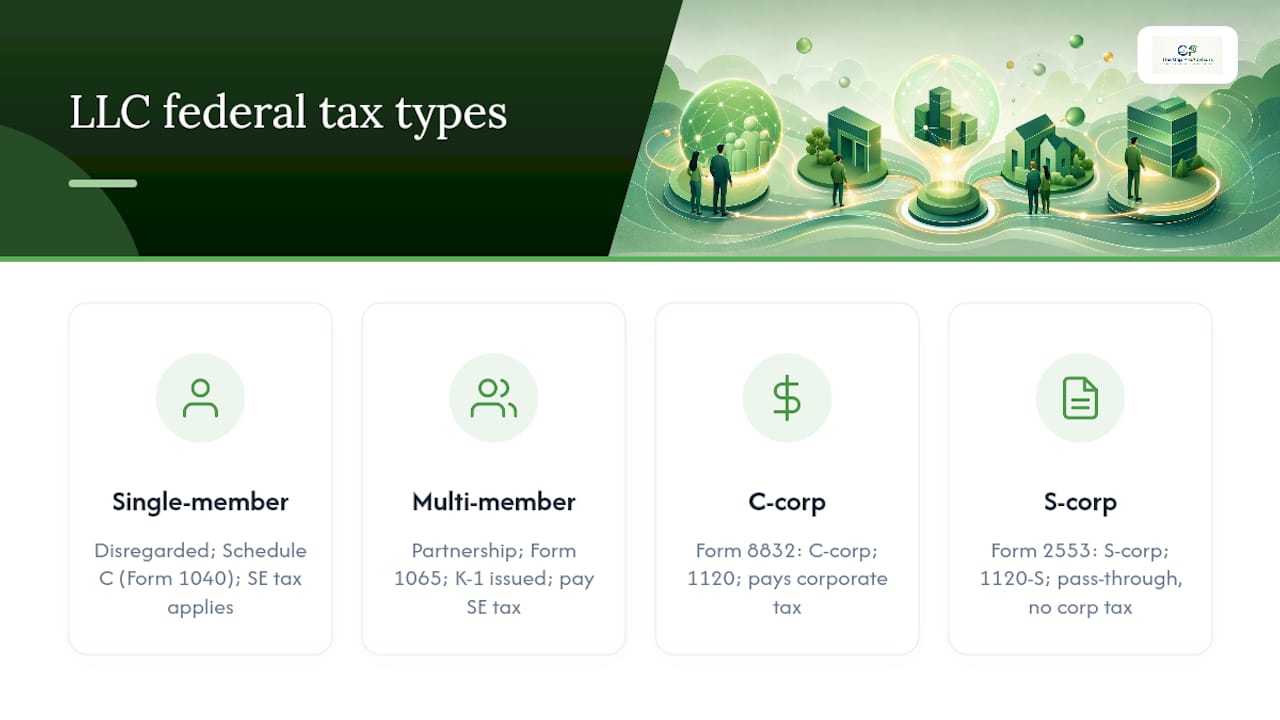
Single-member LLC (one owner): The IRS treats it as a disregarded entity. Your LLC's income and expenses flow directly onto your personal Form 1040 via Schedule C, just like a sole proprietor. You pay income tax plus self-employment tax on your net profit.
Multi-member LLC (two or more owners): The default is partnership treatment. The LLC itself files an informational return (Form 1065) and issues a Schedule K-1 to each member. Each member then reports their share of income on their personal return and generally pays self-employment tax on their distributive share.
Corporation elections: Either type of LLC can file Form 8832 to elect C-corporation treatment, which means the LLC pays corporate income tax and files Form 1120. Alternatively, a qualifying LLC can file Form 2553 to be taxed as an S-corporation, filing Form 1120-S and passing income through to members without corporate-level tax.
"Pass-through" simply means the LLC itself doesn't pay federal income tax. The profit passes through to the owners, who report it on their individual returns and pay tax at their personal rates. This is the default for most small LLCs, and it keeps things relatively simple in the early years.
One nuance beginners often miss: even if your single-member LLC is disregarded for income tax purposes, the IRS treats it as a separate entity for employment and excise taxes. That matters the moment you hire anyone, including yourself as a W-2 employee under an S-corp structure. Publication 3402 covers these employment tax distinctions in detail and is worth bookmarking.
Which federal tax forms your LLC needs and when they're due
Your required forms depend entirely on your tax classification. Getting this mapping right before your first filing saves you from amended returns and late penalties.
| LLC Tax Classification | Primary Return | Additional Forms | Typical Deadline |
|---|---|---|---|
| Single-member (disregarded) | Schedule C on Form 1040 | Schedule SE | April 15 |
| Multi-member (partnership) | Form 1065 + Schedule K-1 | Schedule SE per member | March 15 |
| S-corporation (Form 2553 filed) | Form 1120-S + Schedule K-1 | Payroll forms (941, W-2) | March 15 |
| C-corporation (Form 8832 filed) | Form 1120 | Payroll forms if wages paid | April 15 |
A few points worth knowing:
- Schedule SE is the form that calculates your self-employment tax, which covers Social Security and Medicare. Schedule SE applies to single-member LLC owners and partners in multi-member LLCs. The self-employment tax rate is 15.3% on net earnings up to the Social Security wage base, then 2.9% above it.
- Form 1065 is an informational return. The LLC itself pays no tax on it. Calendar-year partnerships file by March 15 and can request a six-month extension using Form 7004.
- Extensions extend the filing deadline, not the payment deadline. If you owe taxes, you still need to pay by the original due date or face interest and penalties.
- Payroll forms (Form 941, W-2, W-3) apply if your LLC pays wages to employees or to yourself as an S-corp owner-employee.
For LLCs taxed as partnerships, the Schedule K-1 each member receives is what they use to complete their personal return. Members don't wait for a 1099; they wait for their K-1, which is why the March 15 partnership deadline exists before the April 15 individual deadline.
All forms are available free at IRS.gov. Publication 3402 is the IRS's own plain-language guide to LLC taxation and is one of the most useful documents a new LLC owner can read.
How to choose a federal tax classification for your LLC
Most beginners should stay with the default classification for at least the first year. The administrative overhead of a corporation election is real, and the tax savings only materialize above a certain profit level.
The decision framework in plain terms:
- What are your net profits? If your LLC nets less than roughly $40,000–$50,000 annually, the cost of running payroll and filing a corporate return often exceeds the self-employment tax savings from an S-corp election.
- Will you pay yourself a salary? S-corp owners must pay themselves a "reasonable salary" subject to payroll taxes. The IRS scrutinizes this closely. If you're not ready to run payroll, stay pass-through.
- Do you need retained earnings in the business? C-corp treatment lets you keep profits in the company at the corporate tax rate, which can be useful for reinvestment. Most small service businesses don't need this.
- How much administrative capacity do you have? S-corp and C-corp elections require payroll filings, separate corporate returns, and stricter recordkeeping. That's real time and real cost.
A simple numeric example: Suppose your single-member LLC nets $80,000. Under default disregarded entity treatment, you'd pay self-employment tax on the full $80,000. Under an S-corp election, you might pay yourself a $45,000 salary (subject to payroll taxes) and take $35,000 as a distribution not subject to self-employment tax. The payroll tax savings on that $35,000 can be meaningful, but you'd also pay for payroll processing and a corporate return. The math works differently for every business.
How to make the election:
- Form 8832 changes your LLC's federal tax classification to C-corp (or back to default). The election generally can't take effect more than 75 days before the filing date or more than 12 months after it. Late-election relief is available in limited situations, but timing matters.
- Form 2553 elects S-corp status. For the election to apply to the current tax year, it must generally be filed by March 15 of that year (for calendar-year LLCs) or within 75 days of formation.
For a deeper look at the S-corp election trade-offs, the LLC to S-corp election guide at Mygappro walks through the payroll vs. distribution split in practical terms.
First-year checklist: everything to gather before you file LLC taxes
Getting organized before your first filing is the single biggest factor in a clean, accurate return. Here's the ordered list of what to pull together.
- EIN (Employer Identification Number). Every LLC should have one, even single-member LLCs with no employees. You need it for bank accounts, payroll, and tax filings. Get yours at IRS.gov if you haven't already.
- Operating agreement and member information. Know each member's name, address, and Social Security Number or EIN. Multi-member LLCs need this to prepare Schedule K-1s accurately.
- Business bank statements for the full year. Every transaction should run through a dedicated business account, not a personal one. If they're mixed, a bookkeeping cleanup is the first order of business.
- Income records. Collect all invoices, 1099-NEC forms received, payment processor reports, and any other documentation of revenue.
- Expense receipts and records. Organize by category: office supplies, software, travel, professional fees, home office, vehicle use. Digital backups in a folder by month work well.
- Payroll records. If you paid any employees or yourself as an S-corp owner-employee, gather payroll summaries, Form 941 filings, and W-2s issued.
- Asset and depreciation records. If you purchased equipment, vehicles, or other capital assets, you need the purchase date, cost, and business-use percentage.
- Previous tax returns. If the LLC existed in a prior year, the prior return is the starting point for carryovers, depreciation schedules, and basis calculations.
- Bookkeeping closeout. Reconcile every bank and credit card account through December 31. Unreconciled books are the most common reason a first-year filing gets delayed or filed incorrectly.
- Accounting method confirmation. Decide whether you're using cash basis (record income when received, expenses when paid) or accrual basis. Most small LLCs use cash basis.
- Estimated tax payment records. Pull records of any quarterly payments made to the IRS or your state. These reduce your balance due at filing.
Pro Tip: Even if your single-member LLC has no employees, use the LLC's EIN for any payroll or employment tax deposits. Publication 3402 is clear that a disregarded entity is still treated as a separate entity for employment tax purposes. Using your personal SSN for payroll deposits creates misapplied liabilities that are painful to untangle.
A printable version of this kind of checklist is available in the small business tax checklist at Mygappro's blog.
How much to set aside: estimating and paying quarterly taxes
Pass-through income doesn't have withholding. Nobody takes taxes out of your LLC's revenue before it hits your account, which means you're responsible for paying the IRS throughout the year, not just in April.

When estimated taxes apply: If you expect to owe $1,000 or more when you file your return, you're generally required to make quarterly estimated tax payments. Most profitable LLCs hit that threshold quickly.
Quarterly due dates for calendar-year filers:
| Payment Period | Due Date |
|---|---|
| January 1 – March 31 | April 15 |
| April 1 – May 31 | June 15 |
| June 1 – August 31 | September 15 |
| September 1 – December 31 | January 15 (following year) |
How to estimate what to set aside: A practical starting point for most pass-through LLC owners is to set aside a significant portion of net profit for federal and state taxes combined. This amount accounts for self-employment tax plus federal income tax at your marginal rate. If you're in a higher income bracket or a high-tax state, a higher percentage is safer.
Safe harbor rules let you avoid underpayment penalties even if you end up owing more than expected.
How to pay: The IRS's EFTPS system is the most reliable way to make federal estimated tax payments and employment tax deposits. You can also pay through IRS Direct Pay at IRS.gov. Most states have their own estimated payment portals; check your state's department of revenue website for the correct process and due dates.
Common deductions and beginner tax-saving tips for LLC owners
Deductions reduce your taxable income, which directly lowers your tax bill. The key is documentation. A deduction you can't prove is a deduction you can't keep if the IRS asks.
The most useful deductions for new LLC owners:
- Home office deduction. If you use part of your home regularly and exclusively for business, you can deduct a proportional share of rent or mortgage interest, utilities, and insurance. The IRS offers a simplified method ($5 per square foot, up to 300 square feet) or the actual expense method.
- Startup costs. The IRS allows you to deduct up to $5,000 in startup costs in your first year, with the remainder amortized over 180 months. Costs incurred before the business opened count here.
- Qualified Business Income (QBI) deduction. Under Section 199A, eligible pass-through owners may deduct up to 20% of qualified business income on their personal return. Income limits and business type restrictions apply, so confirm eligibility with a tax professional.
- Vehicle and travel. Business mileage is deductible at the IRS standard mileage rate (check IRS.gov for the current rate each year). Keep a mileage log with dates, destinations, and business purpose.
- Supplies, software, and subscriptions. Ordinary and necessary business expenses are deductible. This includes accounting software, cloud storage, and industry-specific tools.
- Legal and accounting fees. Fees paid to attorneys, CPAs, or bookkeepers for business purposes are fully deductible.
- Retirement contributions. A SEP-IRA or Solo 401(k) lets self-employed LLC owners contribute a significant portion of net earnings pre-tax, reducing taxable income substantially.
Recordkeeping rule of thumb: Store every receipt digitally, tag it to a category in your bookkeeping software (QuickBooks Online works well for this), and back up monthly. The IRS generally has three years to audit a return, so keep records for at least that long.
One caveat worth noting: passive activity rules, hobby loss rules, and the "ordinary and necessary" standard all limit what qualifies. When in doubt, document thoroughly and ask a tax professional before claiming it.
State and local taxes: what to check for your state
Federal pass-through treatment doesn't mean your state agrees. State tax obligations for LLCs vary dramatically, and assuming your state mirrors federal rules is one of the most common beginner mistakes.
Common state-level obligations to check:
- State income tax on pass-through income. Most states with an income tax require LLC members to report their share of LLC income on their personal state return, mirroring the federal treatment.
- Franchise taxes and annual fees. Many states charge LLCs an annual fee or franchise tax simply for the privilege of operating, regardless of profit. Some states charge a flat fee; others base it on revenue or net worth.
- Gross receipts taxes. A few states (Texas, for example, with its franchise tax based on gross receipts) tax LLCs on revenue rather than net income. This can create a tax liability even in a year when the business loses money.
- Annual reports. Most states require LLCs to file an annual report with the Secretary of State and pay a filing fee. Missing this can result in the LLC losing its good standing.
- Sales tax nexus. If your LLC sells taxable goods or certain services, you may need to collect and remit sales tax. Nexus rules (the threshold that triggers a collection obligation) vary by state and have expanded significantly since 2018.
Action steps: Visit your state's Secretary of State website to confirm annual report requirements and deadlines. Then check your state's Department of Revenue for income tax filing requirements, franchise tax rules, and sales tax registration. Add every state deadline to your first-year calendar alongside the federal dates.
State obligations can add up fast. A Texas LLC, for instance, may owe a franchise tax report even if it owes no federal income tax. Building state filings into your checklist from day one prevents the surprise of a penalty notice months after you thought you were done.
When a tax or bookkeeping service genuinely helps LLC owners
There's a point where DIY bookkeeping and tax filing costs more than it saves. For most LLC owners, that point arrives earlier than expected.
What a professional service typically handles:
A bookkeeping and tax service starts with an onboarding checklist: your EIN, operating agreement, prior tax returns, bank statements, and any existing bookkeeping files. From there, the service reconciles your books, categorizes transactions, and sets up a system for ongoing recordkeeping. If you've been mixing personal and business expenses, a cleanup phase comes first. A bookkeeping cleanup before year-end often pays for itself by surfacing deductions that would otherwise be missed.

Quarterly estimated tax setup is another area where professional guidance pays off. A good service calculates your estimated payments based on actual profit, not a rough guess, and schedules them through EFTPS so you're never late.
Payroll setup matters the moment you elect S-corp status or hire your first employee. Running payroll incorrectly, or not running it at all when required, creates IRS penalties and back-tax liability. A service that handles payroll filings (Form 941, W-2s, state payroll returns) removes that risk entirely.
Year-end tax return preparation is where the organized books pay off. A clean set of records means faster preparation, fewer questions, and a lower chance of errors that trigger notices.
Illustrative example: An LLC owner netting $90,000 who properly elects S-corp status, pays themselves a reasonable $50,000 salary, and takes $40,000 as a distribution could reduce self-employment tax exposure on that $40,000 distribution. The exact savings depend on the owner's full tax picture, but the combination of organized books, correct classification, and proper payroll can meaningfully lower the total tax bill compared to an unplanned pass-through filing.
What to expect in terms of timing: Most bookkeeping services can onboard a new client within one to two weeks. Tax return preparation typically takes two to four weeks after books are finalized, depending on complexity.
The beginner mistakes that cost LLC owners the most
After working with small business owners through their first LLC tax filings, the same errors show up repeatedly. None of them are complicated. All of them are avoidable.
-
Mixing personal and business finances. Using one bank account for both makes bookkeeping nearly impossible and puts your deductions at risk. Open a dedicated business account before you make your first business purchase. Fix: Open a separate business checking account and route all business income and expenses through it exclusively.
-
Missing quarterly estimated tax payments. Waiting until April to pay a full year's tax liability results in underpayment penalties and a large, stressful bill. Fix: Set a calendar reminder for each quarterly due date and pay through EFTPS.
-
Ignoring state franchise taxes and annual reports. Many new LLC owners focus entirely on federal taxes and forget that their state may charge annual fees regardless of profit. Fix: Check your state's Secretary of State and Department of Revenue websites within your first month of operation.
-
Misclassifying workers. Paying contractors who should be employees, or vice versa, creates payroll tax liability and potential penalties. The IRS uses a behavioral, financial, and relationship test to determine worker classification. Fix: Review IRS Publication 15-A before classifying anyone as an independent contractor.
-
Filing late or missing the K-1 deadline. Multi-member LLC members can't complete their personal returns until they receive their Schedule K-1. A late Form 1065 cascades into late personal returns for every member. Fix: File Form 1065 by March 15, or file Form 7004 for an extension before that date.
-
Skipping the QBI deduction. Many eligible pass-through owners simply don't know the Section 199A deduction exists. It can reduce taxable income by up to 20% of qualified business income. Fix: Ask your tax preparer specifically whether you qualify.
-
Poor documentation for deductions. Claiming a home office or vehicle deduction without a log or records is an invitation for a disallowed deduction in an audit. Fix: Keep a mileage log and document the business purpose of every significant expense at the time it occurs.
How Mygappro supports LLC owners from day one
LLC taxes don't have to be something you figure out alone, and getting it right the first time is far less expensive than fixing mistakes later.

Mygappro's bookkeeping and tax services are built specifically for small business owners who want accurate books, compliant filings, and a clear picture of their numbers year-round. The team handles bookkeeping cleanup, quarterly estimated tax calculations, payroll setup and processing, and full LLC tax return preparation, all through a secure online portal so you never have to drive to an office. If you're considering an S-corp election, Mygappro's tax preparation services include the payroll-versus-distribution analysis that makes the decision clear. Getting started takes a short onboarding call, a document checklist, and a dedicated advisor who stays with you through every quarterly payment and year-end filing. Schedule a free consultation at Mygappro to get your LLC's tax situation organized before the next deadline.
Sources
- Limited liability company (LLC) | Internal Revenue Service
- LLC filing as a corporation or partnership | Internal Revenue Service
- Form 1065: What LLC Founders Need to Know
- About Schedule SE (Form 1040)
- EFTPS
This article is general information, not a substitute for advice from a qualified financial advisor. Consult a qualified financial professional about your own circumstances before acting on anything here.
FAQ
How do taxes work when you first start an LLC?
Your LLC's default federal tax treatment depends on how many members it has. A single-member LLC is a disregarded entity and reports income on Schedule C of your personal Form 1040; a multi-member LLC files Form 1065 and issues Schedule K-1 to each member. You pay income tax plus self-employment tax on your share of net profit.
What do you need to file LLC taxes for the first time?
Gather your EIN, business bank statements, income records (invoices and 1099s received), expense receipts organized by category, payroll records if applicable, and a reconciled set of books through December 31. Multi-member LLCs also need each member's Social Security Number or EIN to prepare Schedule K-1s.
How much should an LLC set aside for taxes?
What do most beginners wish they knew before starting an LLC?
The most common surprise is that federal pass-through treatment doesn't eliminate state taxes. Many states charge franchise taxes or annual fees regardless of profit, and missing those obligations results in penalties and loss of good standing. Setting up a dedicated business bank account and making quarterly estimated tax payments from the start prevents the two most painful first-year problems.
Can an LLC avoid self-employment tax?
Not entirely, but an S-corp election can reduce it. Under S-corp treatment, only the salary portion of an owner's compensation is subject to payroll taxes; distributions are not. The IRS requires that the salary be "reasonable" for the work performed, and the election introduces payroll compliance obligations that add cost and complexity.