
For federal tax purposes in 2026, qualified property acquired and placed in service after January 19, 2025, generally qualifies for a 100% additional first-year depreciation deduction under §168(k). The binding contract or acquisition date is the fact that determines everything. Before you file anything, confirm three things: the exact acquisition or binding-contract date on the property, whether you want to elect out or take a transition rate, and how the deduction lands on Form 4562.
TL;DR:
- Property acquired or placed in service after January 19, 2025, qualifies for 100% bonus depreciation in 2026, with an immediate deduction of the full cost.
- Businesses must verify acquisition and placement dates, choose whether to elect out or apply transition rates, and report their decisions correctly on Form 4562.
- If an asset was purchased before January 19, 2025, it generally falls under the old phase-down schedule rather than the new permanent 100% deduction.
- Electing out of bonus depreciation or choosing a transition rate is optional, with elections requiring specific procedures and deadlines to avoid missing deductions.
- State conformity varies, so companies should check local rules, as some states disallow or restrict federal bonus depreciation benefits.
Table of Contents
- What Does 100% Bonus Depreciation Mean in 2026?
- What Property Qualifies for Bonus Depreciation?
- When Did the Bonus Depreciation Rules Change, and What Comes Before the Cliff?
- Which Elections Should You Make for Bonus Depreciation?
- How Does Bonus Depreciation Interact With Section 179 and State Taxes?
- How Do You Report Bonus Depreciation on Your Tax Return?
- Planning Checklist for Small Businesses
- What Clients Get Wrong About Bonus Depreciation
- How Mygappro Helps You Apply These Rules Correctly
- Sources
- FAQ
What Does 100% Bonus Depreciation Mean in 2026?
The One Big Beautiful Bill Act amended §168(k) to make 100% bonus depreciation permanent, not a temporary boost that phases down again. That's a real shift from the Tax Cuts and Jobs Act framework, which had bonus depreciation sliding down to 40% for property placed in service in 2025 before disappearing entirely by 2027.
The IRS moved fast to explain how this works in practice. Notice 2026-11 tells taxpayers to keep using the existing §168(k) regulations, just with January 19, 2025 substituted for the old TCJA dates. No brand-new regulatory framework, in other words. Just a date swap that changes outcomes dramatically.
You can rely on Notice 2026-11 right now, before the IRS finalizes proposed regulations. For a small business trying to close out 2026 returns or plan 2027 equipment purchases, that interim guidance is the operative rulebook until something more formal replaces it.
What Property Qualifies for Bonus Depreciation?
The IRS applies a four-part test, and missing any one piece disqualifies the claim.
- Property type: the asset must fall into a qualifying category, generally MACRS property with a recovery period of 20 years or less, certain computer software, water utility property, and qualified improvement property.
- Original use or qualifying used property: either you're the first to use the asset, or it meets the used-property rules below.
- Acquisition timing: the property must be acquired after January 19, 2025, under the applicable acquisition-date rules.
- Placed-in-service timing: the asset has to actually be placed in service after that same date, not just purchased.
Used property gets extra scrutiny. The IRS FAQ on additional first-year depreciation lays out five separate requirements: the taxpayer or a predecessor can't have used the property before acquiring it, the seller can't be a related party, the transaction can't be part of a series of related transactions structured to dodge the rules, the taxpayer's basis can't carry over from a prior owner's basis, and the basis can't be determined under specific like-kind exchange or involuntary conversion rules.
Two special categories deserve attention if they apply to your business. Specified plants, like certain fruit-bearing trees and vines, can qualify at the time of planting or grafting rather than waiting for harvest. Qualified sound recording productions also made the cut under OBBBA, which means recording start dates and release timing now matter for depreciation purposes in a way they never did before.
When Did the Bonus Depreciation Rules Change, and What Comes Before the Cliff?
January 19, 2025 is the line in the sand. Property tied to a binding written contract signed before that date, or construction that began before it, generally falls under the old phase-down schedule rather than the new permanent 100% rule.
OBBBA didn't erase that phase-down.
Here's where it gets tricky. Two nearly identical purchases, two very different outcomes, decided entirely by a signature date.
Which Elections Should You Make for Bonus Depreciation?
Bonus depreciation isn't automatic once you clear the eligibility tests. You get real choices, and each one has a deadline and a mechanism.
- Elect out by class. You can decline bonus depreciation for an entire class of property in a given tax year. This election is generally irrevocable once made, so weigh it against income projections before you file.
- Take the transition rate. For the first tax year ending after January 19, 2025, taxpayers may elect a reduced rate, generally 40%, or 60% for certain long-production-period property and aircraft, instead of jumping straight to 100%.
- Use component elections. Self-constructed property let you treat individual components differently based on when each piece was acquired or built, which matters most for large capital projects spanning the cliff date.
- Elect production-by-production for sound recordings. Qualified sound recording productions get their own election mechanics tied to when principal recording activity started.
- Fix a missed election late. Rev. Proc. 2026-08 sets automatic-consent procedures for late §168(k) elections, generally through Form 3115 and a §481(a) adjustment that catches up the missed deduction.
How Does Bonus Depreciation Interact With Section 179 and State Taxes?
Bonus depreciation and Section 179 solve similar problems in different ways. Section 179 comes with an annual dollar cap and a taxable-income limitation, but it gives you asset-by-asset flexibility that bonus depreciation doesn't.
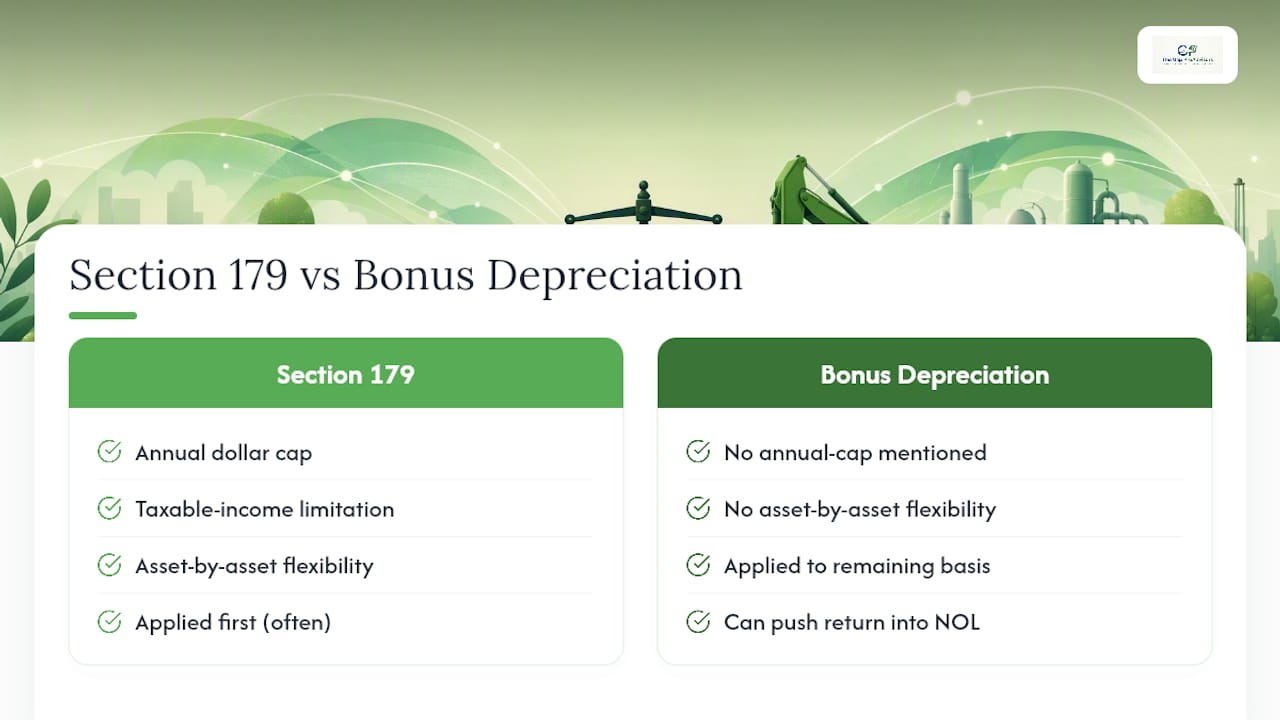
Many small businesses run §179 first, then apply bonus depreciation to whatever basis remains. That sequencing matters most when taxable income is volatile. A business expecting a loss year might skip aggressive expensing altogether to preserve deductions for a profitable year ahead, since bonus depreciation can push a return into a net operating loss.
State conformity adds another wrinkle entirely. A meaningful number of states decouple from federal bonus depreciation, either disallowing it outright or requiring an addback with recovery over several years. Always check your state's specific depreciation instructions before assuming the federal number carries straight through.
How Do You Report Bonus Depreciation on Your Tax Return?
Additional first-year depreciation gets claimed on Form 4562, generally in the section covering special depreciation allowances, separate from regular MACRS depreciation calculations.
Missed the election window entirely? Form 3115 lets you make a late §168(k) election as an automatic accounting method change, with the missed deduction captured through a §481(a) adjustment. Say a business forgot to claim bonus depreciation on a 2025 equipment purchase. Rather than amending, the fix runs through Form 3115 on a later return, catching up the deduction in one adjustment instead of unwinding the prior filing.
Planning Checklist for Small Businesses
Turning these rules into action starts with a short list you can actually run through before year-end.
- Pull every asset purchase contract from the last two years and check the signing date against January 19, 2025.
- Segregate large construction or build-out projects into components so you can apply different treatment where the acquisition timing differs piece by piece.
- Model next year's taxable income before deciding whether to take 100% or elect out of a class, especially if a large deduction would create or deepen a net operating loss.
- Document every election with a written statement attached to the return, not just an internal note.
- Flag any missed prior-year bonus depreciation for a Form 3115 catch-up rather than letting it disappear.
A farming operation planting new orchards, a contractor buying a fleet of trucks, and a small recording studio investing in a new album all face the same core question: does the acquisition date put this asset before or after the cliff? The answer changes the math every time.
Pro Tip: When cash flow is unpredictable, electing out of bonus depreciation for a specific asset class can be smarter than taking the full deduction. A client who expects lean months ahead may prefer to spread depreciation out rather than create a large net operating loss now. Document that decision with a short contemporaneous memo explaining why, in case a future audit asks.
What Clients Get Wrong About Bonus Depreciation
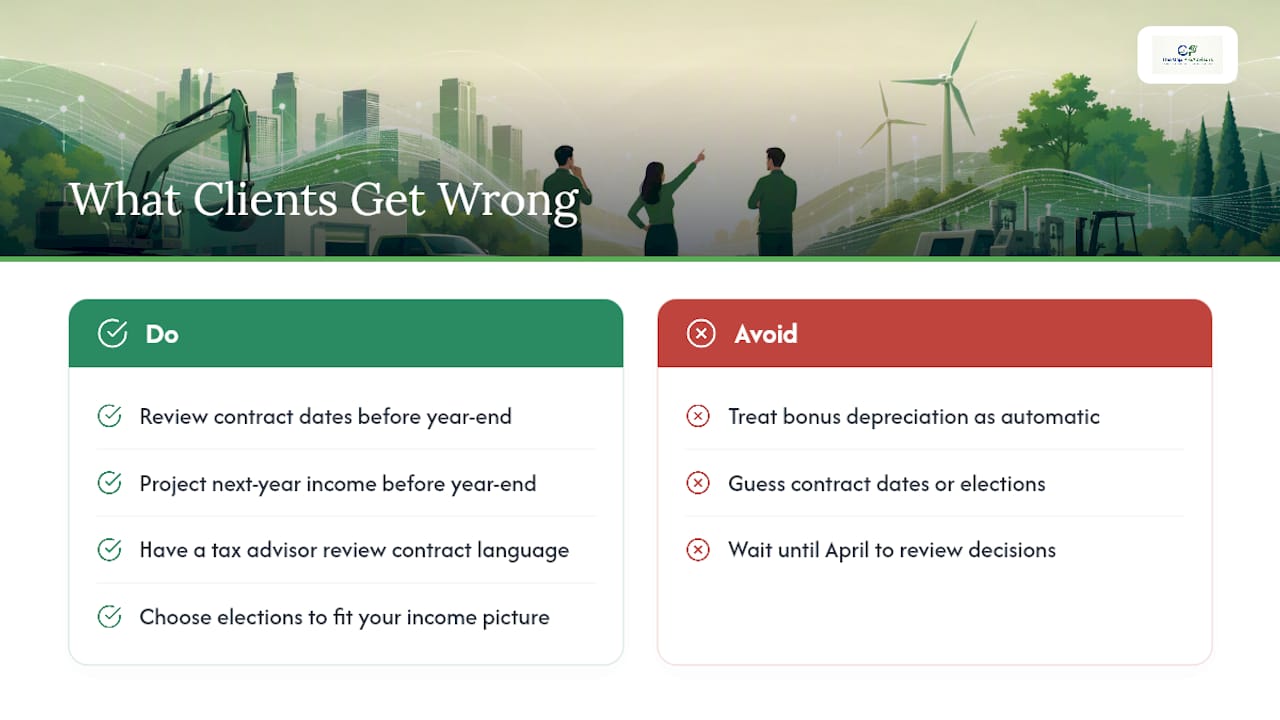
Most small-business owners treat bonus depreciation as a formality, something the software handles automatically. It's not. The election choices genuinely change tax outcomes year over year, and the binding-contract date question trips up more clients than any other part of this rule.
My honest read: the businesses that come out ahead are the ones who review contract dates and income projections before year-end, not in April. If you're unsure whether your acquisition falls before or after the cliff, or which election fits your income picture, get a tax advisor to review the contract language directly rather than guessing.
— Angela
How Mygappro Helps You Apply These Rules Correctly
Mygappro gives you what a software subscription can't: a person who actually reviews your contract dates and election choices before your return gets filed, not after. Our tax preparation services handle Form 4562 reporting and election statements directly, and our year-round tax planning service reviews acquisition timing and income projections before you commit to an election that's hard to undo.

If you bought equipment, started construction, or signed a contract anywhere near the January 2025 cliff date, that single detail could be worth thousands of dollars in deductions either way. We also handle Form 3115 catch-ups for clients who missed an election in a prior year, so nothing gets left on the table permanently. Schedule a consultation through The Gap ProAdvisors and bring your purchase contracts. We'll tell you exactly where you land under the new rules.
This article is general information, not a substitute for advice from a qualified financial advisor. Consult a qualified financial professional about your own circumstances before acting on anything here.
FAQ
Is Bonus Depreciation Coming Back in 2026?
It never left.
What Are the New Depreciation Rules for 2026?
The core change is permanence: instead of phasing down toward zero, qualifying property placed in service after the January 19, 2025 cliff gets a full 100% deduction under Notice 2026-11, with transition and elect-out options available for the first affected tax year.
Is 100% Bonus Depreciation Coming Back?
Yes, and it's structured to stay.
Which States Recognize Bonus Depreciation?
Recognition varies widely. Some states fully conform to federal bonus depreciation rules, while others decouple entirely or require an addback with the deduction recovered over several years, so check your specific state's depreciation instructions before assuming the federal figure applies.