
Texas franchise tax is a state privilege tax charged to taxable entities formed in or doing business in Texas, calculated on a margin, not on net income. Every LLC, corporation, partnership, and similar entity registered with the state falls under it, though most small businesses end up owing nothing.
- Who pays: LLCs, corporations, partnerships, S corps, professional associations, and most other registered entities operating in Texas
- Due date: May 15 every year, no exceptions for weekends beyond the standard next business day rule
- 2026 no-tax-due threshold: $2,650,000 in annualized total revenue
- Rates: 0.375% for retail and wholesale businesses, 0.75% for everyone else
Even businesses under the threshold typically still owe a separate informational report. We'll walk through exactly who that applies to next.
Key Takeaways
Texas franchise tax is based on margin, not net income, and choosing the right calculation method among four options can meaningfully lower what you owe.
| Point | Details |
|---|---|
| Filing deadline | Reports are due May 15 every year, with informational reports required even at zero tax due. |
| 2026 threshold | Businesses under the $2,650,000 threshold owe no franchise tax but still must file the PIR or OIR. |
| Margin method matters | Compare all four margin calculation options before filing since one almost always produces a lower tax base. |
| Estimated payments don't fix notices | You must file the actual report and informational filing to resolve a delinquency notice, not just pay an estimate. |
| Professional review pays off | Mygappro compares margin methods against your real books and handles amendments or notices for Texas businesses. |
Where to Find Official Texas Franchise Tax Resources
- Franchise Tax overview — general filing requirements and entity definitions
- PIR/OIR filing requirements — informational report rules and consequences
- WebFile and due dates — electronic filing access and deadlines
- 2026 forms page — current form numbers and PDFs
This article is general information, not a substitute for advice from a qualified financial advisor. Consult a qualified financial professional about your own circumstances before acting on anything here.
Table of Contents
- Who Has to File Texas Franchise Tax, and Who Is Exempt?
- How Is Texas Franchise Tax Calculated?
- What Are the 2026 Franchise Tax Rates and Thresholds?
- How Do You File Texas Franchise Tax?
- What Happens If You Miss the Deadline or Get a Notice?
- Does Your Business Have Nexus in Texas?
- What Happens to Franchise Tax When You Close or Sell Your Business?
- How Do You Actually Fill Out Each Franchise Tax Form?
- What Credits and Combined-Group Rules Apply?
- How The Gap ProAdvisors Helps With Texas Franchise Tax
- Sources
- FAQ
Who Has to File Texas Franchise Tax, and Who Is Exempt?
Nearly every legal entity registered in Texas owes a look at this tax, even if the final bill is zero. The Comptroller's office defines taxable entities broadly:
- Corporations (C corps and S corps)
- LLCs, including single-member LLCs and series LLCs
- General and limited partnerships (with some exceptions for certain family partnerships)
- Professional associations and business trusts
- Banks and savings institutions organized under state or federal law
Sole proprietorships and general partnerships owned entirely by natural persons are not taxable entities. Certain passive entities, like some real estate investment structures, and organizations with federal tax exemption status also fall outside the tax.
Here's the part that trips up new business owners: filing status and the franchise tax report are two different things. Every taxable entity, even one that owes zero dollars in tax, must still submit a Public Information Report or Ownership Information Report each year. Skip it, and you risk forfeiting your entity's right to sue or defend itself in Texas court, with owners potentially exposed to personal liability; Texas auto dealers can find all necessary filing thresholds and dealer forms in one place to avoid such issues by using Texas car dealer forms, every form you need. Rule 3.586 covers the fine print on nexus and entity classification if you want the full text.
How Is Texas Franchise Tax Calculated?
Texas doesn't tax your net income. It taxes your "margin," and you get to pick whichever of four calculation methods produces the lowest number. According to the Comptroller's franchise tax overview, your margin equals the smallest result from these options:
- Total revenue multiplied by 70%
- Total revenue minus cost of goods sold (COGS)
- Total revenue minus total compensation paid to workers
- Total revenue minus $1 million (a flat floor deduction)
If your business operates in multiple states, that margin gets apportioned to Texas using single-factor apportionment based on gross receipts. Simply put, you calculate what percentage of your total receipts came from Texas customers, then apply that percentage to your margin before the tax rate kicks in.
Here's a simplified worked example. Say a Texas retail business has $3 million in total revenue, $1.8 million in COGS, and $900,000 in compensation costs. Using method 1, margin equals $2.1 million. Using method 2 (COGS), margin drops to $1.2 million. Using method 3 (compensation), margin comes to $2.1 million. The $1 million floor deduction leaves $2 million.
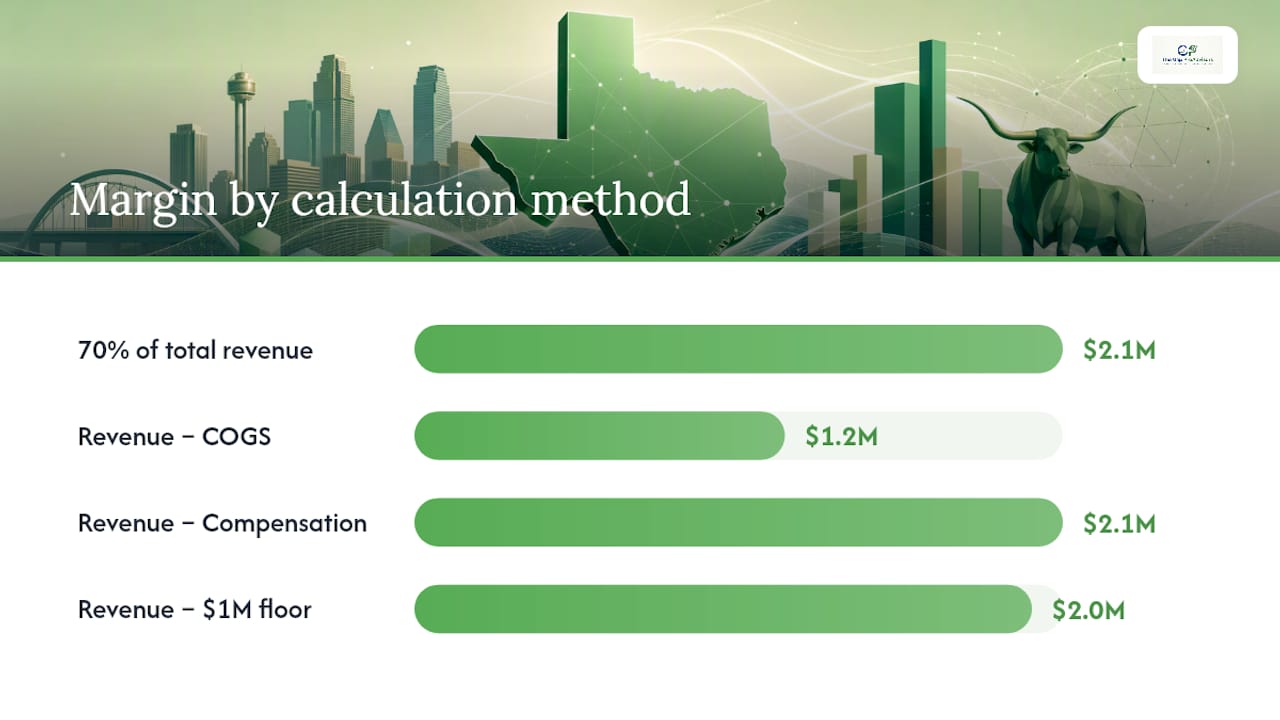
Pro Tip: Inventory-heavy businesses almost always come out ahead using the COGS deduction, while service businesses with high payroll costs usually do better with the compensation method. Run both calculations before you file. Guessing wrong costs real money.
For 2026 reports, rule amendments tied to IRC conformity changed how some total revenue and COGS components get pulled from federal returns, and the state added a one-time net depreciation adjustment for qualifying assets. If your business has significant fixed assets, that adjustment could meaningfully shift your calculation this year.
What Are the 2026 Franchise Tax Rates and Thresholds?
The no-tax-due threshold for reports filed in 2026 rose to $2,650,000 in annualized total revenue. Fall under that number, and you owe zero franchise tax, though the informational report is still required. Cross it, and your rate depends on your business type.
These figures apply specifically to reports due May 15, 2026, and the Comptroller updates these tables most years, so don't assume next year's numbers match this year's.
The compensation deduction, when you choose method 3, is capped per person. Businesses that qualify can also claim credits for research and development activity, historic structure rehabilitation, and carried-forward business losses from prior years. Each credit has its own qualification rules worth checking before you assume eligibility.
How Do You File Texas Franchise Tax?
Which form you use depends on your revenue and your entity's complexity. Here's the breakdown:
- No Tax Due Report — for entities under the $2,650,000 threshold (form 05-163, though many qualifying entities now simply confirm no-tax-due status through Webfile)
- EZ Computation — for entities with revenue up to $20 million that want a simpler calculation (form 05-169)
- Long Form — for entities that exceed the EZ threshold or want to use one of the standard margin deductions (form 05-158)
- PIR or OIR — required separately from every taxable entity, regardless of tax owed (forms 05-102 and 05-167)
Most filers submit electronically through Texas Comptroller WebFile, and certain filers are required to use it. Third-party providers like Avalara and Harbor Compliance also offer franchise tax filing support for businesses managing multi-state compliance alongside their Texas obligations, though your own numbers still need to be right before any software submits them.
A few process notes worth flagging:
- Combined groups file one report through a designated reporting entity, and each member must be included by name
- A federal extension filed with the IRS does not extend your Texas deadline. You must request a Texas extension separately
- Payments can be made electronically through WebFile, or by check for taxpayers not required to pay electronically
- Keep your Webfile number and taxpayer ID accessible before you start. Reentering that information after a rejected submission wastes real time
What Happens If You Miss the Deadline or Get a Notice?
Miss May 15, and Texas charges a flat $50 late-report penalty regardless of whether you owed tax.
Here's what surprises a lot of owners: paying an estimated amount doesn't stop the delinquency clock. According to the Comptroller's own FAQ guidance, you have to actually file the report, plus the PIR or OIR, to resolve a notice. A payment alone leaves the filing gap open.
Common notices include "Original Franchise Tax Report Not Filed" and reminder letters urging you to file now. If you're part of a combined group and get one of these, the fix usually isn't filing separately. It's contacting the group's reporting entity to correct the combined submission.
- File or amend the correct report immediately
- Submit any missing PIR or OIR
- Contact your combined group's reporting entity if the omission originated there
- Call the Comptroller's office directly for Webfile access issues
Pro Tip: File a few weeks before May 15, not on it. Comptroller phone lines get backed up in the final days, and a small data entry error caught early is a five-minute fix instead of a notice three months later.
Does Your Business Have Nexus in Texas?
If you're physically located in Texas, this question answers itself. It gets trickier for businesses with remote employees, inventory stored in Texas warehouses, or substantial sales into the state without a storefront here.
Common nexus triggers include:
- Having employees or contractors working in Texas
- Owning or leasing property in Texas
- Maintaining inventory in a Texas warehouse or fulfillment center
- Generating a meaningful volume of sales to Texas customers
Once nexus exists, you apportion your margin using single-factor apportionment: the percentage of your gross receipts sourced to Texas relative to your total gross receipts everywhere. Comptroller Rule 3.586 spells out sourcing specifics for different revenue types, and those rules get technical fast for service businesses selling across state lines.
When Should You Bring in a Tax Professional?
Combined-group filings, heavy intercompany COGS allocations, complex multi-state apportionment, or an active delinquency notice are the situations where doing it yourself gets risky. A professional can run all four margin methods side by side, prepare or amend the actual report, and represent you if the Comptroller sends a notice.
- Have your prior-year report, current P&L, and payroll records ready before that first call
- Bring documentation for any depreciation adjustments or credits you plan to claim
Our tax planning services exist for exactly this kind of margin-method comparison work.
What Happens to Franchise Tax When You Close or Sell Your Business?
Closing a Texas business doesn't end your franchise tax obligation automatically. You have to file a final franchise tax report covering the period up to your termination date, and you need to request a Certificate of Account Status from the Comptroller before the Secretary of State will process your certificate of termination.
Skip this step, and here's what happens: your entity stays administratively active in the state's eyes, meaning future franchise tax reports keep coming due even though you've stopped operating. Owners have gotten notices years after they assumed a business was closed, simply because the paperwork loop never got closed on the state's side.
The process runs in a specific order. First, file all outstanding franchise tax reports, including the final one marked to reflect the entity's last operating period. Second, pay any tax, penalty, or interest owed. Third, request the Certificate of Account Status confirming the entity is current on its franchise tax obligations. Fourth, file your certificate of termination with the Texas Secretary of State, attaching that certificate.
Mergers and conversions follow a similar logic but require additional documentation showing which entity survives and how tax attributes carry forward. If your business is part of a combined group, the reporting entity needs to account for the departing member in that year's combined report rather than letting it disappear silently.
One detail owners frequently miss: dissolving an LLC with the state doesn't retroactively erase unfiled prior-year reports. The Comptroller will still expect those filed, even for a business that no longer exists, before issuing the account status certificate that clears the way for formal termination.

How Do You Actually Fill Out Each Franchise Tax Form?
Each form asks for different inputs, and mixing them up wastes time. Here's what each one actually requires.
No Tax Due qualification: confirm your annualized total revenue falls under $2,650,000, then complete the entity information section, including your Texas taxpayer number, accounting year dates, and NAICS code. No margin calculation needed if you genuinely qualify.
This works only for entities under the $20 million revenue threshold, and it often produces a higher tax bill than the Long Form for businesses with substantial COGS or compensation deductions, so run both before choosing.
Long Form (form 05-158): this is where the real calculation happens. Report total revenue, then work through whichever of the four margin methods produces your lowest figure. Enter apportioned margin if you operate in multiple states, apply the correct rate for your entity type, and factor in any credits you're claiming.
PIR (form 05-102) or OIR (form 05-167): list every officer, director, member, or general partner along with their addresses. LLCs typically file the OIR; corporations and most other entities file the PIR. This form gets submitted every year regardless of tax owed, and it's the piece owners skip most often because they assume paying zero tax means nothing else is required.
Combined groups attach affiliate schedules identifying every member entity, its Texas taxpayer number, and its share of the group's total revenue and margin.
What Credits and Combined-Group Rules Apply?
Texas offers a handful of franchise tax credits worth checking before you assume you don't qualify. Research and development credits apply to businesses conducting qualifying R&D activity in Texas, calculated as a percentage of qualifying expenses. Historic structure rehabilitation credits apply to businesses that renovate certified historic buildings. Business loss carryforwards let you apply prior-year losses against current-year margin under specific conditions.
Rather than filing separately, the group designates one reporting entity that files a single combined report covering every member. That report must include each member's Texas taxpayer number and its proportional share of the group's total revenue.
The tricky part comes when one member gets excluded from the combined report by mistake. The Comptroller's own guidance notes that when this happens, the omitted member becomes technically delinquent even though the error originated with the reporting entity. Fixing it means the reporting entity corrects the combined filing, not the individual member filing separately. If you're part of a group structure, confirm every member is accounted for before submission, not after a notice arrives.
Intercompany transactions between combined-group members require careful documentation, particularly around COGS allocations when one member sells inventory or services to another within the group.
A Note From the Publisher
The mistakes I see most often aren't calculation errors. They're missed PIR filings, businesses assuming no Texas presence means no nexus, and owners defaulting to whichever margin method feels simplest instead of running the numbers. File early, document your reasoning, and re-check your math before you commit to a deduction.
How The Gap ProAdvisors Helps With Texas Franchise Tax
Mygappro is the practical alternative to guessing your way through margin methods or hiring a firm that only shows up once a year. We handle the year-round bookkeeping that feeds directly into your franchise tax numbers, so your COGS, compensation, and total revenue figures are already clean and reconciled by the time May 15 rolls around.

Our team runs the margin comparison for you, comparing all four methods against your actual books instead of a rough estimate, and we handle amendments or notice responses if the Comptroller flags something in a prior year. A typical engagement starts with your most recent financial statements, payroll records, and prior franchise tax filings, and most Texas margin reviews wrap up within a couple of weeks depending on how clean your books already are. If your books need cleanup first, our bookkeeping services sort that out before we touch the tax calculation, and our payroll services keep your compensation figures accurate all year, not just in April.
Reach out to schedule a franchise tax review, and let's find out which margin method actually saves you the most this year.
Sources
- Franchise Tax - Texas Comptroller
- Texas Franchise Tax Public Information Report (PIR) and Ownership Information Report
- Tax Policy News — April 2026 — Texas Comptroller
FAQ
How Much Is Texas LLC Franchise Tax?
It depends on your margin and rate category.
Who Is Required to Pay Texas Franchise Tax?
Taxable entities formed in or doing business in Texas, including corporations, LLCs, partnerships, and professional associations, are subject to the tax, though many owe nothing if they fall under the revenue threshold.
What Is the Franchise Tax in Texas?
It's a state privilege tax charged on a taxable entity's margin rather than its net income, calculated using whichever of four permitted deduction methods produces the lowest taxable amount.
Do LLCs Pay Franchise Tax in Texas?
Yes, LLCs are taxable entities under Texas law, including single-member and series LLCs, though every LLC must file at least an informational report annually regardless of whether tax is owed.
Does a Federal Tax Extension Cover My Texas Franchise Tax Deadline?
No. A federal extension filed with the IRS has no effect on your Texas obligation. You must request a separate extension directly with the Texas Comptroller before May 15.