
If you work for your S corporation, pay yourself a reasonable W-2 salary through payroll first, then take remaining profit as shareholder distributions. Salary carries payroll taxes; distributions generally don't, though they're capped by your stock basis. Skip the salary step or lowball it, and you've handed the IRS an easy audit trigger.
TL;DR:
- Paying yourself a reasonable salary based on industry and duty benchmarks is essential to avoid IRS audit triggers and properly separate wages from profits.
- Salary should be set with documentation, approved via a board resolution or signed memo, and paid consistently through payroll system reports matching filings.
- Distributions are tax-free only up to your stock basis, which must be continually tracked and adjusted for earnings, losses, and withdrawals to prevent unexpected capital gains.
- Inaccurate or unsubstantiated salary figures, and distributions without proper documentation or a clear basis worksheet, are common audit red flags for S corporation owners.
- When multi-state tax complexities or potential audits arise, hiring professional payroll and tax services ensures compliance and proper documentation to safeguard against penalties.
Table of Contents
- How Salary, Distributions, and a Combined Approach Work for S Corp Owners
- How Do You Determine a Reasonable Salary?
- How Do You Set Up Payroll and Meet Reporting Deadlines?
- What Is Stock Basis and When Are Distributions Tax-Free?
- What Red Flags Trigger an S Corp Audit, and What Protects You?
- Quick Checklist for Paying Yourself Correctly From an S Corp
- When Should You Bring in Professional Payroll and Tax Help?
- How The Gap ProAdvisors Handles Your S Corp Payroll and Compensation
- Sources
- FAQ
How Salary, Distributions, and a Combined Approach Work for S Corp Owners
You have two channels for moving money out of your S corporation, and they're taxed completely differently.
Salary (W-2 wages) covers the work you actually perform for the business. It runs through payroll, gets federal and state withholding taken out, and triggers Social Security and Medicare tax. Combined employer and employee FICA runs about 15.3% on wages, split roughly in half between the company and you.
Distributions are profit paid out to you as a shareholder, reported on your Schedule K-1 instead of a W-2. They're not subject to FICA, which is the whole reason S-Corp elections are attractive. But that tax break comes with a ceiling: you can only take tax-free distributions up to your stock basis.
Most owners land on a mix:
- Salary for the hours and skills you're actually contributing
- Distributions for the leftover profit after salary and expenses
- Adjustments each year as the business grows or shrinks
The IRS expects both pieces on your return if you're actively working in the business. Distributions with no salary at all are one of the fastest ways to land on an examiner's desk.
How Do You Determine a Reasonable Salary?
There's no IRS worksheet that spits out a dollar figure. Instead, the agency looks at a cluster of factors and asks whether your pay is commensurate with your duties and comparable to what another business would pay for the same work.
Factors examiners typically weigh:
- Training, experience, and duties actually performed
- Time and effort devoted to the business
- Comparable salaries for similar positions in your industry
- What the company paid in prior years for the same role
- The pay scale used for other, non-owner employees
Pro Tip: Pull wage data straight from the Bureau of Labor Statistics Occupational Employment and Wage Statistics program before you set your number. Cross-referencing OES data with two or three comparable job postings gives you a defensible range in under an hour.
Some owners also use a cost, or task-by-task, method: list every function you perform (bookkeeping, sales, management), price each at market rate, then total them up. Whichever method you use, write it down. A dated salary analysis, the sources you cited, and a signed board resolution or shareholder memo authorizing the figure turn a guess into evidence.
How Do You Set Up Payroll and Meet Reporting Deadlines?
Once you've settled on a number, you need actual payroll, not a wire transfer with "salary" in the memo line. Pick a pay frequency, weekly, biweekly, or monthly, and run it consistently through a payroll system that calculates withholding correctly.
From there, a handful of federal filings become non-negotiable:
- Form 941, filed quarterly, reports wages and withheld taxes
- Form 940 covers your annual FUTA (unemployment) tax obligation
- Federal tax deposits are due on a schedule tied to your total payroll liability, not just quarterly
- W-2 and W-3 forms go out at year-end to you and the Social Security Administration
- Form 1120-S is your corporate return, with your K-1 attached showing distribution income
State withholding and unemployment filings stack on top of these, and requirements vary by state. A payroll provider handles the calculations and deposit deadlines automatically, which matters because missed deposits carry penalties that compound fast. Reconcile payroll totals against your books every quarter so your 941 filings and your general ledger never drift apart.
What Is Stock Basis and When Are Distributions Tax-Free?
Stock basis is your running tally of what you've invested in the company, adjusted every year. It goes up when the business earns income and goes down when you take distributions or the company reports a loss.
Distributions stay tax-free only up to that basis number, similar to how small business CGT concessions outline capital gains treatment on distributions in Australia. Go over it, and the excess gets taxed as a capital gain, even though the cash came from your own company. Basis is calculated using ordering rules involving the Accumulated Adjustments Account (AAA) and accumulated earnings and profits, and it's determined as of the end of the taxable year, not the moment you write the check.
A few things worth locking in:
- Keep a basis worksheet updated at least quarterly, not just at tax time
- Recompute basis before authorizing large or unusual distributions
- Remember that debt basis (loans you've made to the company) doesn't expand your tax-free distribution room the same way stock basis does
The IRS puts the tracking responsibility squarely on the shareholder, not the bank account balance, so relying on what's sitting in checking is how owners end up with an unexpected capital gain in April.
What Red Flags Trigger an S Corp Audit, and What Protects You?
Examiners have a short list of patterns they look for, and most of them are self-inflicted.
Red flags include: no salary at all while taking distributions, a salary that's suspiciously low relative to your actual duties, a lump "true-up" salary payment tacked on in December and frequent shareholder distributions with no corporate minutes authorizing them.
Documentation that protects you:
- A contemporaneous salary analysis with dated sources, not something reconstructed after the fact
- Payroll reports matching your 941 and W-2 filings
- Meeting minutes or a signed resolution authorizing each distribution
- An updated stock basis worksheet
Pro Tip: If you're ever audited, adjustments usually target the salary figure first, reclassifying distributions as wages and assessing back payroll tax plus penalties. Get a tax professional involved as soon as you receive an examination notice, not after you've already responded.
Quick Checklist for Paying Yourself Correctly From an S Corp
- Define your role and duties, then pull benchmarking data from BLS/OES or comparable job postings.
- Set a documented salary figure and get it approved through a board resolution or signed memo.
- Run payroll on a consistent schedule, remit federal and state deposits, and issue W-2s at year-end.
- Track stock basis continuously and authorize each distribution in writing before the money moves.
When Should You Bring in Professional Payroll and Tax Help?
Multi-state withholding, basis tracking across a growing balance sheet, or any hint of an audit letter are the moments to stop DIY-ing this. The Gap ProAdvisors builds reasonable compensation analyses and basis worksheets for S-Corp owners nationwide, backed by real payroll and tax preparation work, not templates.
— Angela
How The Gap ProAdvisors Handles Your S Corp Payroll and Compensation
Mygappro is the practical alternative to piecing this together with spreadsheets and a payroll app you found online. Instead of guessing at a salary number or hoping your basis worksheet is right, you get a bookkeeping team that builds the documentation an examiner actually wants to see.

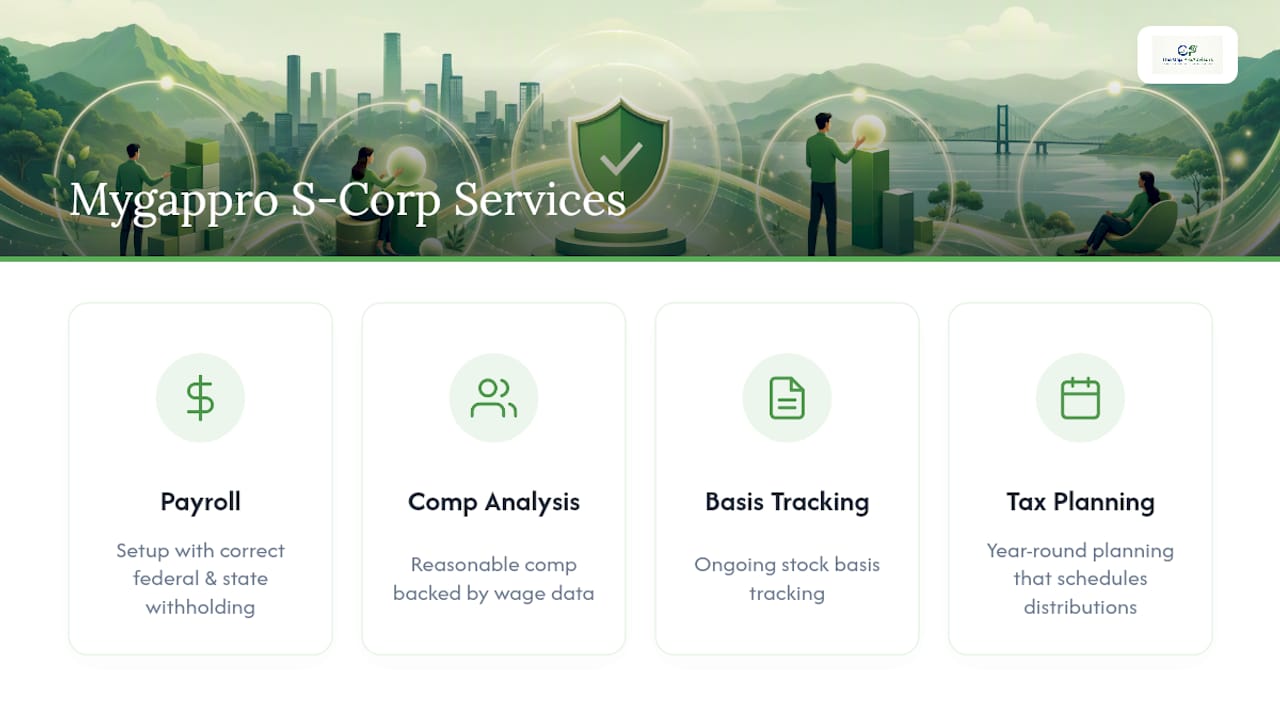
Services map directly to what this article covers: payroll setup with correct federal and state withholding, a reasonable compensation analysis backed by wage data, ongoing stock basis tracking, and year-round tax planning that schedules your distributions instead of leaving them to guesswork. If you're forming or converting to an S corporation, Mygappro also supports the LLC-to-S-Corp election itself.
Getting started means one conversation. Book a free consultation, walk through your current setup, and get payroll services running correctly before your next filing deadline.
This article is general information, not a substitute for advice from a qualified financial advisor. Consult a qualified financial professional about your own circumstances before acting on anything here.
Sources
FAQ
How Do I Pay Myself If I Have an S Corp?
Run a reasonable salary through payroll with normal withholding, then take remaining profit as shareholder distributions reported on your Schedule K-1.
What Is the 2% Rule for S Corps?
It refers to the requirement that shareholders owning more than 2% of an S corporation's stock must include the value of certain fringe benefits, like health insurance premiums, in their W-2 wages for tax purposes.
Is It Better to Take a Salary or Distribution From an S Corp?
Neither works alone. You need a defensible salary for the work you perform, then distributions for remaining profit; skipping salary entirely is a documented audit trigger.
Can I Transfer Money From S Corp to My Personal Account?
Yes, but only as properly categorized salary through payroll or as a distribution tracked against your stock basis, not as an informal transfer with no paper trail.