
A bookkeeper keeps your financial records accurate and current. An accountant takes those records and turns them into strategy, tax filings, and compliance. According to Business News Daily, bookkeepers record daily transactions and maintain ledgers, while accountants create financial statements, prepare tax returns, and provide analysis. The AICPA recognizes the CPA credential as the gold standard for tax representation and audit work. For most small businesses, the hiring logic is straightforward: bring in a bookkeeper when your daily transaction volume is eating your time, call an accountant when tax season arrives or your finances grow complex, and consider both once your revenue or payroll crosses a meaningful threshold.
Key Takeaways
Bookkeepers maintain the financial records that accountants use to file taxes, build strategy, and keep your business compliant. Hiring the right role at the right time is the single most cost-effective financial decision a small business owner can make.
| Point | Details |
|---|---|
| Core distinction | Bookkeepers record transactions; accountants analyze data, file taxes, and advise on strategy. |
| Hiring threshold | Add a bookkeeper when finance tasks exceed five hours a week; add an accountant when revenue or tax complexity grows. |
| Pay difference | Bookkeepers typically charge —; CPAs commonly charge $150–$400/hr, reflecting higher credentials and liability. |
| Credentials that matter | CPAs can represent clients before the IRS and sign audited financials; bookkeepers can earn CB or CPB credentials without a degree. |
| Mygappro | The Gap ProAdvisors delivers remote bookkeeping, payroll, and tax preparation as one integrated service for U.S. small businesses. |
Table of Contents
- Bookkeeper vs accountant: a side-by-side comparison
- What a bookkeeper actually does day to day
- What an accountant actually does — and when you need one
- Education paths, certifications, and career growth
- How pay and job demand differ between the two roles
- Do you need a bookkeeper, an accountant, or both?
- How The Gap ProAdvisors handles bookkeeping and accounting together
- An editorial perspective on when each role matters most
- Mygappro handles both sides of your financial picture
- Sources
- FAQ
Bookkeeper vs accountant: a side-by-side comparison
The table below captures the dimensions that actually matter when you are budgeting for financial help or comparing career paths.
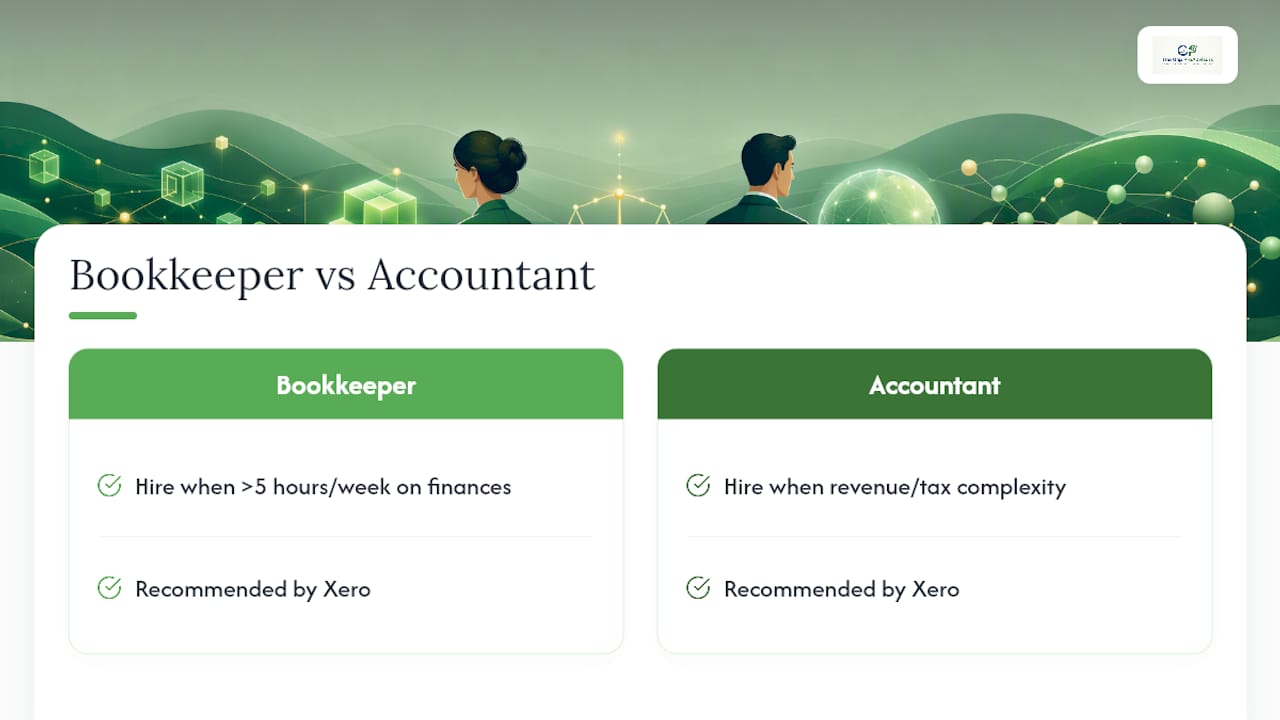
Xero recommends hiring a bookkeeper once you are spending more than five hours a week on financial tasks, and adding an accountant when revenue or tax complexity crosses a practical threshold.
What a bookkeeper actually does day to day
Bookkeepers handle the financial groundwork that makes everything else possible: recording every transaction, keeping accounts reconciled, and making sure your numbers are clean before anyone else touches them. Without accurate books, an accountant has nothing reliable to work with.
Day-to-day bookkeeper responsibilities:
- Entering income and expense transactions into your accounting software
- Reconciling bank and credit card accounts monthly
- Managing accounts payable (bills you owe) and accounts receivable (money owed to you)
- Processing payroll entries and tracking employee hours
- Classifying transactions to the correct chart-of-accounts categories
- Organizing and storing receipts and supporting documents
Typical monthly deliverables a bookkeeper produces:
- Profit and loss statement (income statement)
- Balance sheet snapshot
- Bank reconciliation reports for all accounts
- Accounts receivable aging report
- Month-end close checklist confirming all entries are posted
Automation has shifted the role. Software like QuickBooks and Xero handles much of the repetitive data entry that once defined bookkeeping. The bookkeepers who deliver real value today are the ones who catch classification errors the software misses, flag unusual transactions, and keep the chart of accounts clean enough for an accountant to work from efficiently. According to Business News Daily, automation reduces repetitive tasks but increases the value of bookkeepers who can interpret system outputs and catch exceptions.
Pro Tip: When vetting a bookkeeper, ask them to walk you through how they handle a transaction that hits the wrong bank account. Their answer tells you more about their double-entry knowledge than any resume line.
NeoWork notes that top bookkeepers combine software skill with strong double-entry knowledge and clear communication. Those three qualities together are rarer than you might expect. Also worth checking: who owns the login credentials to your accounting software. Your books should always be accessible to you, not locked behind a contractor's account.
What an accountant actually does — and when you need one

An accountant steps in where a bookkeeper stops: they take your financial data and use it to file taxes, build forecasts, design internal controls, and advise on business decisions. As Dummies explains, accountants design the bookkeeping systems and establish controls that bookkeepers then execute. That structural relationship is why accounting generally requires more education and commands higher pay.
Typical accountant responsibilities include preparing and filing federal and state tax returns, producing audited or reviewed financial statements, performing financial forecasting and cash flow analysis, advising on entity structure and tax planning, and representing clients before the IRS. The last item on that list is where the CPA credential becomes critical.
CPA vs. non-CPA accountant. A CPA (Certified Public Accountant) has met the education, exam, and experience requirements set by their state board and verified by the AICPA. That license allows them to sign audited financial statements, represent clients in IRS proceedings, and take on fiduciary responsibilities that unlicensed accountants cannot. A non-CPA accountant can still prepare tax returns, build financial models, and provide solid advisory work. But if you face an audit, need a formal audit opinion for a lender, or want someone who can legally represent you before the IRS, you need a CPA.
Concrete examples of when an accountant adds value that bookkeeping alone cannot provide: your business received an IRS notice; you are applying for an SBA loan and need reviewed financials; you want to convert from a sole proprietorship to an S-corp; or your revenue has grown to the point where tax planning could save you thousands.
Education paths, certifications, and career growth
The credential gap between bookkeepers and accountants is real, and it shapes both hiring decisions and career trajectories.
Bookkeeper credential options:
- No formal degree is required to work as a bookkeeper. Many start with an associate degree or a community college certificate in accounting fundamentals.
- The Certified Bookkeeper (CB) credential from the American Institute of Professional Bookkeepers (AIPB) requires passing a four-part exam and demonstrating two years of full-time bookkeeping experience.
- The Certified Public Bookkeeper (CPB) from the National Association of Certified Public Bookkeepers (NACPB) is another recognized credential, with its own exam and continuing education requirements.
- The QuickBooks ProAdvisor certification from Intuit signals software proficiency and is widely recognized by small business owners as a practical hiring signal.
Accountant and CPA pathway:
- A bachelor's degree in accounting or a related field is the standard entry point. Most states require 150 credit hours total for CPA licensure, which typically means a master's degree or extra coursework beyond a four-year degree.
- Candidates sit for the Uniform CPA Exam, a four-section exam covering auditing, financial accounting, regulation, and business concepts.
- Most states require one to two years of supervised accounting experience before the CPA license is issued.
- After licensure, CPAs complete continuing professional education (CPE) hours annually to maintain their credential.
According to Beancount, common bookkeeping certifications include the CPB (NACPB) and CB (AIPB). For career growth, bookkeepers often move into senior bookkeeping roles, controller positions, or pivot to accounting with additional education. Accountants progress from staff accountant to senior accountant, controller, CFO, or partner at a CPA firm.
How pay and job demand differ between the two roles
The pay gap between bookkeepers and accountants reflects the difference in qualifications, scope, and liability.
These ranges come from Xero, which also notes that outsourcing bookkeeping is often more cost-effective than hiring in-house, particularly for businesses with variable transaction volumes. NeoWork estimates that outsourcing bookkeeping can reduce costs by 40–60% compared to an in-house hire, once you factor in benefits, payroll taxes, and overhead.
On the job-outlook side, automation is compressing demand for entry-level bookkeeping tasks while keeping demand steady for bookkeepers who can manage software, catch errors, and communicate clearly with owners. Accountant advisory roles, particularly tax planning and CFO-level work, remain largely insulated from automation because they require judgment, not just data entry. Businesses that automate bookkeeping processes often find they need fewer hours of basic data entry but more skilled oversight to validate what the software produces.
Do you need a bookkeeper, an accountant, or both?
The practical rule: hire a bookkeeper first for daily transaction volume, then add an accountant or CPA when tax complexity, revenue growth, or compliance risk makes it necessary.
Hire a bookkeeper when:
- You spend more than five hours a week on financial tasks
- Your transaction volume is growing and reconciliations are falling behind
- You need clean monthly reports to understand your cash position
- You run payroll and need someone to manage entries accurately
Add an accountant or CPA when:
- Revenue approaches or exceeds $500,000 annually
- You have employees in multiple states with varying tax obligations
- You face an IRS notice, audit, or need formal financial statements for a lender
- You want proactive tax planning, not just tax filing
- You are considering a major business decision (entity change, acquisition, exit)
Businesses with more than about 30 employees or roughly $1 million in annual revenue often benefit from dedicated bookkeeping support, according to Beancount.io. At that scale, the cost of messy books, missed deductions, or late payroll filings far outweighs the cost of professional help.
Hiring checklist: questions to ask a bookkeeper
- What accounting software do you use, and can you work in mine?
- Walk me through your month-end close process. What does your checklist include?
- How do you handle a transaction you are unsure how to classify?
- Who will own the login credentials to my accounting software?
- Can you provide a sample reconciliation report or month-end P&L from a similar client?
- How do you communicate with the business owner — weekly, monthly, or on-demand?
- What is your process for catching and correcting errors?
- Do you carry errors and omissions (E&O) insurance?
Red flags to watch for: a bookkeeper who cannot explain double-entry accounting, who insists on holding your software credentials, or who cannot produce a clean sample report on request. Also verify employment eligibility as part of standard hiring due diligence.
Pro Tip: Request a sample month-end report before you hire. A bookkeeper who cannot produce a clean, organized P&L and reconciliation summary for a comparable client is not ready for yours.
How The Gap ProAdvisors handles bookkeeping and accounting together
Mygappro (The Gap ProAdvisors) operates as a fully remote financial services firm built specifically for small business owners who need both clean books and smart tax strategy, without managing two separate vendors.
Core services and what they deliver for clients:
- Remote bookkeeping: Monthly transaction entry, reconciliations, and financial reports delivered through a secure online portal, so you always know where your numbers stand
- Tax preparation and planning: Year-round tax planning that goes beyond filing, identifying deductions and strategies before the tax year closes
- Payroll processing: Full payroll services covering all 50 states, including payroll entry, filings, and compliance
- QuickBooks Online support: Setup, cleanup, and ongoing support so your software works the way it should
- LLC setup and contractor compliance: Entity formation and 1099 filing support for businesses adding contractors
The handoff from bookkeeping to tax work is where many small businesses lose money. When your bookkeeper and your tax preparer are the same team, nothing falls through the gap. Clean monthly books feed directly into accurate tax returns, and year-round planning means deductions are captured as they happen, not reconstructed in April.
Mygappro serves small business owners across the U.S., with remote bookkeeping services designed to replace the stress of financial management with clarity and confidence.
An editorial perspective on when each role matters most
The conventional advice is to hire a bookkeeper first and add an accountant later. That sequencing is usually right, but the reasoning behind it is often wrong. Most guides frame it as a cost decision. The real reason to get bookkeeping right first is that an accountant's advice is only as good as the data underneath it. A CPA working from messy books will spend your billable hours cleaning up transactions instead of planning your tax strategy.
The scenario that illustrates this most clearly: a business owner who skips bookkeeping for two years, then hires a CPA at tax time. The CPA charges $200–$400 an hour to reconstruct records that a bookkeeper would have maintained for $400–$800 a month. The math is not close. Clean books are not a nice administrative habit. They are the foundation that makes every other financial decision cheaper and more accurate.
One practical tip that most hiring guides skip: before you sign with any bookkeeper or accounting firm, ask to see the chart of accounts they would set up for your business. A generic, out-of-the-box chart of accounts is a signal that they are not thinking about your specific industry or tax situation. A customized one, with categories that match your revenue streams and expense types, is a signal that they understand the work.
Mygappro handles both sides of your financial picture
Small business owners who have read this far usually fall into one of three situations: they need clean books and have no system yet, they have books but no tax strategy, or they have outgrown a part-time solution and need a team that can handle everything. Mygappro is built for all three.
The Gap ProAdvisors offers flat-rate remote bookkeeping paired with tax preparation and year-round planning, all delivered through a secure online portal. No chasing down a separate CPA at tax time. No wondering whether your books are clean enough for your accountant to use. One team handles the full cycle, from daily transaction entry to your final tax return, with proactive communication throughout the year. If you are ready to stop managing your finances reactively, schedule a free consultation to see which services fit your situation.
Sources
- Accountant vs. Bookkeeper: What’s the Difference? | Business News Daily
- Bookkeeping vs accounting: what's the difference? | Xero US
- What is the Difference between Bookkeepers and Accountants? | dummies
- What To Look For When Hiring a Bookkeeper: Essential Guide | NeoWork
- Beancount
- Getting started to become a CPA | AICPA
This article is general information, not a substitute for advice from a qualified financial advisor. Consult a qualified financial professional about your own circumstances before acting on anything here.
FAQ
Is an accountant higher than a bookkeeper?
Yes, in terms of scope, credentials, and pay. Accountants analyze financial data, file taxes, and provide strategic advice, while bookkeepers maintain the records that make that work possible. Most accountants hold a bachelor's degree, and CPAs must pass the Uniform CPA Exam and meet state licensing requirements.
What can an accountant do that a bookkeeper cannot?
A CPA can represent you before the IRS, sign audited financial statements, and provide legally recognized tax advice. Bookkeepers record and organize financial data but are not licensed to perform audits or formally represent clients in tax proceedings.
What pays more, accounting or bookkeeping?
Accounting pays more. The gap reflects the difference in education, licensing requirements, and the level of liability accountants carry.
Is it better to be an accountant or a bookkeeper?
It depends on your goals. Bookkeeping offers a faster entry into the finance field with lower education requirements and strong demand among small businesses. Accounting offers higher earning potential, broader career options, and the ability to take on advisory and compliance work that bookkeepers cannot. Many accountants start as bookkeepers and build from there.